


March 5 to March 11
From “Taiwan’s self-rule movement” in 1947 to last year’s “part of the Chinese people’s liberation struggle,” the Chinese Communist Party (CCP) has long propagated its own interpretation of the 228 Incident.
Even though the CCP was not involved in the anti-Chinese Nationalist Party (KMT) uprising and subsequent government crackdown that took place across Taiwan on Feb. 28, 1947, it still commemorated the incident during its 70th anniversary last year.
Photo courtesy of Wikimedia Commons
In fact, ever since the incident broke out, the CCP has used it in their propaganda since it painted their mortal enemy, KMT leader Chiang Kai-shek (蔣介石), as a brutal dictator and mass murderer.
“The brutality of Chiang Kai-shek’s rule of Taiwan has exceeded that of Japanese imperialism … It’s clear that Chiang’s intention is to drown Taiwan’s self-rule movement in blood,” the communist-controlled The Liberation Daily (解放日報) printed on March 20, 1947
A COMMON ENEMY
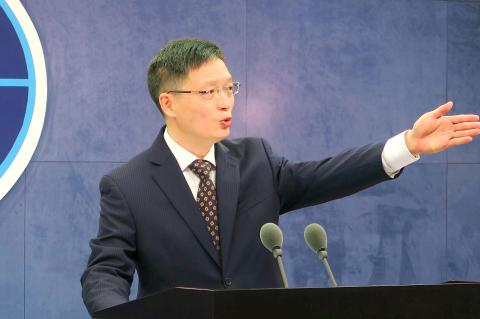
Photo: CNA
As soon as the CCP caught wind of the events in Taiwan, the newspaper printed the news on March 7 with the headline, “The anti-Chiang movement in Taiwan has spread across the entire island, whose people want to establish an autonomous government.”
The next day, the CCP leaders issued a statement voicing their support for “Taiwan’s self-rule movement,” elaborating their position two weeks later in the Liberation Daily.
“Take just a brief look at Taiwan’s history after the war and it will be apparent that this self-rule movement was rational, legal and peaceful. It became an armed revolt because Chiang Kai-shek left them with no choice … Those Chinese feudal fascists have mercilessly plundered from the Taiwanese, leaving them not even a chance of survival … What Taiwanese want is simple, they just want to abolish government monopolies and for Taiwanese to be able to serve in the government of Taiwan.”
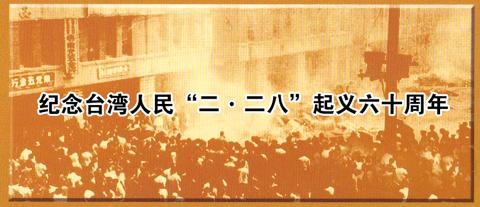
Photo: Screenshot
The article listed the civilian death toll on Feb. 28 as “at least 3,000 or 4,000,” comparing Taiwan to the Communist-controlled areas who also had to fight the KMT for “self-rule.”
“Your fight is our fight, your victory is our victory,” it stated. “Both military and civilians of the liberated areas will support you with our own battles.”
The statement concluded with a suggested battle plan to defeat Chiang.
“First of all, do not compromise. The armed revolt has already started, and if you compromise or surrender, Taiwanese compatriots will suffer the most savage bloodbath at the hands of Chiang,” it began.
The first step would be to establish governing and military bodies. Then the new government should satisfy people’s economic needs so as to minimize internal dissent. A strong leader should be elected, and agents sent across Taiwan to work with peasants and formally organize them into military units to fight against the government. The areas out of government reach should be converted into bases to support the war long term.
The CCP leaders were confident that Taiwanese would win the fight, stating that the KMT was already suffering from troop shortages in the Chinese Civil War and would not have many resources to devote to Taiwan.
“If we win a few more battles in China, that will deplete Chiang’s forces even further, and eventually he’ll loosen the pressure on Taiwan. Therefore, the movement in Taiwan will surely end in victory. The Chinese Communist Party praises the bravery of our Taiwanese compatriots, and congratulates you in advance to a glorious victory.”
SHIFTING NARRATIVES
After the rebellion was quelled, the 228 Incident became a taboo subject in Taiwan and was rarely talked about for several decades. The initial KMT narrative of the uprising being incited by Japanese or Communist agents or sympathizers (which was being espoused by the government even into the 1980s) has been shattered even though many details are still under dispute.
In China, the story remains mostly the same. Huang Chin-sheng (黃錦昇) writes in the study, The Interpretation Contexts of the 228 Incident between the Taiwan Strait, that the China-based Taiwan Democratic Self-Government League began commemorating the event in 1949.
“They claim that the patriotic and democratic movement against the KMT dictatorship as part of the Chinese liberation struggle,” Huang writes. “Their most prominent historical narrative is that the CCP supported the Taiwanese in their fight against the KMT.”
This has changed little over the years with An Fengshan (安峰山), spokesman for China’s Taiwan Affairs Office, pretty much repeating those exact words last year before the 70th anniversary of the incident.
“The 228 Incident has not been as important to [the CCP’s] continued success; therefore, there has been little if any divergence from their initial interpretation of the event,” writes Craig Smith in the paper, Taiwan’s 228 Incident and the Politics of Placing Blame.
Embellishments were sometimes added. On the 28th anniversary of the incident in 1975, Beijing released a statement linking it to other pro-communist uprisings in China during the 1940s, adding that the Taiwanese were inspired by then-CCP leader Mao Zedong (毛澤東).
The story’s emphasis also shifted with the times. Huang writes that as relations between the KMT and CCP thawed in the mid-2000s, China placed less focus on bashing the KMT, instead praising the Taiwanese for their bravery and stressing that the two sides of the Taiwan Strait shared the same history.
Since the Democratic Progressive Party (DPP) retook power in 2015, China has criticized those who frame the incident as a struggle against an outside regime, which would indicate that Taiwan and China were two entities.
“[The DPP has] distorted historical fact, instigated contradictions based on provincial origin, tearing at Taiwan’s ethnic groups and creating antagonism in society,” An said last year. “I think the motives behind this are really despicable.”
Taiwan in Time, a column about Taiwan’s history that is published every Sunday, spotlights important or interesting events around the nation that have anniversaries this week.

This month the government ordered a one-year block of Xiaohongshu (小紅書) or Rednote, a Chinese social media platform with more than 3 million users in Taiwan. The government pointed to widespread fraud activity on the platform, along with cybersecurity failures. Officials said that they had reached out to the company and asked it to change. However, they received no response. The pro-China parties, the Chinese Nationalist Party (KMT) and Taiwan People’s Party (TPP), immediately swung into action, denouncing the ban as an attack on free speech. This “free speech” claim was then echoed by the People’s Republic of China (PRC),

Exceptions to the rule are sometimes revealing. For a brief few years, there was an emerging ideological split between the Democratic Progressive Party (DPP) and Chinese Nationalist Party (KMT) that appeared to be pushing the DPP in a direction that would be considered more liberal, and the KMT more conservative. In the previous column, “The KMT-DPP’s bureaucrat-led developmental state” (Dec. 11, page 12), we examined how Taiwan’s democratic system developed, and how both the two main parties largely accepted a similar consensus on how Taiwan should be run domestically and did not split along the left-right lines more familiar in
Many people in Taiwan first learned about universal basic income (UBI) — the idea that the government should provide regular, no-strings-attached payments to each citizen — in 2019. While seeking the Democratic nomination for the 2020 US presidential election, Andrew Yang, a politician of Taiwanese descent, said that, if elected, he’d institute a UBI of US$1,000 per month to “get the economic boot off of people’s throats, allowing them to lift their heads up, breathe, and get excited for the future.” His campaign petered out, but the concept of UBI hasn’t gone away. Throughout the industrialized world, there are fears that
The Democratic Progressive Party (DPP) controlled Executive Yuan (often called the Cabinet) finally fired back at the opposition-controlled Legislative Yuan in their ongoing struggle for control. The opposition Chinese Nationalist Party (KMT) and Taiwan People’s Party (TPP) acted surprised and outraged, but they should have seen it coming. Taiwan is now in a full-blown constitutional crisis. There are still peaceful ways out of this conflict, but with the KMT and TPP leadership in the hands of hardliners and the DPP having lost all patience, there is an alarming chance things could spiral out of control, threatening Taiwan’s democracy. This is no


 RSS
RSS