


Feb. 5 to Feb. 11
It’s hard to believe that today’s ubiquitous 7-Eleven was once labeled as the “prodigal son of Uni-President Enterprises Corp.” But during its early days, the convenience store cost the corporation more than NT$2 billion in total losses.
Launching its first store in February 1980 on Taipei’s Changan E Road, the venture had already eaten into about half the original capital of NT$1.9 billion by September 1982.
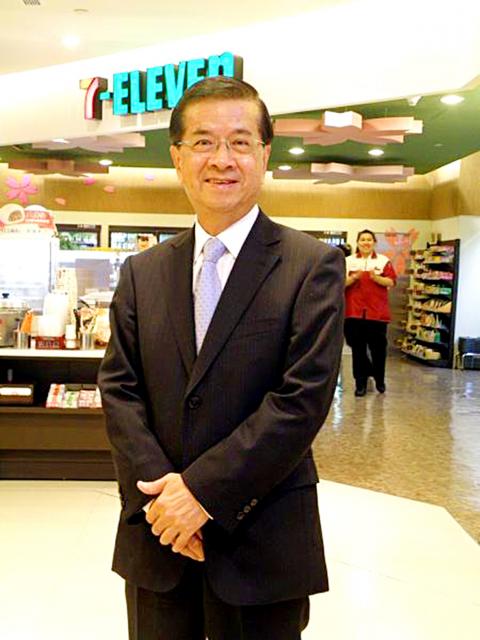
Photo: Yang Ya-min, Taipei Times
“Besides Uni-President, other shareholders had little desire to keep the stores running,” Lee Jen-fang (李仁芳) writes in the book, 7-Eleven Takes Over Taiwan (7-Eleven 統一超商縱橫台灣).
At the same time, foreign and local investors bombarded Uni-President with calls about acquiring the stores. But the corporation refused all offers, instead buying out the other shareholders and taking full control over the venture by incorporating it into the company as its “supermarket department.”
It would take several more years for the company to finally turn a profit, but this was the beginning of its 7-Eleven empire in Taiwan.
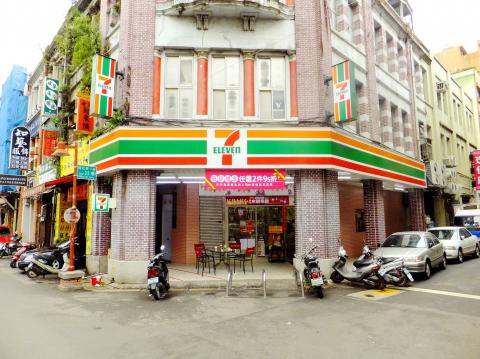
Photo courtesy of Wikimedia Commons
RISE OF THE MINIMART
The late 1970s saw the rise of the two food giants of Uni-President Enterprises Corp (UPE, 統一企業) and Wei Chuan Foods Corp (味全食品) in response to increased competition in the consumer market.and need for more streamlined and efficient operations.
However, the first mini-market chain was launched by the Council of Agriculture, Taipei City Government and Youth Development Administration in 1977. According to the a 60th Anniversary publication by Wei Chuan (who later purchased the chain), government officials launched this venture after visiting the US and noticing how clean their supermarkets were compared to the traditional markets of Taiwan.
In 1979, UPE simultaneously opened 14 “modern convenience stores” across the country. Run as a subsidiary, the company held half the shares and gave the rest to dealers, family and friends. The corporation not only wanted to create a clean and bright shopping experience, but also hoped to have complete control over the channels of distribution for its products by running its own stores.
It was a daring venture as the average annual income was less than US$2,500 back then, says Hsu Chung-jen (徐重仁), who played a key role in the rise of 7-Eleven.
“As a food producer, Uni-President jumped straight into the unfamiliar world of retail and chain stores, and opened 14 stores at once with the intent of opening more. They did not even understand the basic differences between an independent store and a retail chain,” he says.
Hsu says they started out working almost 20 hours a day. He and two colleagues borrowed two desks at the parent company to conduct business, but when the company needed the desks they were relegated to a couch by the receptionist.
Hsu adds that the stores struggled because they were not able to fully identify customer needs.
“To fulfill the one-stop-shop needs of our customers, if someone wanted a broom we would start selling brooms. By the end, we had seven or eight types of detergent and milk formula and even sold vegetables, fresh meat and fish,” Hsu says.
GROWING PAINS
Hsu tried to collaborate with US corporations, but talks were stalled due to the US cutting diplomatic ties in 1979. Finally, Southland Corporation, which ran 7-Eleven in the US, reached out and the two companies signed a deal to run the stores under the 7-Eleven module and moniker.
Southland’s directive was to establish uniform, modern stores that would eventually replace traditional “mom-and-pop” businesses. They targeted housewives primarily and the initial stores were all located in residential areas. As its name suggests, the initial stores opened at 7am and closed at 11pm. And like its US counterparts, it sold Slurpees and other signature items.
However, Hsu noticed that due to the different nature of residential areas in the US and Taiwan, the US-mandated module was not attracting as many customers as they expected. Their prices were also higher — and Taiwanese housewives then were much more sensitive to prices than their US counterparts.
In 1981, the stores experimented with 24-hour service, but its products did not attract late night shoppers and soon reverted to its original hours. The franchising module did not work either as it was uncommon in Taiwan at that time.
Hsu wanted to localize the stores by eschewing the Western fast food for tea eggs and meat buns, but Southland objected on the grounds that it would ruin the image of the store. Hsu insisted, and tea eggs are a staple of all convenience stores today.
The store experienced massive losses, but still had the full support of management. Hsu returned to the fold after a short departure and got rid of 35 underperforming locations, mostly in residential communities. They analyzed the sales revenue from each store and were confident enough in 1983 to make one of the stores permanently 24-hours.
The evolution continued from there. As more women went to work, 7-Eleven in 1985 launched its signature series of microwavable meals. It opened stores in more visible areas and poured money into advertising, also adjusting its target market to the 18 to 35 crowd who were less sensitive to higher prices.
In 1986, six years after the initial venture, the chain made a profit for the first time. There was still a long road to climb, but 7-Eleven was the prodigal son no more.
“We can make up what we lost during those six years in a month or two now,” the late Uni-President founder Kao Ching-yuan (高清愿) said in 1995.
Today, there are 5,235 7-Elevens across the nation, and UPE just opened its first staffless store at their headquarters in Taipei on Monday.
Taiwan in Time, a column about Taiwan’s history that is published every Sunday, spotlights important or interesting events around the nation that have anniversaries this week.
Recently the Chinese Nationalist Party (KMT) and its Mini-Me partner in the legislature, the Taiwan People’s Party (TPP), have been arguing that construction of chip fabs in the US by Taiwan Semiconductor Manufacturing Co (TSMC, 台積電) is little more than stripping Taiwan of its assets. For example, KMT Legislative Caucus First Deputy Secretary-General Lin Pei-hsiang (林沛祥) in January said that “This is not ‘reciprocal cooperation’ ... but a substantial hollowing out of our country.” Similarly, former TPP Chair Ko Wen-je (柯文哲) contended it constitutes “selling Taiwan out to the United States.” The two pro-China parties are proposing a bill that

Institutions signalling a fresh beginning and new spirit often adopt new slogans, symbols and marketing materials, and the Chinese Nationalist Party (KMT) is no exception. Cheng Li-wun (鄭麗文), soon after taking office as KMT chair, released a new slogan that plays on the party’s acronym: “Kind Mindfulness Team.” The party recently released a graphic prominently featuring the red, white and blue of the flag with a Chinese slogan “establishing peace, blessings and fortune marching forth” (締造和平,幸福前行). One part of the graphic also features two hands in blue and white grasping olive branches in a stylized shape of Taiwan. Bonus points for
March 9 to March 15 “This land produced no horses,” Qing Dynasty envoy Yu Yung-ho (郁永河) observed when he visited Taiwan in 1697. He didn’t mean that there were no horses at all; it was just difficult to transport them across the sea and raise them in the hot and humid climate. “Although 10,000 soldiers were stationed here, the camps had fewer than 1,000 horses,” Yu added. Starting from the Dutch in the 1600s, each foreign regime brought horses to Taiwan. But they remained rare animals, typically only owned by the government or
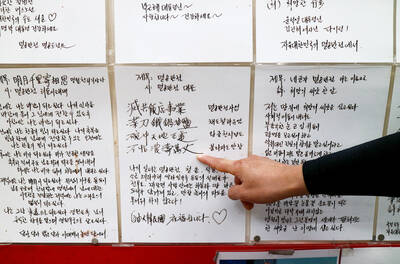
“M yeolgong jajangmyeon (anti-communism zhajiangmian, 滅共炸醬麵), let’s all shout together — myeolgong!” a chef at a Chinese restaurant in Dongtan, located about 35km south of Seoul, South Korea, calls out before serving a bowl of Korean-style zhajiangmian —black bean noodles. Diners repeat the phrase before tucking in. This political-themed restaurant, named Myeolgong Banjeom (滅共飯館, “anti-communism restaurant”), is operated by a single person and does not take reservations; therefore long queues form regularly outside, and most customers appear sympathetic to its political theme. Photos of conservative public figures hang on the walls, alongside political slogans and poems written in Chinese characters; South


 RSS
RSS