


Taiwan’s transition to democracy from 1979 through 1992 is something the people of Taiwan can be truly proud of. It changed the equation of the country’s identity and laid the foundation for a brighter future.
The major events that bookended and shaped the transition process are well-known: the Kaohsiung Incident of 1979, the formation of the Democratic Progressive Party (DPP) in 1986, the end of martial law in 1987 and the passage of legislation and constitutional reforms from 1991 to 1992, establishing a fully elected legislature and enabling direct presidential elections in 1996.
However, much less is known about one of the most important drivers in support of this transition to democracy: dangwai (黨外, “outside the party”) movement magazines published between the 1970s and 1980s. What follows is an overview of these publications, the people behind them and the various phases they went through.
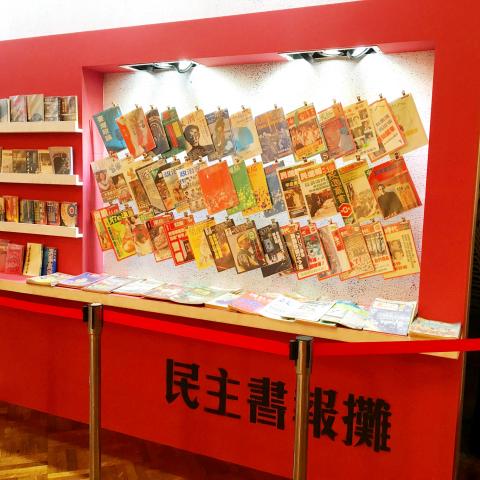
Photo: Yang Ming-yi, Taipei times
Before 1979, there were a few initiatives to get opposition publications off the ground, including the Taiwan Political Review in 1975, but generally these efforts were relatively small-scale and short lived, as they were quickly shut down by the still repressive ruling Chinese Nationalist Party (KMT).
ANXIOUS ERA
However, in 1979, the situation changed: after US de-recognition of the KMT as the government of China in December 1978, there was a period of anxiety and tension, when the authorities postponed the Legislative Yuan and National Assembly elections for which the dangwai had formed a loose coalition.
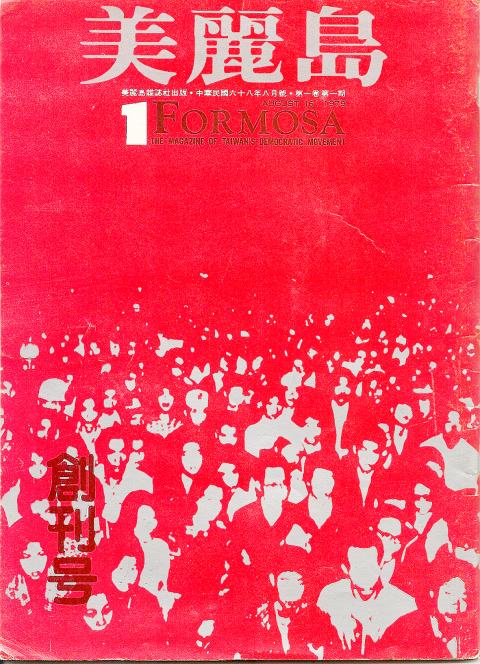
Photo courtesy of Gerrit van de Wees
In the summer of 1979, two dangwai groups started a magazine: 1980s (8十年代), led by Kang Ning-hsiang (康寧祥) and edited by Antonio Chiang (江春男), and Formosa Magazine (美麗島), led by veteran activist Huang Hsin-chieh (黃信介).
During the Fall of 1979, both quickly gained popularity, but also were the subject of increasing restrictions by the (often secret) police and subject to virulent attacks by pro-unification gangsters, the “anti-communist-heroes.”
FORMOSA INCIDENT
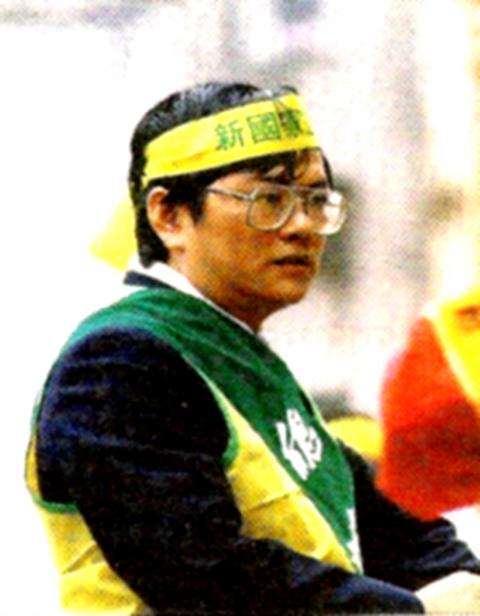
Photo courtesy of Gerrit van de Wees
This all culminated in the now well-known Formosa Incident: the Human Rights Day celebration on Dec. 10, 1979 in Kaohsiung that turned ugly when police surrounded a peaceful crowd of some 10,000 and started to use teargas. Chaos ensued, and three days later the KMT government arrested virtually all dangwai leaders and accused them of “sedition” and “trying to overthrow the government.”
Three trials took place from March through May 1980. To the outside world, it laid bare a very repressive political system and a highly biased judicial system. The Chicago Tribune headlined its commentary “Comic Opera Trial.”
During this period, no dangwai magazines were allowed, but by the end of 1980, the KMT went ahead with the delayed elections for the legislature and National Assembly. Relatives of the imprisoned opposition leaders ran as dangwai candidates and scored major victories: Yao Chia-wen’s (姚嘉文) wife Chou Ching-yu (周清玉) in the National Assembly, and Chang Chun-hung’s (張俊宏) wife Hsu Jung-hsu (許榮淑) and Huang Hsin-chieh’s younger brother Huang Tien-fu (黃天福) in the Legislative Yuan.
These election wins empowered them to look for ways to spread the message about the goals and objectives of the democratic opposition, the continuing lack of human rights and democracy and the plight of those imprisoned.
In the spring of 1981, several magazines saw the light of day: 1980s (8十年代) resumed publication, while Hsu Jung-hsu started Cultivate (深耕) and Chou Ching-yu CARE Magazine (關懷). By the Summer of 1982 the number of dangwai magazines had grown to about a dozen.
Between the Summer of 1982 and the following year, these magazines were joined by a second generation of magazines, such as Taiwan Panorama (博觀), published by Kaohsiung Incident lawyer You Ching (尤清), Vertical-Horizontal (縱橫) and Bell Drum Tower (鐘鼓樓), published by Huang Tien-fu, and was later succeeded by Neo Formosa Weekly (蓬萊島).
CENSORSHIP
The increase in the number of publications led to a crack down by KMT authorities. There were four levels of censorship: removing or blacking out a particular offending article; banning the publication (though many remained available under the counter); confiscation; and suspending the publication’s license (often circumvented by registering several similar-sounding titles).
The reasons for censorship included revealing the harsh prison conditions under which the Kaohsiung Incident prisoners were held; discussing Taiwan’s isolated international status; establishing an opposition party; and writing unflattering profiles on the KMT and the family of the nation’s authoritarian ruler, Chiang Kai-shek (蔣介石).
The magazines also examined several political murders that took place during the early 1980s: the murder of the mother and twin daughters of human rights lawyer Lin I-hsiung (林義雄) on Feb. 28 1980, the murder of Taiwanese-American scholar Chen Wen-chen (陳文成) of Carnegie Mellon University in July 1981 and the murder — on American soil — of China-born US writer Henry Liu (劉宜良), who was writing an unflattering biography of then-President Chiang Ching-kuo (蔣經國).
DANGWAI MAGAZINES — 3G
By the beginning of 1984, a third generation of dangwai magazines appeared: Lin Cheng-chieh (林正杰) started Progress (前進), while Deng Nan-jung (鄭南榕) started Freedom Era Weekly (自由時代 ). These magazines were different from previous generations in that they were started by people who had no direct connection to the Kaohsiung Incident.
This new generation of publications and those who ran them also initiated street protests to put more pressure on the authorities.
The widespread pressure for liberalization and democratization from activists prompted an increase in censorship from the KMT authorities: in October 1984 there was an infamous “Thought Police” meeting attended by the Garrison Command, the head of the Government Information Office, Chang Ching-yu, and James Soong (宋楚瑜) of the KMT. The minutes of the meeting, which read like something out of Nineteen Eighty-Four, were leaked.
From early 1985, there was an intensified confiscation campaign with more than 1,000 police dedicated to confiscating publications. The authorities also started “legal” proceedings against several magazines, such as Neo Formosa Weekly, which led to the imprisonment of future president Chen Shui-bian (陳水扁). By September 1985 some 95 percent of all publications had been confiscated.
However, the pressure to end martial law and move towards a representative democracy intensified through street protests: the dangwai movement — as it came to be called — was able to field increasingly large numbers of people in street protests. The most well-known was the “Green Ribbon Campaign” started by Deng on May 19, 1986.
This pressure at home was accompanied by pressure from abroad: in Washington a small group of key senators and congressmen held frequent hearings on the lack of democracy and human rights in Taiwan, urging the KMT authorities to end martial law and move towards a democratic political system.
THE END OF MARTIAL LAW
In the second half of 1986 Taiwan’s political scene witnessed rapid change: leading dangwai members established the DPP, then-president Chiang Ching-kuo announced in October to the Washington Post that he would end martial law, and in the December Legislative Yuan and National Assembly elections, the democratic opposition made major gains.
In 1987, Chiang Ching-kuo made good on his promise, and on July 14 of that year lifted martial law. However, it was replaced by a National Security Law, with a particularly onerous Article 100, which continued to inhibit freedom of speech. Chiang Ching-kuo passed away on Jan. 13 1988, and was succeeded by then-vice-president Lee Teng-hui (李登輝), but much of the undemocratic political system remained.
One of those who continued to fight for “100 percent freedom of speech” was Deng. In December 1988 he published a draft constitution for a free and democratic “Republic of Taiwan” in his magazine. To the authorities this was “against the law.” He was charged with “sedition,” and police surrounded his office.
On April 7 1989, after a three-month siege, police stormed the office. But rather than surrender and be subjected to questioning and imprisonment, Deng set his office on fire, perishing in the flames in an ultimate expression of freedom of speech.
Pressure from home and abroad, and Lee’s guiding hand, eventually resulted in the momentous events in May 1992, when the National Security Law and Article 100 were abolished, the “Period of Communist Rebellion” was ended and Lee passed legislation and constitutional amendments providing for the election of all seats in the legislature and National Assembly by the people of Taiwan, and for direct presidential elections in 1996.
Taiwan had made its transition to democracy, and was ready for a new chapter in its future as a free and democratic nation, in large part thanks to the courageous men and women of the dangwai magazines.
— Gerrit van der Wees is a former Dutch diplomat, who served as editor of Taiwan Communique from 1980 through 2016.
By global standards, the traffic congestion that afflicts Taiwan’s urban areas isn’t horrific. But nor is it something the country can be proud of. According to TomTom, a Dutch developer of location and navigation technologies, last year Taiwan was the sixth most congested country in Asia. Of the 492 towns and cities included in its rankings last year, Taipei was the 74th most congested. Taoyuan ranked 105th, while Hsinchu County (121st), Taichung (142nd), Tainan (173rd), New Taipei City (227th), Kaohsiung (241st) and Keelung (302nd) also featured on the list. Four Japanese cities have slower traffic than Taipei. (Seoul, which has some

Michael slides a sequin glove over the pop star’s tarnished legacy, shrouding Michael Jackson’s complications with a conventional biopic that, if you cover your ears, sounds great. Antoine Fuqua’s movie is sanctioned by Jackson’s estate and its producers include the estate’s executors. So it is, by its nature, a narrow, authorized perspective on Jackson. The film ends before the flood of allegations of sexual abuse of children, or Jackson’s own acknowledgment of sleeping alongside kids. Jackson and his estate have long maintained his innocence. In his only criminal trial, in 2005, Jackson was acquitted. Michael doesn’t even subtly nod to these facts.
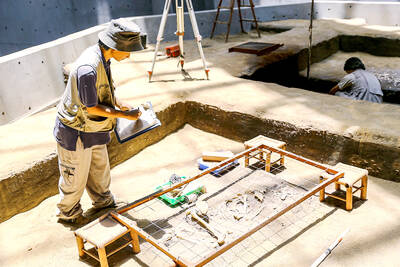
Writing of the finds at the ancient iron-working site of Shihsanhang (十 三行) in New Taipei City’s Bali District (八里), archaeologist Tsang Cheng-hwa (臧振華) of the Academia Sinica’s Institute of History and Philology observes: “One bronze bowl gilded with gold, together with copper coins and fragments of Tang and Song ceramics, were also found. These provide evidence for early contact between Taiwan aborigines and Chinese.” The Shihsanhang Web site from the Ministry of Culture says of the finds: “They were evidence that the residents of the area had a close trading relation with Chinese civilians, as the coins can be
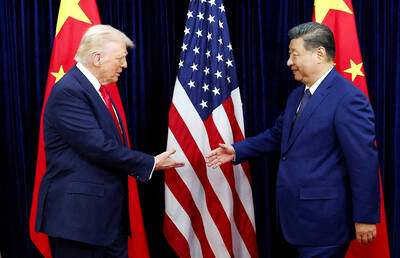
The March/April volume of Foreign Affairs, long a purveyor of pro-China pablum, offered up another irksome Beijing-speak on the issues and solutions for the problems vexing the People’s Republic of China (PRC) and the US: “America and China at the Edge of Ruin: A Last Chance to Step Back From the Brink” rang the provocative title, by David M. Lampton and Wang Jisi (王緝思). If one ever wants to describe what went wrong with US-PRC relations, the career of Wang Jisi is a good place to start. Wang has extensive experience in the US and the West. He was a visiting


 RSS
RSS