


Despite the not unreasonable claims among us northerners that Taipei is (and always will be) Taiwan’s greatest city, Kaohsiung is a pretty awesome place too, once you start exploring it. Taipei may have the larger number of historic buildings, the best public transport system and by far the finer range of day hikes and excursions. But look below the surface glitz and color of modern Kaohsiung, and it’s a surprisingly varied and interesting place, with a lot to see and explore.
Shoushan (壽山) is one of several outcrops of limestone (or rather ancient coral) that occur in southern Taiwan. The ridge, about six kilometers long and two kilometers wide, was lifted above the surface of the ocean eons ago, and the exposed rock has since been cracked by earthquakes and dissolved by rain to form a weird landscape of narrow clefts, jagged coral formations and caves. Sadly, those last features aren’t open to the public, and neither is the mysterious northern half of the ridge, which is still a controlled military area. The accessible area is still a great place for exploring, though, especially off the well-trodden main trails.
GEOLOGICAL RICHES

Photo: Richard Saunders
Shoushan, which is rich in geological, ecological and (pre)historic interest, became Taiwan’s first National Nature Park (established in October 2009). It’s divided into five distinct areas, all on the western side of Kaohsiung City. Shoushan ridge itself is the largest protected area, but two other smaller uplifted coral hills — Guishan (龜山) and Mount Banping (半屏山) — and even several historic relics, including part of the old walled city of Zuoying (左營) and a couple of minor prehistoric sites, also lie within the park’s multiple boundaries.
The long, wooded ridge of Shoushan is a conspicuous feature from many areas of Kaohsiung, but the three main trailheads all take a little effort to seek out, since they’re not especially well signposted. The easiest entry point to locate starts near the city zoo, at the southern end of the ridge, while the other two are close to each other, about half-way up the eastern side of the ridge. Once you’ve finally found a way onto the mountain, signage improves considerably: English language maps and signs are generously scattered along paths all over the mountain, so getting around is straightforward.
The best place to start exploring Shoushan is probably from the middle trailhead of the three, which starts at a large car park beside Qianguang Temple (千光宮). Walk past the unmanned visitor center, which has a map of the National Nature Park, and a small display explaining some of the geology, flora and fauna of the ridge, and take a raised wooden walkway that climbs quite steeply above the car park, past a huge old banyan tree. Shortly the boardwalk turns into an unattractive, dusty track winding up the wooded hillside. Hang in there; it does get more interesting later on.
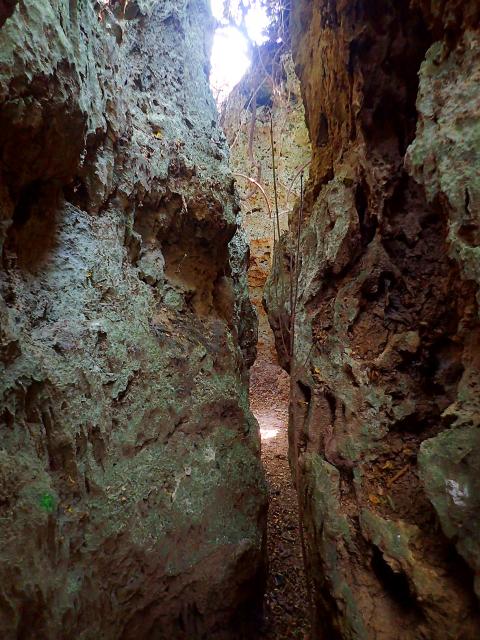
Photo: Richard Saunders
FORMOSAN MACAQUES
In about 20 minutes the track passes the Four Banyans (四棵榕), a row of old trees that provide the first good view over the city, from where several routes climb the hillside for about another half hour to the more impressive Rocky Banyan (盤榕), clinging to the side of a limestone crag and usually busy with Shoushan’s famous Formosan macaques (the only species of monkey native to Taiwan).
These critters might look cute, but treat them with respect. Years of sharing the ridge with the countless hikers that come up there each day has taught them not only to have no fear of humans, but also to see them as a source of food, so keep all edibles well hidden, even away from busy monkey stations such as here.

Photo: Richard Saunders
The Rocky Banyan is a useful landmark, as it’s the place where Shoushan really starts to get interesting; most of the best caves, gorges and other formations are within easy walking distance of it. Some of these are marked on the English-language maps, but the best plan is to choose a direction, get off the wide main trails as soon as possible and simply explore.
Worth a look before leaving the Rocky Banyan area is the nearby Lotus Cave (蓮花洞), a sinkhole beside the path. From here a trail strikes north past the Monkey View Pavilion (觀猴亭; guaranteed close encounters with loads more Formosan macaques), the bluff known as Monkey Rock (猴岩) and on to the deep cleft curiously known as Thailand Valley (泰國谷), perhaps the most impressive formation on the entire ridge.
For my favorite so-far discovered portion of Shoushan, however, head west from the Rocky Banyan along a dull but flat track leading to a flat terrace called the Longevity Rest Area (長壽園). Now turn west (right) off along any of the tiny dirt trails that branch off, and start wandering along the network of rough dirt trails towards the highest point of the entire ridge (349 meters), in search of some of Shoushan’s more intriguing features such as the Tiger Cave (虎洞), Monkey Cave (猴洞) and the Mountain Pig Cave (山豬洞).
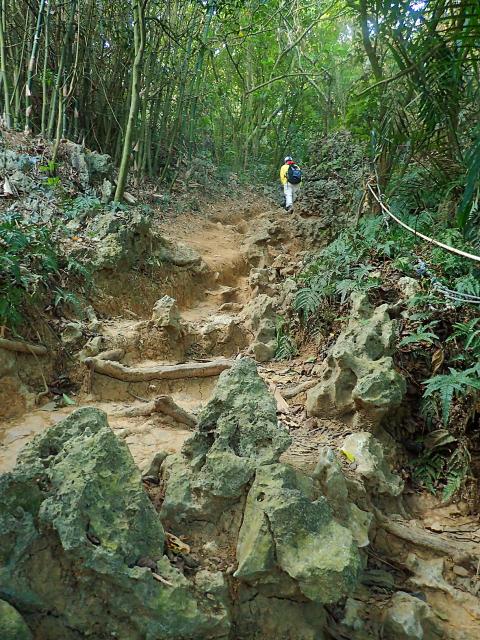
Photo: Richard Saunders
Richard Saunders is a classical pianist and writer who has lived in Taiwan since 1993. He’s the founder of a local hiking group, Taipei Hikers, and is the author of six books about Taiwan, including Taiwan 101 and Taipei Escapes. Visit his Web site at www.taiwanoffthebeatentrack.com.
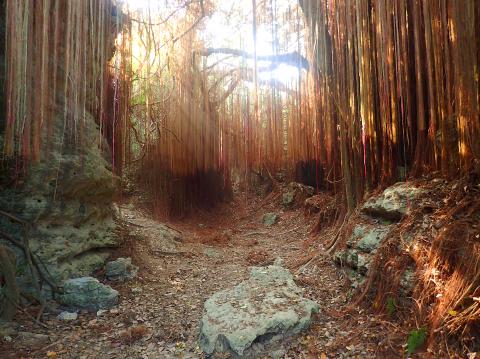
Photo: Richard Saunders
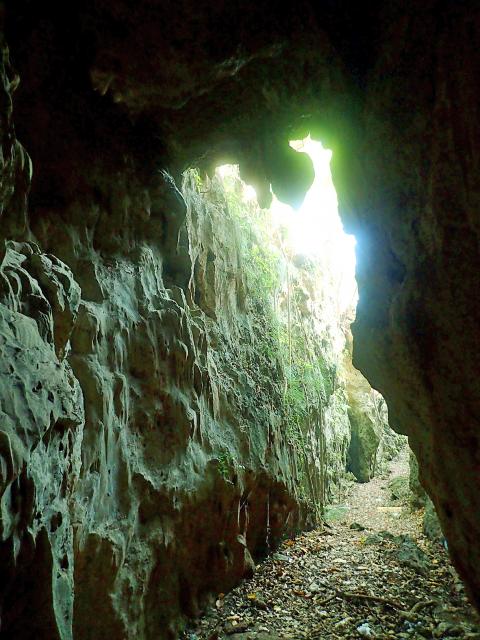
Photo: Richard Saunders

This month the government ordered a one-year block of Xiaohongshu (小紅書) or Rednote, a Chinese social media platform with more than 3 million users in Taiwan. The government pointed to widespread fraud activity on the platform, along with cybersecurity failures. Officials said that they had reached out to the company and asked it to change. However, they received no response. The pro-China parties, the Chinese Nationalist Party (KMT) and Taiwan People’s Party (TPP), immediately swung into action, denouncing the ban as an attack on free speech. This “free speech” claim was then echoed by the People’s Republic of China (PRC),

Exceptions to the rule are sometimes revealing. For a brief few years, there was an emerging ideological split between the Democratic Progressive Party (DPP) and Chinese Nationalist Party (KMT) that appeared to be pushing the DPP in a direction that would be considered more liberal, and the KMT more conservative. In the previous column, “The KMT-DPP’s bureaucrat-led developmental state” (Dec. 11, page 12), we examined how Taiwan’s democratic system developed, and how both the two main parties largely accepted a similar consensus on how Taiwan should be run domestically and did not split along the left-right lines more familiar in

Most heroes are remembered for the battles they fought. Taiwan’s Black Bat Squadron is remembered for flying into Chinese airspace 838 times between 1953 and 1967, and for the 148 men whose sacrifice bought the intelligence that kept Taiwan secure. Two-thirds of the squadron died carrying out missions most people wouldn’t learn about for another 40 years. The squadron lost 15 aircraft and 148 crew members over those 14 years, making it the deadliest unit in Taiwan’s military history by casualty rate. They flew at night, often at low altitudes, straight into some of the most heavily defended airspace in Asia.
Many people in Taiwan first learned about universal basic income (UBI) — the idea that the government should provide regular, no-strings-attached payments to each citizen — in 2019. While seeking the Democratic nomination for the 2020 US presidential election, Andrew Yang, a politician of Taiwanese descent, said that, if elected, he’d institute a UBI of US$1,000 per month to “get the economic boot off of people’s throats, allowing them to lift their heads up, breathe, and get excited for the future.” His campaign petered out, but the concept of UBI hasn’t gone away. Throughout the industrialized world, there are fears that


 RSS
RSS