


The Square, a Swedish movie about the curator of a museum filled with grotesquely pretentious conceptual art, on Sunday beat stiff competition to win the top prize at the Cannes Film Festival.
Critics hailed the movie by writer-director Ruben Ostlund as “high-wire cinema” that veers between comedy and thriller with moments of pure surrealism, although some said it could easily have shed part of its two hours and 22 minutes running time.
The film’s highlight is a dinner for the museum’s well-to-do patrons, with a performance artist leaping from table to table impersonating an ape in a bizarre, tense and ultimately violent scene.
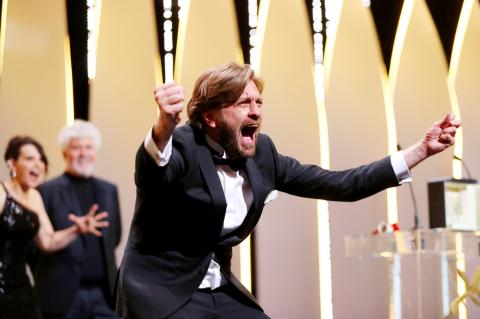
PHOTO: AFP
Spanish filmmaker Pedro Almodovar, who headed the jury of nine people that included Hollywood stars Will Smith and Jessica Chastain, said the film was about “the dictatorship of being politically correct.”
“Such a serious subject is treated with an incredible imagination. It is very, very, very funny,” he said.
120 Beats Per Minute a French movie about HIV/AIDS awareness campaigners in the 1980s, had been favorite for the award but had to settle for second place, taking the Grand Prize of the Jury, something Almodovar seemed to regret.
“This is a very democratic jury and I am the ninth part of this jury,” he said and fought back tears as he talked of the film’s portrayal of “real heroes that saved many lives.”
Sofia Coppola won best director for The Beguiled, a remake of the 1971 Clint Eastwood tale of sexual tension between an injured soldier in the American Civil War and the women and girls who take him in.
Although members of the jury said she was the first woman to win that prize, the history books show that Soviet director Yuliya Solntseva won it in 1961.
Nicole Kidman, who starred alongside Colin Farrell in The Beguiled and The Killing of a Sacred Deer missed out on the best actress trophy, but was awarded a special prize, collecting the jury’s 70th Anniversary Award.
Best actress went to Diane Kruger for her performance in German film In the Fade, playing a woman trying to put her life back together after her husband and young son are killed in a bomb attack. It was her first role in her native German.
Joaquin Phoenix was named best actor for his portrayal of a psychologically damaged hitman in You Were Never Really Here by Scottish director Lynne Ramsay, who shared the prize for best screenplay with the writers of The Killing of a Sacred Deer, Yorgos Lanthimos and Efthimis Filippou.
Video-streaming company Netflix, which had two acclaimed movies in competition, left empty-handed. Its lack of success should have come as no surprise, given that Almodovar said at the start of the festival that the Palme d’Or should not go to a movie that would not be given a theatrical release.

This month the government ordered a one-year block of Xiaohongshu (小紅書) or Rednote, a Chinese social media platform with more than 3 million users in Taiwan. The government pointed to widespread fraud activity on the platform, along with cybersecurity failures. Officials said that they had reached out to the company and asked it to change. However, they received no response. The pro-China parties, the Chinese Nationalist Party (KMT) and Taiwan People’s Party (TPP), immediately swung into action, denouncing the ban as an attack on free speech. This “free speech” claim was then echoed by the People’s Republic of China (PRC),

Exceptions to the rule are sometimes revealing. For a brief few years, there was an emerging ideological split between the Democratic Progressive Party (DPP) and Chinese Nationalist Party (KMT) that appeared to be pushing the DPP in a direction that would be considered more liberal, and the KMT more conservative. In the previous column, “The KMT-DPP’s bureaucrat-led developmental state” (Dec. 11, page 12), we examined how Taiwan’s democratic system developed, and how both the two main parties largely accepted a similar consensus on how Taiwan should be run domestically and did not split along the left-right lines more familiar in
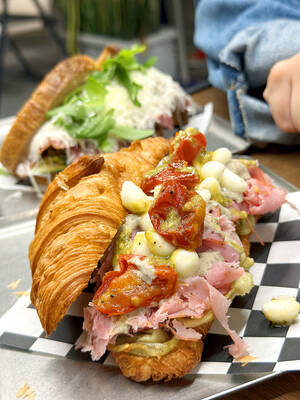
Specialty sandwiches loaded with the contents of an entire charcuterie board, overflowing with sauces, creams and all manner of creative add-ons, is perhaps one of the biggest global food trends of this year. From London to New York, lines form down the block for mortadella, burrata, pistachio and more stuffed between slices of fresh sourdough, rye or focaccia. To try the trend in Taipei, Munchies Mafia is for sure the spot — could this be the best sandwich in town? Carlos from Spain and Sergio from Mexico opened this spot just seven months ago. The two met working in the
Many people in Taiwan first learned about universal basic income (UBI) — the idea that the government should provide regular, no-strings-attached payments to each citizen — in 2019. While seeking the Democratic nomination for the 2020 US presidential election, Andrew Yang, a politician of Taiwanese descent, said that, if elected, he’d institute a UBI of US$1,000 per month to “get the economic boot off of people’s throats, allowing them to lift their heads up, breathe, and get excited for the future.” His campaign petered out, but the concept of UBI hasn’t gone away. Throughout the industrialized world, there are fears that


 RSS
RSS