


Don’t be put off by the dead body in the opening scene of Silent Teacher — you’ll likely be moved to tears later. No exaggerating here, there was much sobbing heard during the screening. Director Maso Chen (陳志漢) tackles a potentially morbid subject with sensitivity, crafting a tender and informative documentary on “silent teachers” (大體老師), or people who have donated their body to medical schools for dissection.
Due to the traditional belief in keeping one’s corpse whole, medical schools in Taiwan often have difficulty finding cadavers for their students to dissect in anatomy classes. As a result, the cadaver-to-medical student ratio in Taiwan is five times lower than that of Western countries. Here, these bodies are literally treated as “teachers,” with the students bowing and thanking them after each session.
It could be argued that the film’s protagonist is Hsu Yu-e (徐玉娥), a Chiayi woman whose body is being prepared for dissection at Fu Jen Catholic University’s medical school (the process takes about a year), but the narrative is primarily told through Lin Hui-tsung (林惠宗), her husband of 23 years, who travels to Taipei every month to update his wife’s body on how the family is doing. Both of them had signed up to donate their bodies for education.
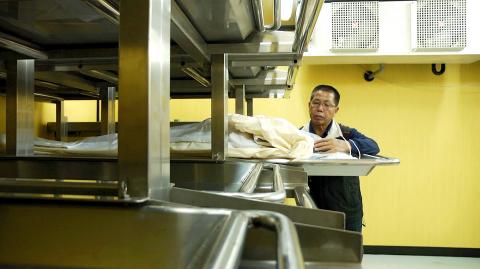
Photo courtesy of The Classic Vision
The film also places much attention on the medical students and staff, especially as they have to interact with their designated corpse’s family members, who are pretty much involved in every step of the process (except for watching the dissection, which they can’t bear to do).
The professor repeatedly stresses that the cadaver is more than just a body to dissect — it is a lesson in respecting life. And like the class, the scope of the film reaches way beyond the subject matter, which is clearly and cohesively presented — the director also explores deeper themes on life, death and humanity.
We hear their daughter discussing what she has learned about life from this experience, while the anatomy class professor ponders whether she can handle her students dissecting her own mother, who has volunteered to be a silent teacher when she dies. There’s also discussion of religion through how a Catholic university handles bodies from people with Buddhist or Taoist backgrounds. The cause of Hsu’s death is revealed indirectly as the students dissect her body.
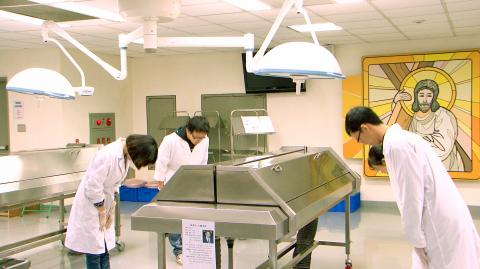
Photo courtesy of The Classic Vision
Through masterful editing, much of the story is told through conversations and slice-of-life scenes — and there is much material to choose from as the director spent a year documenting Lin’s life, after Hsu’s body arrived at Fu Ren. For example, we only learn that he visits his wife’s body often through his casual banter with the medical staff. Lin is an ideal candidate for this type of story — he appears optimistic most of the time as we watch him try to carry on with his life — even posing for selfies in a karaoke bar. His positive attitude makes the film less heavy, but his grief is still there, and our hearts break when he breaks down.
Since there are essentially two timelines going on with the family and the medical school — which only converge every now and then — it makes for some interesting juxtaposition scenes that the director fully makes use of. And while the cadaver is frequently shown in the film, it is treated delicately but not too conservatively. We see just enough to realize that this is without a doubt reality, but not too much that we would feel uncomfortable.
Running just 73 minutes, there’s a lot packed into this film, but it doesn’t seem rushed — in fact it’s probably just long enough. When a viewer leaves the theater full of emotions, thoughts and new information without any hints of boredom — that’s all the signs of a good documentary.

Taiwan’s English education system is being pulled apart by three opposing forces. Bilingual Nation 2030 pulls students toward English and global communication. Artificial Intelligence (AI) readiness pulls them toward digital judgment, verification and AI-mediated work. But Taiwan’s old exam culture pulls them back toward memorization, grammar drills, timed reading and correct answers. If the education system keeps using old exams to define success, it risks producing graduates who are neither genuinely bilingual nor genuinely AI-ready, but trained for tasks machines can already perform. The first force is Bilingual Nation 2030. Launched in 2018, the policy aimed to “help Taiwan’s workforce connect
It seems every few days one bumps into one of those “real man” comments in which Taiwan is urged to “face reality” or similar, and “make a deal,” with the speaker implying that soon it will be too late. “Deal” advocates always present themselves as having a superior grip on reality, and the manly ability to make the “hard choice.” Their testosterone-laden language often echoes that of Taiwan sellout advocates. Note that such commentary always specifies a process (“make a deal, work with, make progress”), never the end state of what occupation by a violent authoritarian colonialist state will entail. In
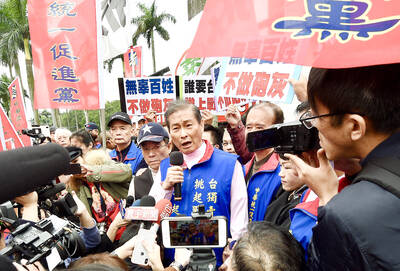
There are shadowy cabals plotting to sell out Taiwan to be annexed by China, by invasion if necessary. Fortunately, they are buffoons. In 2019, former Bamboo Union gangster and founder of the China Unification Promotion Party (CUPP), Chang An-le (張安樂, colorfully known as “White Wolf”), led a protest at the Legislative Yuan against comments made by then-premier Su Tseng-chang (蘇貞昌) that in the event of an attack by China, he would never surrender, but would protect the nation by fighting to the end, even if he only had a broom. Chang had party members bring a wooden casket that they
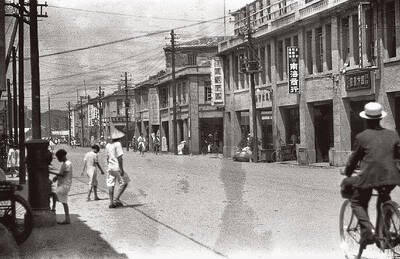
June 1 to June 7 "If all Taiwanese were as afraid of dying as you, then what would happen?” Physician Shih Chiang-nan (施江南) reportedly said this to his wife Chen Chiao-tung (陳焦桐) after she urged him to stop intervening on behalf of Taiwanese soldiers stranded overseas after serving in the Japanese Army during World War II. Shih had clashed with high-ranking officials over the issue, engaged in several heated arguments with Taiwan governor-general Chen Yi (陳儀) and allegedly shouted at general Ko Yuan-fen (柯遠芬), chief of staff of the Taiwan Garrison Command, over


 RSS
RSS