


The Taipei Jazz Festival (台北爵士音樂節) turns 10 this year, and celebrates by adding two indoor shows featuring international heavyweights and a newcomer competition to its existing program of a weekend of live music in Da-an Forest Park.
The indoor shows are held at Zhongshan Hall, featuring an American All-star lineup of guitarist Dean Brown, bassist Stuart Hamm and drummer Chris Coleman tonight and the TJF Collective tomorrow, headlined by Panamanian saxophonist Carlos Agrazal and violinist Joshue Ashby Humphreys.
The usual program at Da-an Park’s bandshell will feature a mix of local and international talent, with sounds ranging from fusion to big band to middle eastern-tinged grooves featuring the oud, an Arabic pear-shaped stringed instrument.
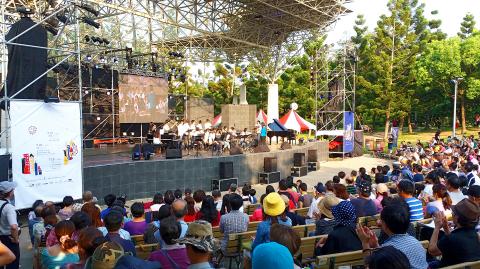
Photo: Han Cheung, Taipei Times
In addition, the festival hosted master classes this week and several mini-concerts and jazz appreciation seminars in the past two months, expanding its repertoire in jazz education and promotion.
■ The indoor shows are tonight and tomorrow from 5:30pm 7:30pm at 98, Yanping S Rd, Taipei City (台北市延平南路98號). General admission is NT$500; NT$300 for students.
■ The outdoor shows are tonight through Sunday from 3pm to about 10pm. Admission is free, and the bandshell is located near the center of the park.
■ For more information, visit jazz.festival.taipei/2016/ (Chinese only)

This month the government ordered a one-year block of Xiaohongshu (小紅書) or Rednote, a Chinese social media platform with more than 3 million users in Taiwan. The government pointed to widespread fraud activity on the platform, along with cybersecurity failures. Officials said that they had reached out to the company and asked it to change. However, they received no response. The pro-China parties, the Chinese Nationalist Party (KMT) and Taiwan People’s Party (TPP), immediately swung into action, denouncing the ban as an attack on free speech. This “free speech” claim was then echoed by the People’s Republic of China (PRC),

Exceptions to the rule are sometimes revealing. For a brief few years, there was an emerging ideological split between the Democratic Progressive Party (DPP) and Chinese Nationalist Party (KMT) that appeared to be pushing the DPP in a direction that would be considered more liberal, and the KMT more conservative. In the previous column, “The KMT-DPP’s bureaucrat-led developmental state” (Dec. 11, page 12), we examined how Taiwan’s democratic system developed, and how both the two main parties largely accepted a similar consensus on how Taiwan should be run domestically and did not split along the left-right lines more familiar in

Most heroes are remembered for the battles they fought. Taiwan’s Black Bat Squadron is remembered for flying into Chinese airspace 838 times between 1953 and 1967, and for the 148 men whose sacrifice bought the intelligence that kept Taiwan secure. Two-thirds of the squadron died carrying out missions most people wouldn’t learn about for another 40 years. The squadron lost 15 aircraft and 148 crew members over those 14 years, making it the deadliest unit in Taiwan’s military history by casualty rate. They flew at night, often at low altitudes, straight into some of the most heavily defended airspace in Asia.
Many people in Taiwan first learned about universal basic income (UBI) — the idea that the government should provide regular, no-strings-attached payments to each citizen — in 2019. While seeking the Democratic nomination for the 2020 US presidential election, Andrew Yang, a politician of Taiwanese descent, said that, if elected, he’d institute a UBI of US$1,000 per month to “get the economic boot off of people’s throats, allowing them to lift their heads up, breathe, and get excited for the future.” His campaign petered out, but the concept of UBI hasn’t gone away. Throughout the industrialized world, there are fears that


 RSS
RSS