


Brian Lee (李俊樺) arrives at his plot of land in New Taipei City’s Shulin District (樹林) in the morning just like any other professional farmer — but instead of tending to the vegetables, the first thing he does is feed the Taiwanese tilapia and other fish located in two large tanks in the back of his hoop house.
Then he checks the water quality before moving on to monitoring each plant for pests, then harvesting and planting.
Wes Kuo (郭庭瑋), a director of the Taiwan Aquaponics Promotion Association, says Lee is one of a handful of aquaponic commercial farmers in Taiwan. Kuo says he knows of just four facilities, covering a total area of about 6,500m2.
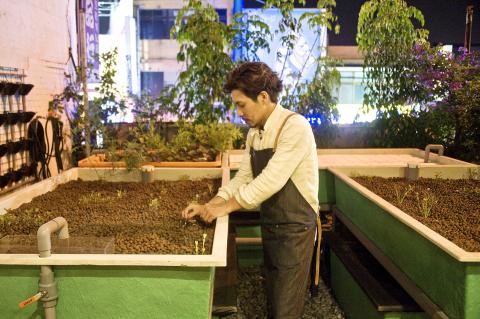
Photo: Han Cheung
The system is a closed loop — microbes convert fish waste from the tanks into nitrates, which the plants absorb as nutrients, and the leftover water is aerated and returned to the fish pond or tank. Lee sells both the fish and the vegetables as food.
And while there are concerns that the water tanks will be a breeding ground for mosquitos, Lee says introducing Paradise fish to the tanks will significantly reduce the larva, which they eat.
Since its introduction to Taiwan about three years ago, aquaponic systems are often marketed as suitable for urban use because of its portability and ease of maintenance. But there is also a growing movement to produce commercially on a large scale, a selling point being that aquaponic produce is guaranteed to be free of pesticide or chemical fertilizer — otherwise the fish die, and the system collapses.
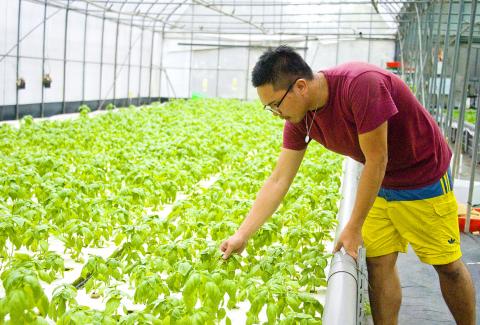
Photo: Han Cheung
“A community garden is already considered a large-scale operation,” Lee says. “But I wanted to see if it was possible to do it commercially, especially when few people have started to do it yet. I want to be at the forefront of this movement.”
The demand is also there, from both individual households and health-conscious restaurants. Lee’s hoop house can currently support about 25,000 plants and 1,000 fish, but he says he has put many orders on hold until he completes his second hoop house, which is twice as large.
A CHEMICAL PAST
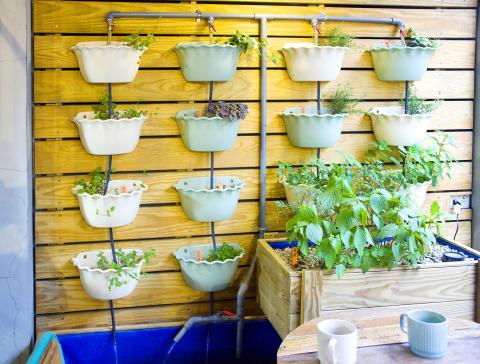
Photo: Han Cheung
Lee is among a new breed of young farmers, who are returning to the land as the market calls for healthier and stabler produce due to changing attitudes toward food, unstable market prices as well as concern over the numerous food-safety scares in recent years.
He says when restaurateurs decide to look for better quality or healthier ingredients, they often have no choice but to source from overseas. And when innovative farmers experiment with non-traditional crops, there is little interest from the general public.
The son of fruit farmers from Pingtung County, Lee moved to Taipei to study at Keelung’s National Taiwan Ocean University (國立海洋大學), where he specialized in aquaculture water treatment and microbe applications.
“My areas of study just happened to be the most important process in this whole system,” he says, as he discovered aquaponics while researching for his master’s thesis.
“It also coincided with the food safety issue in Taiwan, which I care a lot about,” he adds.
The system, Kuo says, uses about one-tenth of the water required for traditional agriculture, is low on electricity costs and requires no soil. The crops also grow about 15 to 20 percent faster because of the constant nutrient stream from the fish waste supplied directly to the roots. It is possible to further speed up the process by using LED lights, but Lee wants to keep the entire process natural and only relies on sunlight.
Kuo says the abundance of pesticide or chemical fertilizer-laden crops can be traced back to the days before Taiwan’s industrialization, when the government promoted building the country on agriculture. Farmers then took on an assembly line mentality, emphasizing mass production.
“They sold their crops by weight, instead of the time it took to grow the crops, or the quality of the crops,” Kuo says. “So they started doing anything they could to maximize production.”
This, in addition to the subsequent rapid industrialization, has caused much damage to the country’s soil. Kuo says that even if farmers stop using pesticides, the soil remains laden with heavy metals.
True organic farming, where the soil and water are tested and proven to not be contaminated, is doable — and Kuo says some people do it very well. But is costly to install and maintain.
Kuo supports aquaponic farming because it might be a way to make healthy produce more widespread in Taiwan. The downside is that it is difficult to mass produce root and stem crops — but he has seen it done before overseas.
TO THE TABLE
Kuo uses aquaponic vegetables at his restaurant, Good Food Lab (好福食研室) in Taipei’s Shihlin District (士林). His role with the Aquaponics Promotion Association includes connecting restaurants with farms so they can understand each other’s needs.
With more communication, Kuo’s network of farmers can grow certain items for specific restaurants that are hard to source locally because they have little traditional market value. Kuo says he will even help the farmers find seeds.
“The produce is actually more expensive, but more and more restaurants are embracing it,” he says. “I want to create a positive loop, instead of a negative loop where people compete to produce the cheapest crops regardless of method.”
Jessie Hung (洪?), owner of Sprout (初芽) in Tianmu, estimates that about 10 percent of the produce served in her restaurant is aquaponic. She also has a small system on the deck of her cafe, where she grows herbs and spices used in the kitchen.
Hung says that it depends on the crop, but that soil-grown produce is generally richer in flavor than aquaponic ones.
“But when you consider the safety and health benefits, it is pretty good,” she says. “I can trust that there are no chemicals in aquaponic produce.”
Since the leaves are not the only thing in a salad, there are ways to work around it, Hung says. Sometimes it just takes a shift in perception. For example, Hung found that some varieties of lettuce with less robust flavor would actually work better in a sandwich as it does not overpower the other ingredients.
“But maybe that is just how vegetables taste in our memory,” Kuo argues. “It is the taste of the earth, and since you have been eating soil-grown vegetables since you were a child, your brain thinks it should taste that way.”
Kuo says this is just the beginning, and it will still take a while for people to get used to the idea, as farmers he spoke to would still balk at the idea of producing smaller-sized and fewer crops.
“They do not see the fact that aquaponic crops grow faster, and we pay a whole lot more for it,” he says.

Taiwan’s English education system is being pulled apart by three opposing forces. Bilingual Nation 2030 pulls students toward English and global communication. Artificial Intelligence (AI) readiness pulls them toward digital judgment, verification and AI-mediated work. But Taiwan’s old exam culture pulls them back toward memorization, grammar drills, timed reading and correct answers. If the education system keeps using old exams to define success, it risks producing graduates who are neither genuinely bilingual nor genuinely AI-ready, but trained for tasks machines can already perform. The first force is Bilingual Nation 2030. Launched in 2018, the policy aimed to “help Taiwan’s workforce connect

It seems every few days one bumps into one of those “real man” comments in which Taiwan is urged to “face reality” or similar, and “make a deal,” with the speaker implying that soon it will be too late. “Deal” advocates always present themselves as having a superior grip on reality, and the manly ability to make the “hard choice.” Their testosterone-laden language often echoes that of Taiwan sellout advocates. Note that such commentary always specifies a process (“make a deal, work with, make progress”), never the end state of what occupation by a violent authoritarian colonialist state will entail. In
There are shadowy cabals plotting to sell out Taiwan to be annexed by China, by invasion if necessary. Fortunately, they are buffoons. In 2019, former Bamboo Union gangster and founder of the China Unification Promotion Party (CUPP), Chang An-le (張安樂, colorfully known as “White Wolf”), led a protest at the Legislative Yuan against comments made by then-premier Su Tseng-chang (蘇貞昌) that in the event of an attack by China, he would never surrender, but would protect the nation by fighting to the end, even if he only had a broom. Chang had party members bring a wooden casket that they
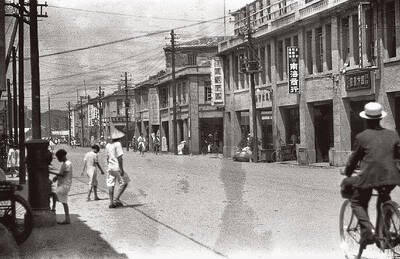
June 1 to June 7 "If all Taiwanese were as afraid of dying as you, then what would happen?” Physician Shih Chiang-nan (施江南) reportedly said this to his wife Chen Chiao-tung (陳焦桐) after she urged him to stop intervening on behalf of Taiwanese soldiers stranded overseas after serving in the Japanese Army during World War II. Shih had clashed with high-ranking officials over the issue, engaged in several heated arguments with Taiwan governor-general Chen Yi (陳儀) and allegedly shouted at general Ko Yuan-fen (柯遠芬), chief of staff of the Taiwan Garrison Command, over


 RSS
RSS