


For his arthouse debut, Kaili Blues (路邊野餐), writer and director Bi Gan (畢贛) shot the film in and around his hometown of Kaili, Guizhou Province in southern China, and cast locals, including his family and friends, as actors.
But the 26-year-old Chinese director does not attempt to represent physical reality or make a work of social realism, as many filmmakers of his generation have.
Instead, Bi’s mesmerizing debut defies logic. It explores cinema’s ability to hypnotize and entrance, and at the same time, is rooted in the life, land and the community where the director was born and raised.
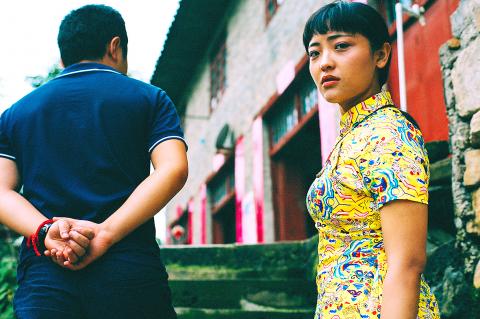
Photo courtesy of Flash Forward Entertainment
The film centers on Chen Sheng, played by Chen Yongzhong (陳永忠), Bi’s uncle, an ex-con who now leads an honest life and runs a small country clinic. Chen is troubled that his half-brother Crazy Horse’s (Xie Lixun, 謝理循) has sold off his son Weiwei, and embarks on a journey to find his young nephew.
More cryptic than this synopsis suggests, the film is not driven by a narrative but channels of feeling. It respects the viewer’s intelligence and trusts us to understand its characters as we follow them from one mystical scene to another.
Still, much is uncertain. Guided by a sense of freedom and fluidity, the film abounds in otherworldly visions and enigmatic imagery. In one remarkable scene, a projected image of an upside-down train appears to crash through a damp, gloomy hut.
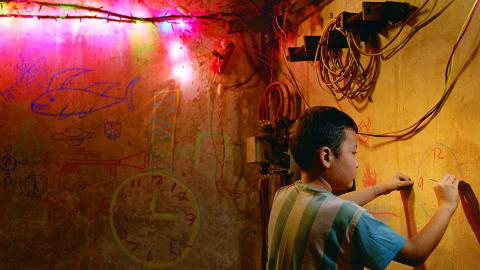
Photo courtesy of Flash Forward Entertainment
Occasionally, radio newscasts report sightings of a wild man, and every now and then, Chen cites evocative poetry in a monotonous tone as he leads us through his cinematic dream space.
The poems were written by Bi, from a collection entitled Roadside Picnic (路邊野餐).
In this dream, past, present and future intermingle and conflate, astonishingly manifested in a 40 minute-long extended take that follows Chen through rural Guizhou in search of his nephew.
The hand-held camera tracks characters on motorbikes, across narrow pathways, into homes and on a river ferry. Sometimes, it veers off to follow different players who appear and disappear from the frame.
During the journey, the protagonist encounters a variety of characters, notably the future version of Weiwei and a woman who could be Chen’s deceased wife.
The normal perceptions of time and space do not apply here. In his daring cinematic experiment, Bi creates a cyclic cosmos where memories, dreams and reality infiltrate and inform on each other.
The personal and the collective also intertwine. Throughout the film, the culture and tradition of the Miao ethnic minority, of whom Bi is a member, are alluded to.
At the same time, the nation’s shadowy past quietly emerges when Chen promises his senior medical colleague to deliver a cassette tape to an old lover he had known during the Cultural Revolution.
To be sure, there is a lot to accomplish in a film, but Bi has done it here with self-assurance and sincerity. Not a single moment feels pretentious or forced. It shows the making of a filmmaker in possession of a unique vision of rural China.
Kaili Blues has received numerous of international accolades, including the top award at the Festival of the Three Continents in France as well as the Best New Director prizes at the Locarno International Film Festival and Taiwan’s Golden Horse Awards last year.
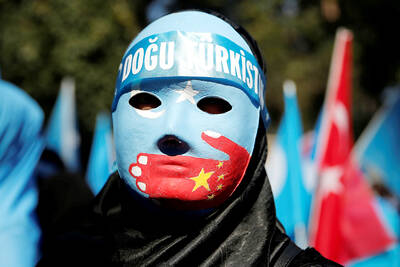
It seems every few days one bumps into one of those “real man” comments in which Taiwan is urged to “face reality” or similar, and “make a deal,” with the speaker implying that soon it will be too late. “Deal” advocates always present themselves as having a superior grip on reality, and the manly ability to make the “hard choice.” Their testosterone-laden language often echoes that of Taiwan sellout advocates. Note that such commentary always specifies a process (“make a deal, work with, make progress”), never the end state of what occupation by a violent authoritarian colonialist state will entail. In

There are shadowy cabals plotting to sell out Taiwan to be annexed by China, by invasion if necessary. Fortunately, they are buffoons. In 2019, former Bamboo Union gangster and founder of the China Unification Promotion Party (CUPP), Chang An-le (張安樂, colorfully known as “White Wolf”), led a protest at the Legislative Yuan against comments made by then-premier Su Tseng-chang (蘇貞昌) that in the event of an attack by China, he would never surrender, but would protect the nation by fighting to the end, even if he only had a broom. Chang had party members bring a wooden casket that they
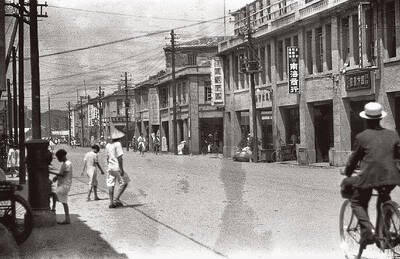
June 1 to June 7 "If all Taiwanese were as afraid of dying as you, then what would happen?” Physician Shih Chiang-nan (施江南) reportedly said this to his wife Chen Chiao-tung (陳焦桐) after she urged him to stop intervening on behalf of Taiwanese soldiers stranded overseas after serving in the Japanese Army during World War II. Shih had clashed with high-ranking officials over the issue, engaged in several heated arguments with Taiwan governor-general Chen Yi (陳儀) and allegedly shouted at general Ko Yuan-fen (柯遠芬), chief of staff of the Taiwan Garrison Command, over

Food prices have often played a major role in Taiwan’s history. The first major wave of migration from China occurred in 1628. A moderate drought, the Ming Dynasty maritime ban that prohibited fishing and trading (intended to reduce piracy) and a temporary tax, conspired to exhaust local resources, leading to famine in Fujian Province. The famed pirate and trader Zheng Zhilong (鄭芝龍), scooped up starving people from Fujian and transported them across the Taiwan Strait, where they settled under the Dutch. Two factors enabled Zheng. First, by 1624 he had settlements around today’s Beigang (北港) in Yunlin County with a small


 RSS
RSS