


Dodging motorcycles while making my way through Wenchang Street (文昌) — which is also dubbed Taipei’s “furniture street” — I glimpse a smattering of new speakeasies and wine bars sandwiched in between old stores selling beaten-down desks and armchairs. As I approach the intersection by Xinyi Road (信義), I make out a young man in an uncreased gray dress shirt buttoned up to the collar. He’s sitting on the front porch of a small, two-story shop with floor-to-ceiling windows that peek into what looks like endless rows of rum and whisky bottles. The left side of the man’s black hair is slicked back while the right side reveals a buzz cut. His moustache and goatee are neatly trimmed. As he puffs away on a cigarette, I can’t help thinking that he’s only missing a fedora.
Ryan Huang (黃亨鈞) puts out his cigarette in a black ash tray and welcomes me to Chord Cafe x Bistro, a blend of Parisian bistro and American speakeasy. Paneled floors of dark wood and burgundy bar top chairs line the narrow establishment, drawing attention to an otherwise minimalist bar that boasts a vast selection of rums, whiskies and bitters, as well as aromatic herbs bottled up in tiny glass containers.
Despite his debonair facade, I detect a hint of shyness in Huang’s voice when he talks about his dream of running a bar. The 30-year-old was a bartender for eight years. During this time, he also worked as a consultant helping other people open bars before scraping together the resources to open Chord in 2013. He chose the name because it has a melodious ring and conjures up warm, welcoming feelings.
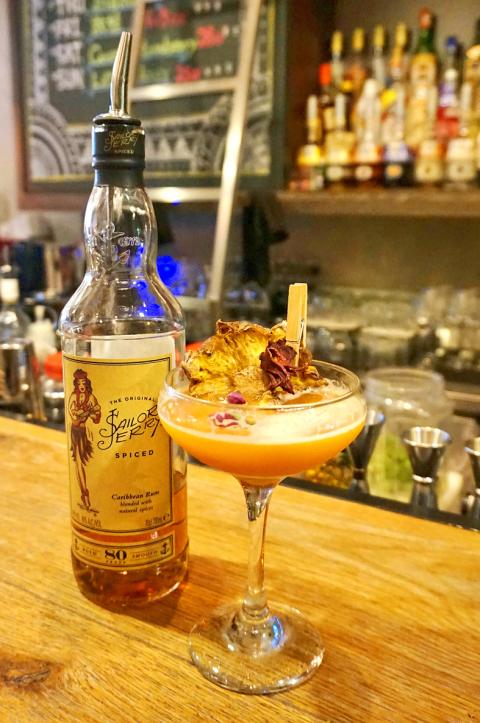
Photo: Dana Ter, Taipei Times
“Chord has a dual meaning,” Huang tells me. “But the meaning we’re going for is to be touching, or to strike a chord in someone, so to speak.”
As we chat, I notice a few regulars shooting the breeze and talking whiskies with some of the bartenders. Service is taken seriously at Chord, and interaction with the bartender is central to the cocktail-drinking experience. Like many speakeasy-type places in Taipei, Chord doesn’t have a drink menu. Instead, customers tell the bartender their favorite flavors and he’ll come up with something delectable from the ingredients available. While the fruits are locally sourced from an old man who runs a fruit store nearby, the herbs, spices and liquors come from all over the world.
“I think a lot of people in Taiwan don’t know how to order cocktails,” Huang says. “So that’s why this methods works.”
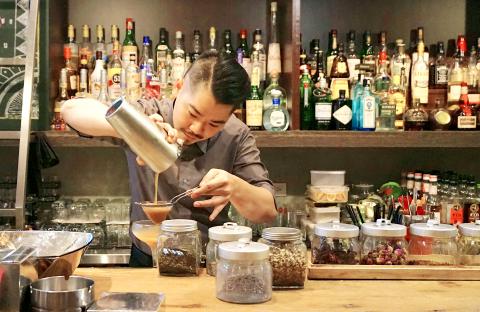
Photo: Dana Ter, Taipei Times
The general attitude of customers, he says, is that if the drink is not good, then it’s the bartender’s fault. That’s why Huang treats his job as a craft, dicing fruit and mixing liquor with a lab technician’s precision. If a customer doesn’t like the cocktail, he’ll take it back and make a new one.
When I ask Huang about some of the more bizarre drink requests he’s received, he says he gets a number of female customers saying things like: I want a cocktail that will help me find love.
While Huang has yet to find the right mix of ingredients to create the perfect love potion, he tries his best.
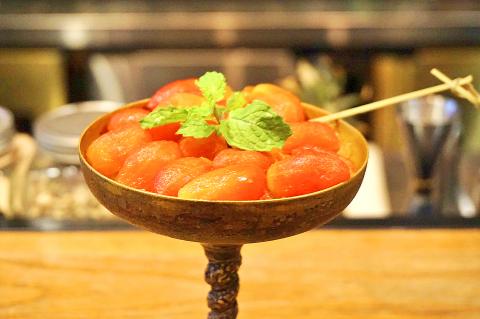
Photo: Dana Ter, Taipei Times
“I’ll just have to keep on asking them what flavors they want, like if they’re looking for something bitter, or something sweet, or bittersweet,” he says.
Although Chord specializes in craft cocktails — and apparently, love elixirs — they’re also a cafe and bistro serving pastas, risottos, pastries and rum-infused coffees. Huang was drawn to the concept of a bistro, because he liked the idea of sitting down for dinner without the pressure of having to seek out a nearby watering hole for post-dinner drinks.
Not everyone has latched onto this concept though. Chord has had to change its opening time from 2pm to 6pm since people passing by in the afternoon would just dismiss it as a bar and not step in for coffee and pastries.
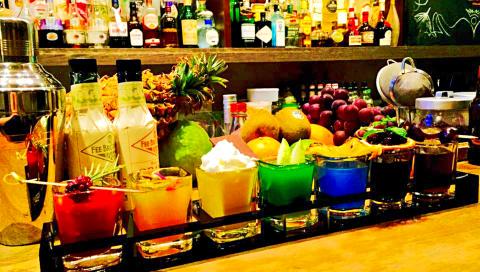
Photo: Dana Ter, Taipei Times
Huang adds that for some customers, “their main objective is just to get drunk.”
However, he’s optimistic that this will change. For starters, women requesting drinks that will make them fall in love is a promising sign that customers believe that Chord’s bartenders are just that skilled. More importantly, Huang’s can-do attitude and his passion and knowledge of various ingredients and flavors is what draws in the regulars — notably those who enjoy a good tippler without all the faux niceties.
TOP PICKS
Mango-strawberry-rum cocktail
The mango-strawberry-rum cocktail, which was Huang’s specially-made concoction for me, is delightfully sour and sweet at the same time. The base is Sailor Jerry Spiced Rum, a black rum from the Caribbean. The mango and strawberry add a refreshing dimension, while the sourness comes from a dollop of lemon and the sweetness from a small scoop of honey and a drop of cherry liquor. Herbal garnishing and a homemade dried pineapple tops of the drink by providing aesthetic props and giving it a candied kick. — NT$350
Tomatoes with white wine vinegar
This is probably the closet to a “love potion” that Chord has to offer. While not exactly a cocktail, the cherry tomatoes — or “angel tomatoes” (天使蕃茄) as they are called in Chinese — are dipped in a shallow cup filled with chilled white wine vinegar. The natural sweetness of the cherry tomatoes overpowers the sourness of the white wine vinegar and the result is a sweet taste with hints of bitterness. Huang says women usually order three of this, while men can barely finish one. — NT$80
Rainbow cocktail
Chord’s rainbow cocktail is seven shots designed for one person (yes, one person) although it can also be shared among friends. The red shot is a gin-raspberry infusion with rosemary syrup. Orange is a whiskey with orange, kumquat and rose. Yellow is a mango-coconut-rum infusion topped with whipped cream. Green is a refreshing blend of guava, melon and tequila with a dollop of honey. Blue is vodka, pineapple and lemon topped with an aromatic oasmanthus fragans. Violet is a strong and hearty brandy with blackcurrant and orange. Purple is a mix of red wine with Japanese grape liquor and grape. —NT$900
Taipei is a city that has positioned itself as being cheap and fast, but the revolution for craft drinks is taking wind and alcohol aficionados are thirsty for more. Drinking Taipei is a monthly column devoted to spotlighting chic, conceptual bars that aren’t your typical watering hole.

Taiwan’s English education system is being pulled apart by three opposing forces. Bilingual Nation 2030 pulls students toward English and global communication. Artificial Intelligence (AI) readiness pulls them toward digital judgment, verification and AI-mediated work. But Taiwan’s old exam culture pulls them back toward memorization, grammar drills, timed reading and correct answers. If the education system keeps using old exams to define success, it risks producing graduates who are neither genuinely bilingual nor genuinely AI-ready, but trained for tasks machines can already perform. The first force is Bilingual Nation 2030. Launched in 2018, the policy aimed to “help Taiwan’s workforce connect

It seems every few days one bumps into one of those “real man” comments in which Taiwan is urged to “face reality” or similar, and “make a deal,” with the speaker implying that soon it will be too late. “Deal” advocates always present themselves as having a superior grip on reality, and the manly ability to make the “hard choice.” Their testosterone-laden language often echoes that of Taiwan sellout advocates. Note that such commentary always specifies a process (“make a deal, work with, make progress”), never the end state of what occupation by a violent authoritarian colonialist state will entail. In
June 1 to June 7 "If all Taiwanese were as afraid of dying as you, then what would happen?” Physician Shih Chiang-nan (施江南) reportedly said this to his wife Chen Chiao-tung (陳焦桐) after she urged him to stop intervening on behalf of Taiwanese soldiers stranded overseas after serving in the Japanese Army during World War II. Shih had clashed with high-ranking officials over the issue, engaged in several heated arguments with Taiwan governor-general Chen Yi (陳儀) and allegedly shouted at general Ko Yuan-fen (柯遠芬), chief of staff of the Taiwan Garrison Command, over

“Taiwan’s Opposition Leader Comes to US With a Message Straight Out of Beijing” read a May 31 headline in the Wall Street Journal. Top US administration officials and members of Congress almost certainly read the WSJ, and if there was a bullet point takeaway that people in Washington should absorb ahead of Chinese Nationalist Party (KMT) Chair Cheng Li-wun’s (鄭麗文) arrival in DC on June 9, that headline is it. The last few columns have discussed this very topic, and the timing is not coincidental. While those top officials likely do not read the Taipei Times, judging by the number


 RSS
RSS