


Taipei’s fall overload of dance programs is going strong this weekend, with three terrific cross-cultural programs to choose from. The overload is having an impact at the box office, though, with many companies reporting slower ticket sales than normal because of the increased competition, something that is set to continue almost through the end of the year.
The National Theater Concert Hall’s (NTCH) Dancing in Autumn series has programs running in both the main theater, Hui (迴), and the Experimental Theater, So Blue, while the annual iDance Taipei festival opened its tent last night across town at the Wellspring Theater in the Gongguan (公館) area.
‘HUI’ — SEASONS OF LIFE
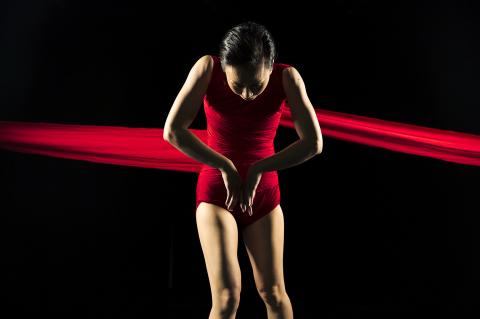
Photo courtesy of Chen You-wei
First up, simply because the size and complexity of the production is Hui, which opens tomorrow night for a three-show run. It was specially commissioned by the NTCH as a collaboration between Dance Forum Taipei (舞蹈空間) and New York City-based contemporary Chinese composer Tan Dun (譚盾).
The show has been three years in the making, complicated by the distance between the collaborators, their busy schedules, and, according to Dance Forum founder and director Ping Heng (平珩), because Tan kept coming up with new ideas and music for the show.
Dance Forum pulled in Amsterdam Anmaro Asia Arts to co-produce the show as well as a team from Glasgow-based Cryptic company, including founder Cathie Boyd, who co-directed the piece alongside American multi-disciplinary artist Josh Armstrong.
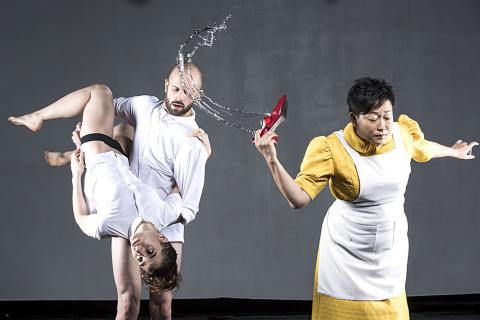
Photo courtesy of Chen You-wei
The cast is made up of Dance Forum Taipei’s dancers, along with Ines Belda, Javier Monzon and Christopher Tandy, actress Priscilla Leung (梁小衛), and pianists Wang Wen-chuan (王文娟) and Hsu Yu-ting (許毓婷), with choreography by frequent DFT collaborator Yang Ming-lung (楊銘隆) and Netherlands-based Spaniard Ivan Perez Aviles.
Hui, which centers on Tan’s piano music, is described as a journey through the seasons of life, focusing on the continual return of the Moon and its influence on the water that surrounds us and is in us. The concept of a continuous cycle is reinforced by the title, since it can mean to rotate, to turn around, to come back.
A line from Tang Dynasty official and poet Bai Juyi (白居易) is used to sum up the show: “In the time of snow, moon and flowers, I think of you.”
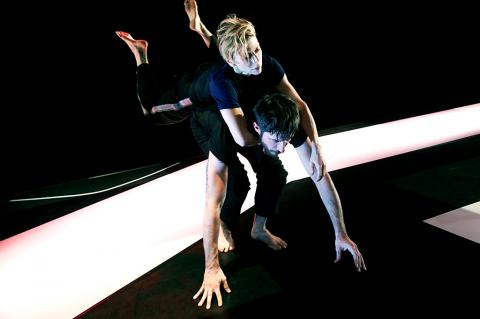
Photo Courtesy of Carl Lessard
The idea of “snow, moon and flowers” is a reference to the transience and permanence of the natural world and its endless passage of time.
The show is divided into eight parts: Prologue, Sunset, Dew-Fall-Drops, Traces, Midnight, C-A-G-E C-A-G-E, 8 Memories in Watercolor and Dawn.
The score is drawn from Tan’s work, including Dew-Fall-Drops, which was composed 2000 on commission for the Carnegie Hall Millennium Piano Book, and is a collection of solos for solo piano.
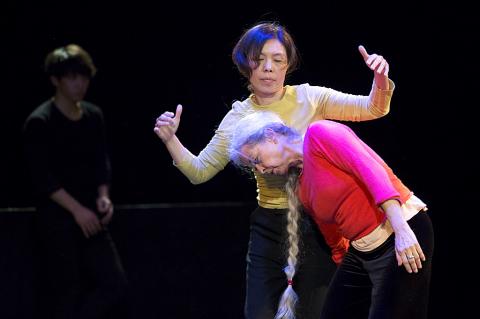
Photo Courtesy of Ku and Dancers
Traces is from 1989 and was inspired by a bus ride Tan took through some mountains in south China and the wind that whistled through the gaps in the bus windows. C-A-G-E C-A-G-E, from 1993, is in memory of US composer John Cage, who had been a mentor and a friend. Eight Memories in Watercolor dates from 1979, when Tan was studying at the Central Conservatory of Music in Beijing and was homesick for Hunan Province.
The show runs about 70 minutes with no intermission, and there will subtitles in English.
Additional performances on Nov. 28 and Nov. 29 at the Yunlin Performance Hall in Changhua County’s Yuanlin Township.
‘SO BLUE’ — PERPETUAL MOTION
Starting tonight, Fou Glorieux, a Montreal-based company founded by 57-year-old Canadian dancer/choreographer Louise Lecavalier, famed for her work with Edouard Lock’s La La La Human Steps troupe, is taking over the Experimental Theater with her first extensive solo chorographic venture So Blue, which premiered in 2012.
Danced primarily by Lecavalier, with the brief inclusion of Frederic Tavernini, So Blue, is an intense 60-minute work based on deconstructing movements from daily life and challenging the constraints of the body and inertia that sees her throw herself into feverish perpetual motion, the energy appear to literally explode from her body. The portions with Taverini appear more contact improvisation that formal choreography.
The music is largely percussive and can apparently get extremely loud, according to the guidance given by the NTCH Web site, though there are some quieter interludes. There is also a recommendation against children younger than 12 seeing the show. There will be a post-show question-and-answer session after Sunday’s matinee.
IDANCE TAIPEI
Dance improvisation is the order of the day — or rather the week — with the iDance Taipei festival, which has been running workshops all this week at ArtSpace71 and closes with two showcases at the Shilin Residence Chrysanthemum Show on Sunday.
Coordinated by Ku Ming-shen’s (古名伸) Ku and Dancers (古名伸舞蹈團) troupe, the public performance portion of the festival, which began last night at the Wellspring Theater, offers four different ways of approaching body, movement, space and one another, presented by guest artists from Europe, America, Japan and South Korea.
The remaining four shows feature different artists on each night.
Tonight it its South Korea-based French dancer Celine Bacque, South Korean Choi A-reum, and Sunny Yang (楊乃璇), Liu Yen-cheng (劉彥成), Ku & Dancers and the jam portion by Colin Offord, with music by Claudia Howard Queen, an associate professor of music for dance at Oberlin College in the US.
Tomorrow sees German Michael Schumacher, Tung Kuei-ju (董桂汝), Lin I-ching (林宜瑾), Ka Dao Yin (卡到音) and Colin Offord, while on Saturday it will be Japanese dancers Kosei Sakamoto and Yuko Mori, joined by Tung, with music by Tina Ma (馬麗英) and the jam portion by Arnaud Lechat.
Sunday’s show is something of a grand finale, with Sakamoto, Mori, Bacque, Choi, Lin and Yin, along with Ku’s dancers joining Arnaud Lechat and Ma for the final jam session.
More information on the iDance Taipei festival is available at www.idancetaipei.tw.
Performance Notes:
Hui
When: Tomorrow and Saturday at 7:45pm, Sunday at 2:45pm
Where: National Theater (國家戲劇院), 21-1 Zhongshan S Rd, Taipei City (台北市中山南路21-1號)
Admission: NT$600 to NT$2500; available at NTCH box offices, online at www.artsticket.com.tw and at convenience store ticketing kiosks. For Friday’s show, the only tickets left are in the NT$900 to NT$1,600 range. The top seats for Saturday’s show are sold out.
Additional Performances: Nov. 28 at 7:30pm and Nov. 29 at 2:30pm at the Yunlin Performance Hall (彰化縣員林演藝廳表演廳), 99, Ln 2, Zhongzheng Rd, Yuanlin Township, Changhua County (員林市大饒里員林大道二段99號)
Place: Tickets are NT$300 to NT$700; available at the theater box office, online at www.artsticket.com.tw and at convenience store ticketing kiosks. Only NT$300 and NT$400 seats are left for the first show, top seats are sold out for the second show.
So Blue
When: Tonight, tomorrow and Saturday at 7:45pm, Sunday at 2:45pm
Where: Experimental Theater (國家實驗劇場), 21-1 Zhongshan S Rd, Taipei City (台北市中山南路21-1號)
Admission: Tickets are NT$800, available at NTCH box offices, online at www.artsticket.com.tw and at convenience store ticketing kiosks. Saturday and Sunday’s shows are sold out.
iDance Taipei 2015
When: Tonight, tomorrow and Saturday at 7:45pm, Sunday at 5pm
Where: Wellspring Theater (水源劇場), 92 Roosevelt Rd Sec 4, Taipei City (台北市羅斯福路四段92號)
Tickets: NT$600, available at ticketing offices, online at www.artsticket.com.tw, convenience store ticketing kiosks and at the door.

By global standards, the traffic congestion that afflicts Taiwan’s urban areas isn’t horrific. But nor is it something the country can be proud of. According to TomTom, a Dutch developer of location and navigation technologies, last year Taiwan was the sixth most congested country in Asia. Of the 492 towns and cities included in its rankings last year, Taipei was the 74th most congested. Taoyuan ranked 105th, while Hsinchu County (121st), Taichung (142nd), Tainan (173rd), New Taipei City (227th), Kaohsiung (241st) and Keelung (302nd) also featured on the list. Four Japanese cities have slower traffic than Taipei. (Seoul, which has some
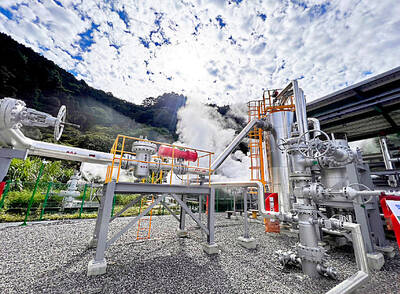
Taiwan’s semiconductor industry consumes electricity at rates that would strain most national grids. Taiwan Semiconductor Manufacturing Co (TSMC) alone accounted for more than 9 percent, or 2,590 megawatts (MW), of the nation’s power demand last year. The factories that produce chips for the world’s phones and servers run around the clock. They cannot tolerate blackouts. Yet Taiwan imports 97 percent of its energy, with liquefied natural gas reserves measured in days. Underground, Taiwan has options. Studies from National Taiwan University estimate recoverable geothermal resources at more than 33,000 MW. Current installed capacity stands below 10 MW. OBSTACLES Despite Taiwan’s significant geothermal potential, the

In our discussions of tourism in Taiwan we often criticize the government’s addiction to promoting food and shopping, while ignoring Taiwan’s underdeveloped trekking and adventure travel opportunities. This discussion, however, is decidedly land-focused. When was the last time a port entered into it? Last week I encountered journalist and travel writer Cameron Dueck, who had sailed to Taiwan in 2023-24, and was full of tales. Like everyone who visits, he and his partner Fiona Ching loved our island nation and had nothing but wonderful experiences on land. But he had little positive to say about the way Taiwan has organized its
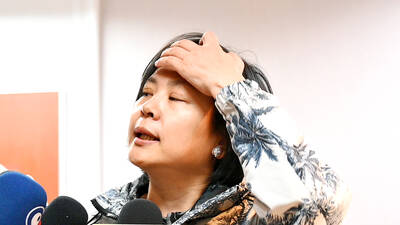
The entire Li Zhenxiu (李貞秀) saga has been an ugly, complicated mess. Born in China’s Hunan Province, she moved to work in Shenzhen, where she met her future Taiwanese husband. Most accounts have her arriving in Taiwan and marrying somewhere between 1993 and 1999. She built a successful career in Taiwan in the tech industry before founding her own company. She also served in high-ranking positions on various environmentally-focused tech associations. She says she was inspired by the founding of the Taiwan People’s Party (TPP) in 2019 by Ko Wen-je (柯文哲), and began volunteering for the party soon after. Ko


 RSS
RSS