


A designer hollers “lunch time” as models — male, female, toddlers and middle-aged — scamper to folding tables, grab a lunch box and plop themselves on the grass. A group of people next to the makeshift catwalk are trying to rearrange a row of bamboo plants brought down from the mountains of Miaoli County. Next to them, a few male models are hanging pieces of Styrofoam cut to resemble clouds over a sign for the Suraw Atayal Fashion Show (森林之心色舞繞泰雅服裝秀), which takes place on Saturday in the county’s Shei-Pa National Park (雪霸國家公園).
A few bamboo plants and Styrofoam clouds smack in the middle of Taipei did not exactly evoke a sense of the thundering mountains and lush greenery that Taian Township (泰安) in Miaoli County, home to the Atayal tribe, is known for. In fact, the entire affair feels more like an informal gathering of friends than preparation for a press conference and fashion show.
Yet I was also grateful for the fact that there weren’t hordes of crazed reporters and fans clawing at each other like you see every year at New York Fashion Week.
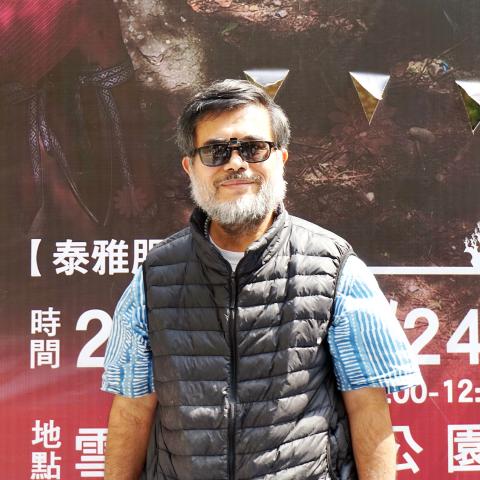
Photo: Dana Ter, Taipei Times
EXCAVATING FASHION
“I’m reluctant to use the term ‘fashion show’ because it comes with certain connotations and expectations,” says Baunay Watan, the event’s organizer and a member of the Atayal community.
Although the ambiance says otherwise, I still expected to see a little fashionista in a big poncho or a lanky man with skinny pants rolled up at the ankles, so am slightly shocked when I find Baunay to be a middle-aged man with a grizzly beard.
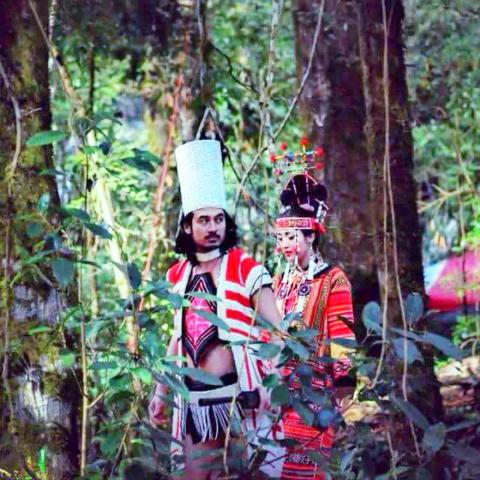
Photo courtesy of Luo Hsiao-fang
Baunay, who has been traveling around Taiwan photographing Atayal clothing for nearly 20 years, opened a workshop in 2012 with his wife Yuma Taru. Together, they seek out designers to create designs inspired by the traditional ones they have photographed. Some designers follow the traditional Atayal red-and-white shawls with intricate embroidery, while others embed Atayal motifs in flowing dresses and snug sweaters.
Baunay says their workshop has created jobs in their community, and their annual fashion show has helped to garner interest in Aboriginal culture. While his employees are mostly Atayal, the designers and models are a mixture of Aborigines from other communities and other Taiwanese.
Every year, the fashion show attracts designers from overseas. This year’s line-up includes designers from Japan, South Korea and Russia.
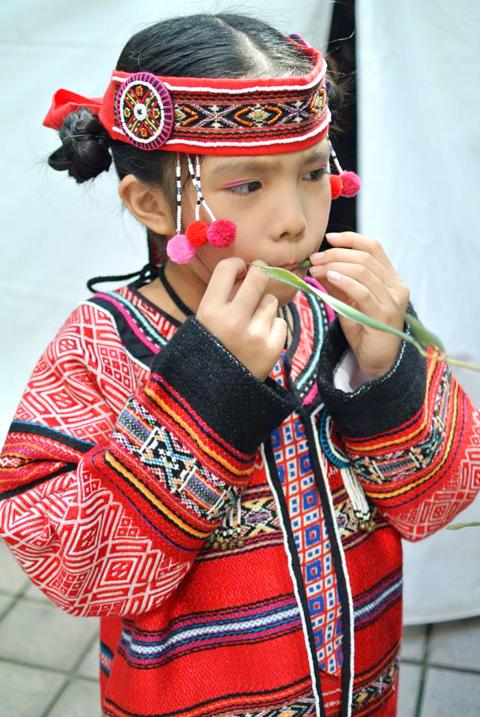
Photo courtesy of Bui Hoang Nga
“We consciously chose not to hold the show in Taipei,” Baunay says. “We wanted a more authentic setting.”
Although it would be more convenient for most people to attend a show in Taipei, Baunay says the idea was to have it in the woods that inspired the designs in the first place.
INVALUABLE LESSONS
As we chat under the shade, Baunay’s kindergarten-age daughter, who is also one of the models, pops up behind him and mumbles something in his ear. She has a full face of makeup and her hair is done up in two buns.
“Fashion is an important way for our people, especially the youth, to better connect to our culture,” Baunay says.
Indeed, fashion shows are a community affair for the Atayal residents of rural Taian Township. Children as young as two years old strut down the “runway” — a clearing in a forest — dressed in embroidered vests and beaded headbands. Even at the Taipei press conference, the children are all smiles, practicing songs in Atayal and working the catwalk with the adult models.
Baunay hopes that being exposed to their culture at a young age will mold their way of thinking in the future. Knowing it’s inevitable that young people will move out of their communities in search of better job opportunities in the city, Baunay’s wish is for them to learn how to integrate into non-Aboriginal society without forgetting their roots.
“Perhaps they can even teach other young people a bit about Atayal culture through donning their traditional clothes from time to time,” Baunay says.
But there are some who don’t understand his intention of making fashion — a term that automatically connotes snobbery and elitism — inclusive and participatory.
“They come to Miaoli thinking it’ll be like fashion week in New York, London or Paris, and are taken aback to discover that it isn’t set up like that,” Baunay says.
Their priority is not to make money, as they aren’t selling any of their clothes, at least not yet. Their models are not all young, tall and skinny. Instead of promoting a certain image or lifestyle, the fashion show serves as a starting point to get people interested in learning more about other facets of Aboriginal culture, including languages, customs and cuisines.
“The clothes may not be considered ‘fashionable’ in the aesthetic or conceptual sense, but they have educational value,” Baunay says.
As for future shows, he hopes to continue to garner a global audience until one day people will start associating Aboriginal clothing as one of Taiwan’s national clothes. But for now, Baunay and his team are content with doing what they do, taking rehearsals light-heartedly and knowing when to stop and indulge in a hearty, greasy lunch box.
For more information about Saturday’s Suraw Atayal Fashion Show, visit their Facebook page (Chinese) at zh-tw.facebook.com/LIHANGWORKSHOP.
Towering high above Taiwan’s capital city at 508 meters, Taipei 101 dominates the skyline. The earthquake-proof skyscraper of steel and glass has captured the imagination of professional rock climber Alex Honnold for more than a decade. Tomorrow morning, he will climb it in his signature free solo style — without ropes or protective equipment. And Netflix will broadcast it — live. The event’s announcement has drawn both excitement and trepidation, as well as some concerns over the ethical implications of attempting such a high-risk endeavor on live broadcast. Many have questioned Honnold’s desire to continues his free-solo climbs now that he’s a
As Taiwan’s second most populous city, Taichung looms large in the electoral map. Taiwanese political commentators describe it — along with neighboring Changhua County — as Taiwan’s “swing states” (搖擺州), which is a curious direct borrowing from American election terminology. In the early post-Martial Law era, Taichung was referred to as a “desert of democracy” because while the Democratic Progressive Party (DPP) was winning elections in the north and south, Taichung remained staunchly loyal to the Chinese Nationalist Party (KMT). That changed over time, but in both Changhua and Taichung, the DPP still suffers from a “one-term curse,” with the
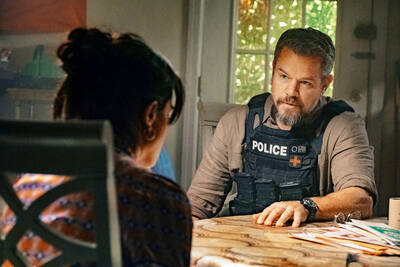
Lines between cop and criminal get murky in Joe Carnahan’s The Rip, a crime thriller set across one foggy Miami night, starring Matt Damon and Ben Affleck. Damon and Affleck, of course, are so closely associated with Boston — most recently they produced the 2024 heist movie The Instigators there — that a detour to South Florida puts them, a little awkwardly, in an entirely different movie landscape. This is Miami Vice territory or Elmore Leonard Land, not Southie or The Town. In The Rip, they play Miami narcotics officers who come upon a cartel stash house that Lt. Dane Dumars (Damon)
Today Taiwanese accept as legitimate government control of many aspects of land use. That legitimacy hides in plain sight the way the system of authoritarian land grabs that favored big firms in the developmentalist era has given way to a government land grab system that favors big developers in the modern democratic era. Articles 142 and 143 of the Republic of China (ROC) Constitution form the basis of that control. They incorporate the thinking of Sun Yat-sen (孫逸仙) in considering the problems of land in China. Article 143 states: “All land within the territory of the Republic of China shall


 RSS
RSS