


Hou Hsiao Hsien (侯孝賢) and the wuxia genre seem to be unsuited as the martial-arts cinema, which traditionally focuses on movement and action, is not the type of film one easily associates with the Taiwanese auteur known for his quiet, minimal cinematic ethos.
But Hou’s fans can rest assured. The Assassin (刺客聶隱娘), the director’s eagerly anticipated first foray into the martial-arts realm, turns out to be ravishingly beautiful work of wuxia that is instantly recognizable as a Hou film.
The story is set during the decline of the Tang Dynasty, a time when the provinces maintained uneasy relations with the Imperial Court.
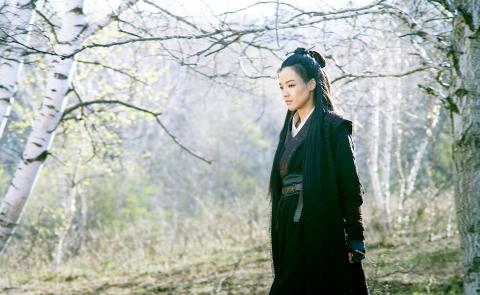
Photo courtesy of Tsai Cheng–tai, Spot Films
The story revolves around Nie Yinniang, a female assassin who works for master and princess-turned-nun Jiaxin (Sheu Fang-yi (許芳宜).
A sequence soon follows that gorgeously demonstrates how different Hou’s approach is going to be. Yinniang practices her craft; the action plays out at a distance, behind glittering foliage and flashing blades. Not even a glimpse of blood is shown.
However, after Yinniang backs down from an assignment because she sees her target with his young son, a disappointed Jiaxin orders her back to Weibo, her hometown, to assassinate Lord Tian Ji’an (Chang Chen, 張震). Weibo is the strongest of the provinces that have become hotbeds of rebellion as the authority of the Emperor weakens.
Yinniang returns home after an absence of 13 years, lurks in the shadows and observes.
As we soon learn, Yinniang is the general’s daughter. She was taken from her family at age 10 and placed in the care of Jiaxin, who trained her to become a killer tasked with eliminating warlords. Yinniang’s new target, Lord Tian, happens to be her cousin, to whom she was once promised in marriage as a child.
Meanwhile, Lord Tian reigns over his realm with ruthlessness. In the lord’s household, brewing intrigue also takes place between his murderous wife (Zhou Yun, 周韻) and favorite concubine Huji (Hsieh Hsin-ying, 謝欣穎), who is pregnant with his child.
So far, this summary has revealed more clues than the audience will be able to discern. For the wuxia tale, Hou and his writers take inspiration from a short story entitled Nie Yinniang (聶隱娘) in the collection Legendary Tales (傳奇) by Tang dynasty scribe Pei Xing (裴鉶).
The characters and plots were originally constructed to fuel the filmmakers’ vision, but a considerable amount of material was eventually left on the cutting-room floor. Dialogue is minimized so that characters express their complex emotions cinematically.
But this requires patience from the viewer. The characters, speaking classical Chinese, move from one exquisitely composed frame to another. They whisper behind fluttering curtains and flickering candle flames, stand in solitude on precipitous clifftops obscured by mist or disappear slowly toward the lush horizon.
The cinematographer, Mark Lee (李屏賓), has chosen not to concentrate on the characters themselves, but to locate them within the larger landscape. Lee prefers the classic ratio instead of the wide-screen format because it more eloquently expresses the director’s vision.
Hou clearly didn’t intend to make a conventional epic. It’s not so much about the narrative and plot, as it is about the people. As with Cafe Lumiere (珈琲時光, 2003) and Flight of the Red Balloon (2007), The Assassin is about a heroine’s quest.
Hou’s wuxia is seen through the eyes of Shu Qi’s character, who tries to make sense of the incomprehensible world around her with determination.
With Assassin, Hou sets out to do something new with the wuxia genre as well as his own cinema. He places his characters into a bygone life re-imagined and strives to tackle the anachronistic tension without reservation. Perhaps, for this reason alone, the film will remain a rare curio in the eyes of the auteur’s fans.

This month the government ordered a one-year block of Xiaohongshu (小紅書) or Rednote, a Chinese social media platform with more than 3 million users in Taiwan. The government pointed to widespread fraud activity on the platform, along with cybersecurity failures. Officials said that they had reached out to the company and asked it to change. However, they received no response. The pro-China parties, the Chinese Nationalist Party (KMT) and Taiwan People’s Party (TPP), immediately swung into action, denouncing the ban as an attack on free speech. This “free speech” claim was then echoed by the People’s Republic of China (PRC),

Exceptions to the rule are sometimes revealing. For a brief few years, there was an emerging ideological split between the Democratic Progressive Party (DPP) and Chinese Nationalist Party (KMT) that appeared to be pushing the DPP in a direction that would be considered more liberal, and the KMT more conservative. In the previous column, “The KMT-DPP’s bureaucrat-led developmental state” (Dec. 11, page 12), we examined how Taiwan’s democratic system developed, and how both the two main parties largely accepted a similar consensus on how Taiwan should be run domestically and did not split along the left-right lines more familiar in

Specialty sandwiches loaded with the contents of an entire charcuterie board, overflowing with sauces, creams and all manner of creative add-ons, is perhaps one of the biggest global food trends of this year. From London to New York, lines form down the block for mortadella, burrata, pistachio and more stuffed between slices of fresh sourdough, rye or focaccia. To try the trend in Taipei, Munchies Mafia is for sure the spot — could this be the best sandwich in town? Carlos from Spain and Sergio from Mexico opened this spot just seven months ago. The two met working in the
Many people in Taiwan first learned about universal basic income (UBI) — the idea that the government should provide regular, no-strings-attached payments to each citizen — in 2019. While seeking the Democratic nomination for the 2020 US presidential election, Andrew Yang, a politician of Taiwanese descent, said that, if elected, he’d institute a UBI of US$1,000 per month to “get the economic boot off of people’s throats, allowing them to lift their heads up, breathe, and get excited for the future.” His campaign petered out, but the concept of UBI hasn’t gone away. Throughout the industrialized world, there are fears that


 RSS
RSS