


What do Taiwan, Japan, Australia and France have in common? They are part of the global nuclear industry chain that starts with mining companies like Canada’s Cameco and Areva from France that extract uranium ore to build and fuel nuclear power plants.
Throughout the chain, there is another thing that happens over and over: the nuclear industry stores its waste at facilities located in poor and Aboriginal communities because of their remote locations. These communities also offer the least resistance against corporations and governments.
“We have an expression in Australia called ‘radioactive racism,’ meaning all of the radioactivity, nuclear tests, uranium mining and nuclear waste are always targeted at Aboriginal communities,” says Marcus Atkinson, an organizer with the Anti-Nuclear Alliance of Western Australia.
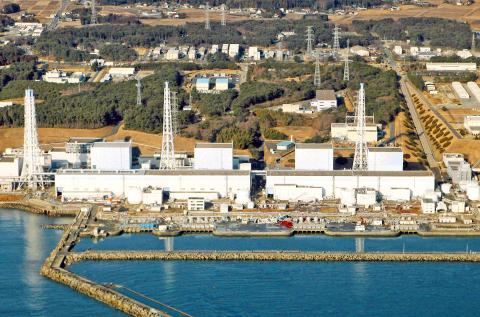
Photo: AFP/ Jiji Press
The anti-nuclear activist was in Taipei last week to attend the No Nukes Film Festival (核電影), a free biennial event organized by Green Citizens’ Action Alliance (綠色公民行動聯盟), an NGO and anti-nuclear advocacy group. The festival and film screenings ends Sunday.
For the past 20 years, Atkinson has worked as anti-uranium mining activist in Australia, which has nearly 40 percent of the uranium reserves on earth, making it the world’s third largest supplier.
REACHING OUT
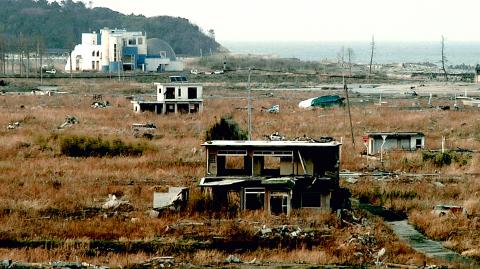
Photo courtesy of No Nukes Film Festival
Now in its second edition, the film festival examines different aspects of the global nuclear industry with a focus on issues that are rarely discussed in Taiwan such as uranium mining and environmental justice.
“I used to think of nuclear issues within a national framework,” says Chen Shi-ting (陳詩婷), the action alliance’s executive secretary. “But the nuclear industry is actually the source of oppression to people throughout the globe.”
“Through the film festival, we can ... reach out to the general public who either don’t care about the nuclear issue or find it hard to digest,” she adds.
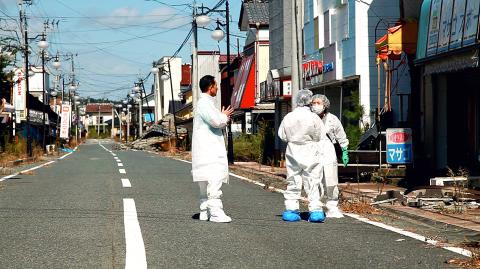
Photo courtesy of No Nukes Film Festival
THE SYSTEM OF SACRIFICE
Among the lineup of 13 documentaries, Paiwan filmmaker Sasuyu Ubalat’s Get Out (原來我們不核) examines the Paiwan village of Nantian (南田) in Taitung County. The villagers are deeply divided over the future of their small community, which was chosen by Taiwan Power Co (Taipower) as a candidate for a permanent nuclear waste storage facility.
While a handful of tribal leaders and elders view the project as encroaching on ancestral land, the majority of villagers support hosting the storage facility because they believe that the massive financial incentives offered by Taipower will help the poverty-stricken village.
Atkinson says he sees many similarities between what is happening in Nantian and Aboriginal communities in Australia that are struggling to keep uranium mining off their land.
“It is definitely the same tactic... The money and pressure divide the community, kill the resistance and get people fighting with each other. Then the government and company can do whatever they want,” Atkinson says.
In his documentary series Nuclear Nation I and II, Japanese filmmaker Atsushi Funahashi documents the displaced residents of Futaba Town, Fukushima, which remains dangerously contaminated after a 2011 earthquake and tsunami caused a nuclear meltdown at the nuclear power plant in Fukushima. Funahashi says the nuclear industry thrives on “a system of sacrifice” in which poor communities like Futaba sacrifice their histories, cultures and futures so that people in the cities can have enough electricity.
“The nuclear power plant robs small towns and villages of selfhood. It brings jobs and money, and locals become dependent on and addicted to it, fearing that if the plant is closed down, their livelihood will disappear… How to enable villages to survive without nuclear power plants is an important question we need to address,” Funahashi says.
“Ultimately, nuclear power is an ethical issue, not an economic one… What right do we have to impose something we don’t want onto others, our future generations and the environment?” he asks.
ALLYING WITH ABORIGINALS
With a long nuclear-free history, Western Australia has a strong foundation for an anti-nuclear movement. Atkinson says Aboriginal people have formed a close and still growing alliance with environmental groups, politicians and union organizations since the 1990s because they have learned to “listen to each other.”
For example, the Walkatjurra Walkabout is an annual month-long trek through the Wangkatja country and is joined by local Aborigine villagers and people from around Australia as a way to celebrate the strength of an Aboriginal community that has fought to stop uranium mining for over 40 years.
Atkinson says that when it first started in 2011, the event was limited to protesting uranium mining. But as community elders and villagers began to contribute, the walk has become about supporting Aboriginal sovereignty and advocating human rights, while facilitating a deeper understanding and reconnection to the land and traditional culture.
“The experience has been more empowering for us in a lot of ways. I think the work with the Aboriginal communities has really opened my eye to the bigger picture,” Atkinson says.
PHASING OUT NUCLEAR POWER
In Australia, uranium mining companies have suffered a major setback as global uranium prices have dropped 70 percent since the Fukushima meltdown, prompting Japan, one of the biggest importers of Australia’s uranium, to switch off its nuclear reactors.
Atkinson says that all the big companies that have thrived in the nuclear industry in Australia since the 1950s are going broke as they wait for Japan to restart their reactors.
Meanwhile, mining giants are leading the push to build new nuclear power plants in countries like India and Indonesia.
But Atkinson says the future looks bright. He says there is a strong sense that Australia’s four uranium mines will shut down over the next decade as renewable energy becomes cheaper than nuclear power.
And nuclear waste? Atkinson says that nuclear waste in Australia should be stored closest to where the greatest number of people use electrical power — Sydney — and where “people who know how dangerous it is can do the best they can to look after it.”
“This out of sight, out of mind philosophy is not the best way to deal with a substance so dangerous… [Nuclear waste] is never going to be in the middle of nowhere. We need to realize that there is no such thing as nowhere. There is always someone living somewhere,” he says.
The No Nukes Film Festival runs through Sunday at Taipei Contemporary Art Center (台北當代藝術中心) and LUX Cinema (樂聲影城). Details about the festival can be found at: zeronuke.gcaa.org.tw.
Chen says the festival will set out for an island-wide tour in September. Anyone who can get an audience of 20 or more people and a place to screen films — whether a park, night market or an office — is welcome to contact the alliance, which can also help to arrange after-screening discussions. For more information, visit the alliance’s Web site: www.gcaa.org.tw.

Ajay Verma, a consultant gastroenterologist at Kettering general hospital in Northamptonshire, says our gut is a “complex machine.” “It is constantly providing us with the nutrition we need, initially to grow and develop, and then for us to survive, thrive and repair from injury and illness.” How can we keep it functioning well? Put simply: “Make sure what you put into it is balanced, and that you clear out its waste products adequately,” Verma says. “In a general gastroenterology clinic, the most common conditions we see are irritable bowel syndrome (IBS), gastroesophageal reflux disease, inflammatory bowel disease and constipation,” says Nisha
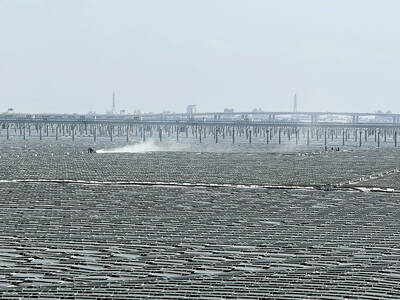
The arithmetic is straightforward and uncomfortable. By the end of 2025, Taiwan had committed itself to a 50-30-20 electricity mix — half natural gas, 30 per cent coal, 20 per cent renewables. The Ministry of Economic Affairs’s (MOEA) own monthly energy reports tell a different story. Natural gas reached 47.8 per cent of generation last year. Coal stood at 35.4 per cent, comfortably above its target ceiling. Renewables came in at 13.1 per cent, well short of the 20 per cent Taipei had pledged a decade earlier. Installed renewable capacity reached roughly half of the 12 gigawatts (GW) the government

Last week US President Donald Trump was asked by a reporter whether he would speak on the phone to the President of Taiwan. “l’ll speak to him. I speak to everybody. We have that situation very well in hand,” Trump said. This marked the second time in a couple of weeks he had said he would talk to the President of Taiwan. In 2016 he famously took a call from then-president Tsai Ing-wen (蔡英文), when he was president-elect. Despite warnings that the apocalypse was nigh because of a phone call, the world quickly forgot about the conversation between two democratically-elected presidents.
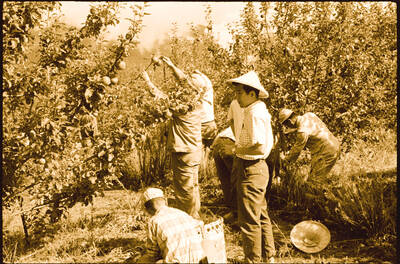
May 25 to May 31 Few believed that apples could be cultivated on a commercial scale in Taiwan’s high mountains. When horticulturalist Cheng Chao-hsiung (程兆熊) first proposed the idea in 1955, both American and Taiwanese colleagues dismissed it as implausible, arguing that temperate fruit could not be reliably grown on a subtropical island, especially on rugged terrain. However, it was this terrain in the Central Mountain Range where many Chinese Civil War veterans were resettled in the late 1950s. With limited job prospects and no family in Taiwan, they were placed on cooperative farms aimed toward self-sufficiency. Some say the conditions


 RSS
RSS