


The word on the street last Saturday night was that the local police department was planning to raid the newest club in the ATT4Fun building, Elektro, sometime between 11:30pm and 12:30am before the DJ Diplo show. Diplo, whose real name is Thomas Wesley Pentz, was supposed to go on at 1:30am. At midnight, the lineup to get in was stretched around the corner — but not a police officer in sight. For the next 90 minutes, those with table reservations jostled, scrambled and elbowed their way in, but a lot of those who had purchased presale tickets were left standing outside in the cold.
At 1:45am, the lights went on in the cramped club and a voice similar to the woman who announces the MRT stops said in Mandarin and English that everyone who did not have a table had to leave. She added that the “Xinyi police department would like everyone to keep their noise levels to a minimum,” instructions that were met with a collective groan. Revelers went to hide in the bathrooms, hallways and any nook and cranny they could find.
A little after 3am, the quick claps of Take U There, Diplo’s trapped out collaboration with Skrillex as Jack U, played over the speakers. It was then that Elektro went berserk. By the end of his first song, Diplo had already stage dived into the crowd.
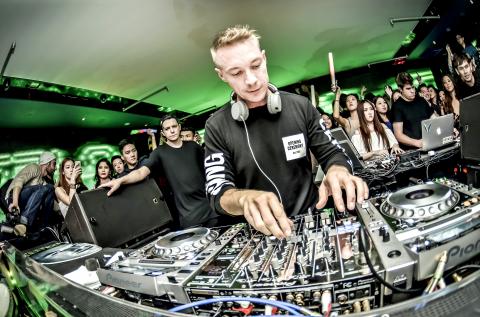
Photo courtesy of Danny Chu
Diplo may only be ranked 32 on DJ Mag’s list of top 100 DJs, but he is a prime example of why that list is outdated because he is a kingmaker in music these days. He collaborates with stars like Beyonce, Justin Bieber, Snoop Dogg and Madonna, as well as some of the hottest underground artists like Grandtheft, Party Squad, and M.I.A. While many big name DJs play the hottest tracks, Diplo’s goal is not only to rock a crowd but to introduce people to something new and different.
As soon as he hit the decks, Diplo had everyone in Elektro on the dance floor as he played hip-hop bangers (0 to 100 by Drake, Turn Down for What by Lil’ Jon and DJ Snake), trap monsters (Summer by Calvin Harris, Pon De Floor by his side project, Major Lazer) and remixes that only he does (No Type by Rae Sremmurd, Try Me by Dej Loaf). At one point, Diplo called out for people to “twerk” next to him and two sumptuous women with shorts that left little to the imagination got up and did their thang.
While it was aggravating to actually get into Elektro, once inside the set Diplo played was the perfect soundtrack for wanting to fight, almost getting arrested and having the time of one’s life.

It seems every few days one bumps into one of those “real man” comments in which Taiwan is urged to “face reality” or similar, and “make a deal,” with the speaker implying that soon it will be too late. “Deal” advocates always present themselves as having a superior grip on reality, and the manly ability to make the “hard choice.” Their testosterone-laden language often echoes that of Taiwan sellout advocates. Note that such commentary always specifies a process (“make a deal, work with, make progress”), never the end state of what occupation by a violent authoritarian colonialist state will entail. In
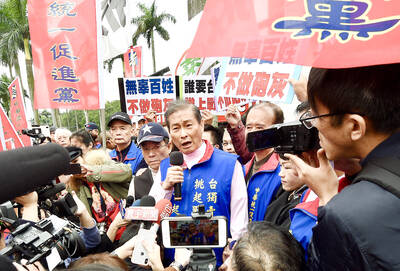
There are shadowy cabals plotting to sell out Taiwan to be annexed by China, by invasion if necessary. Fortunately, they are buffoons. In 2019, former Bamboo Union gangster and founder of the China Unification Promotion Party (CUPP), Chang An-le (張安樂, colorfully known as “White Wolf”), led a protest at the Legislative Yuan against comments made by then-premier Su Tseng-chang (蘇貞昌) that in the event of an attack by China, he would never surrender, but would protect the nation by fighting to the end, even if he only had a broom. Chang had party members bring a wooden casket that they
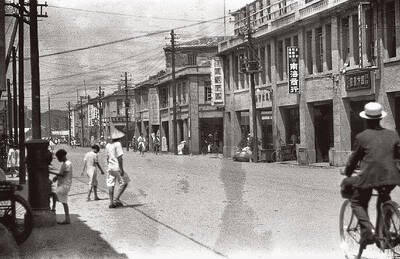
June 1 to June 7 "If all Taiwanese were as afraid of dying as you, then what would happen?” Physician Shih Chiang-nan (施江南) reportedly said this to his wife Chen Chiao-tung (陳焦桐) after she urged him to stop intervening on behalf of Taiwanese soldiers stranded overseas after serving in the Japanese Army during World War II. Shih had clashed with high-ranking officials over the issue, engaged in several heated arguments with Taiwan governor-general Chen Yi (陳儀) and allegedly shouted at general Ko Yuan-fen (柯遠芬), chief of staff of the Taiwan Garrison Command, over

Food prices have often played a major role in Taiwan’s history. The first major wave of migration from China occurred in 1628. A moderate drought, the Ming Dynasty maritime ban that prohibited fishing and trading (intended to reduce piracy) and a temporary tax, conspired to exhaust local resources, leading to famine in Fujian Province. The famed pirate and trader Zheng Zhilong (鄭芝龍), scooped up starving people from Fujian and transported them across the Taiwan Strait, where they settled under the Dutch. Two factors enabled Zheng. First, by 1624 he had settlements around today’s Beigang (北港) in Yunlin County with a small


 RSS
RSS