


Welcome to the New Year in one of the most exciting cities in Asia. Taipei’s night scene has come a long way in the last few years. It’s become a weekend clubbing destination for people from throughout the region and a regular stop on the map for international DJs. With so many choices of clubs, especially in the Xinyi District (信義), it’s astounding that they are always full. But there is always room for one more, so once you’ve recovered from New Year’s Eve, prepare yourself for the grand opening of Elektro featuring none other than Diplo (real name: Thomas Wesley Pentz).
Elektro enters Taipei as the successor to Spark, which abruptly shut down last month. The new club has a similar operational strategy: Vegas-style bottle service with Vegas-style presentation. In what is a reflection of how massive Taipei dance music industry has become, the musical direction of the club will join many others in the area and will be centered on EDM, which means you can expect to see regular international bookings to fuel the club’s vibe.
First up is Diplo, who plays his first solo show in Taipei in more than five years. The US DJ, rapper and Mad Decent record label founder has since formed Jack U with fellow dance music bigwig Skrillex (real name: Sonny John Moore). He also championed the twerking movement and has been immensely busy collaborating regularly with artists like Beyonce and Madonna, who credits him on her upcoming album Rebel Heart. It proves that there is a fine line between what’s considered pop music and dance music. But he’s balancing it in a way that is both tactful and admirable to everyone in the industry.

Photo courtesy of the Windish Agency
Diplo is without a doubt one of the biggest names in the industry and a spontaneous stop in Taipei is a great start to what should be a bustling year for our growing city. We can only hope that police in the won’t have an equally as bustling year.
■ Diplo plays tomorrow night 9pm at Elektro, 6F, 12 Songshou Rd, Taipei City (台北市松壽路12號6樓). Admission is NT$1,600 and includes two drinks.

It seems every few days one bumps into one of those “real man” comments in which Taiwan is urged to “face reality” or similar, and “make a deal,” with the speaker implying that soon it will be too late. “Deal” advocates always present themselves as having a superior grip on reality, and the manly ability to make the “hard choice.” Their testosterone-laden language often echoes that of Taiwan sellout advocates. Note that such commentary always specifies a process (“make a deal, work with, make progress”), never the end state of what occupation by a violent authoritarian colonialist state will entail. In

There are shadowy cabals plotting to sell out Taiwan to be annexed by China, by invasion if necessary. Fortunately, they are buffoons. In 2019, former Bamboo Union gangster and founder of the China Unification Promotion Party (CUPP), Chang An-le (張安樂, colorfully known as “White Wolf”), led a protest at the Legislative Yuan against comments made by then-premier Su Tseng-chang (蘇貞昌) that in the event of an attack by China, he would never surrender, but would protect the nation by fighting to the end, even if he only had a broom. Chang had party members bring a wooden casket that they
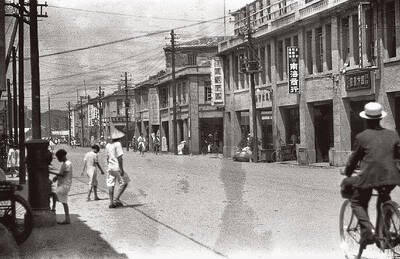
June 1 to June 7 "If all Taiwanese were as afraid of dying as you, then what would happen?” Physician Shih Chiang-nan (施江南) reportedly said this to his wife Chen Chiao-tung (陳焦桐) after she urged him to stop intervening on behalf of Taiwanese soldiers stranded overseas after serving in the Japanese Army during World War II. Shih had clashed with high-ranking officials over the issue, engaged in several heated arguments with Taiwan governor-general Chen Yi (陳儀) and allegedly shouted at general Ko Yuan-fen (柯遠芬), chief of staff of the Taiwan Garrison Command, over

Food prices have often played a major role in Taiwan’s history. The first major wave of migration from China occurred in 1628. A moderate drought, the Ming Dynasty maritime ban that prohibited fishing and trading (intended to reduce piracy) and a temporary tax, conspired to exhaust local resources, leading to famine in Fujian Province. The famed pirate and trader Zheng Zhilong (鄭芝龍), scooped up starving people from Fujian and transported them across the Taiwan Strait, where they settled under the Dutch. Two factors enabled Zheng. First, by 1624 he had settlements around today’s Beigang (北港) in Yunlin County with a small


 RSS
RSS