


Even though there was no Formoz Rock Festival (野台開唱) this year, fans have been posting photos of themselves at last year’s festival to Facebook, with captions like, “Here we are a year ago.” It seems as if Taiwan has once again fallen into an uncanny valley of music festival promotions. Hundreds of die-hards are willing to fly to Japan, paying upwards of NT$40,000 for weekend trips to Fuji Rock or Summer Sonic, but if local festivals try to sell tickets at one-tenth that price (last year’s Formoz was about NT$3,900 for a weekend pass), local promoters are pressed to make the numbers.
And despite this, the Heart Town Festival (山海屯音樂節), held last weekend in Greater Taichung, was a total blast. As Taiwan’s first-ever hardcore and metal fest, it drew around 5,000 fans over two days who watched about 60 bands on four stages. Most impressive, no commercial festival like this has happened in Greater Taichung for at least six years.
The best acts were Japanese bands Crossfaith and Coldrain and the UK band Architects, metalcore bands who have the right mix of explosive music, screamo vocals and stage charisma. The dudes dug it. The girls screamed. The Thai death metal band Dezember was properly guitar goddish, and local digital hardcore act OVDS proved it was worthy of a big stage. The crowd was so often instructed to form circle pits, crouch down and then leap up, or form a wall of death — a violent maneuver in which the crowd is split with an empty space down the middle, then the two sides charge into each other — that it sometimes felt redundant. But it was always fun. Despite afternoon downpours, the energy of the bands was always there to fuel the chaos.
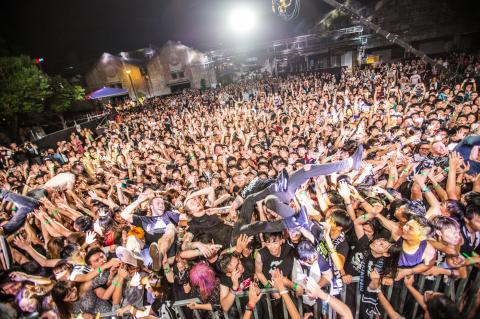
Photo courtesy of Heart Town Festival
Heart Town comes as something of a relief to Greater Taichung’s music drought, which has been severe in the last three years, after the city shut down almost all of its commercial music venues following a 2011 night club fire.
Yet an even larger problem for the city, and all of Taiwan’s culture scene outside of Taipei, is the unfortunate fact that the public is not used to buying tickets for anything.
Heart Town Fest organizer Jimmy Liu (劉鈞輝) believes this is because local governments’ insistence on sponsoring free, mediocre events has strangled development of professional culture industries. It’s an issue he was happy to discuss at length.
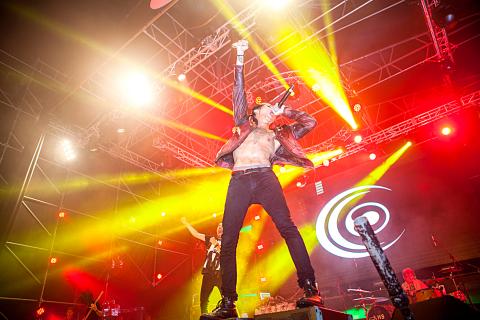
Photo courtesy of Heart Town Festival
“Why do people from outside Taichung feel there are no decent music events in Taichung?” Liu asked. “It’s because there are too many free events, and there is no quality.”
Over the last decade, Greater Taichung’s list of public freebies has included the Taichung International Jazz Festival (established in 2002) and Rock in Taichung (established in 2009). There have also been large productions like the Three Tenors (2005), Lady Gaga (2011) and The Royal Burgh of Stirling Pipeband (2013).
Liu believes that these free events “fundamentally dismantled the links in the production industry. Not one single component could operate normally. We could not have a complete food chain.”
“Every time former classmates or friends in PR companies hear they are going to do an event in Taichung, they are highly dubious. There is good reason. Taichung City has done a lot for cultural events, but it has also buried cultural events.”
In 2006 and 2007, Liu performed with his band Solidor at Tai-ke Rock, a two-day festival that charged NT$899. He was able to play for around 10,000 ticket-buying fans. “I will never forget standing on that stage and witnessing that scene,” he said.
Last year there was a similar sized crowd for the Japanese visual rock band Alice Nine at Rock in Taichung. Liu was producing the event for the third year on a government contract. “But what was different, these 10,000 people had come in for free. At that moment I felt highly conflicted.”
In effect, Liu’s problem was that Taiwan’s local governments have weaned their citizens on a cultural mush of low quality events. But when commercial events, that have to play by market rules, try to provide something better, they find themselves competing against government handouts and an uneducated public.
After three years of dealing with fixed government contracts at Rock in Taichung, he nevertheless decided to set out on his own and initiate the Heart Town Festival. Though the first year was a feel-good success, first-year ticket sales will be difficult to repeat in the long term.
By comparison, similar overseas festivals measure fans in the tens of thousands, and last year’s Formoz claimed to have around 15,000 individual ticket buyers.
Liu explained that this new event was conceived according to a three-year plan, which will give the festival the time it needs to develop. He estimates about 60 percent of the fans were from Greater Taichung, with the rest coming from elsewhere in Taiwan or even a few from Japan, Hong Kong and elsewhere.
“We didn’t get as many overseas visitors as Formoz, but for any music festival in Taichung, this is the most ever,” said Liu.
It is well worth hoping he pulls it off again next year.

Michael slides a sequin glove over the pop star’s tarnished legacy, shrouding Michael Jackson’s complications with a conventional biopic that, if you cover your ears, sounds great. Antoine Fuqua’s movie is sanctioned by Jackson’s estate and its producers include the estate’s executors. So it is, by its nature, a narrow, authorized perspective on Jackson. The film ends before the flood of allegations of sexual abuse of children, or Jackson’s own acknowledgment of sleeping alongside kids. Jackson and his estate have long maintained his innocence. In his only criminal trial, in 2005, Jackson was acquitted. Michael doesn’t even subtly nod to these facts.
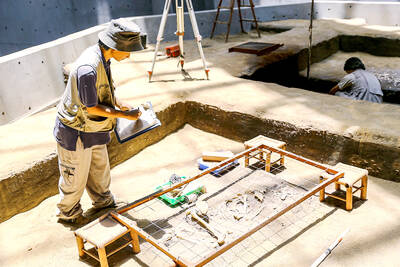
Writing of the finds at the ancient iron-working site of Shihsanhang (十 三行) in New Taipei City’s Bali District (八里), archaeologist Tsang Cheng-hwa (臧振華) of the Academia Sinica’s Institute of History and Philology observes: “One bronze bowl gilded with gold, together with copper coins and fragments of Tang and Song ceramics, were also found. These provide evidence for early contact between Taiwan aborigines and Chinese.” The Shihsanhang Web site from the Ministry of Culture says of the finds: “They were evidence that the residents of the area had a close trading relation with Chinese civilians, as the coins can be
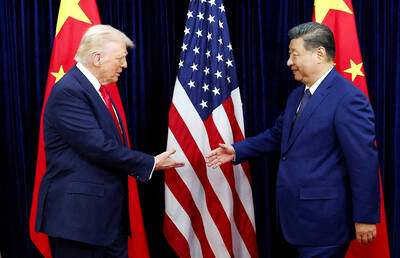
The March/April volume of Foreign Affairs, long a purveyor of pro-China pablum, offered up another irksome Beijing-speak on the issues and solutions for the problems vexing the People’s Republic of China (PRC) and the US: “America and China at the Edge of Ruin: A Last Chance to Step Back From the Brink” rang the provocative title, by David M. Lampton and Wang Jisi (王緝思). If one ever wants to describe what went wrong with US-PRC relations, the career of Wang Jisi is a good place to start. Wang has extensive experience in the US and the West. He was a visiting
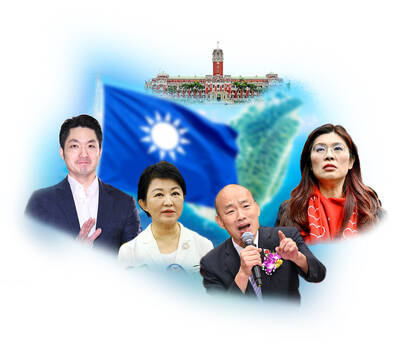
The January 2028 presidential election is already stirring to life. In seven or eight months, the primary season will kick into high gear following this November’s local elections. By this point next year, we will likely know the Democratic Progressive Party (DPP) candidate and whether the Taiwan People’s Party (TPP) will be fielding a candidate. Also around this time, the Chinese Nationalist Party (KMT) will either have already completed their primary, or it will be heading into the final stretch. By next summer, the presidential race will be in high gear. The big question is who will be the KMT’s


 RSS
RSS