


While the rest of the world has been on a binge of healthy eating, health food fanatics in Taipei have been clamoring for just one spot that serves healthy, plant-based food. MissGreen is exactly that, and it’s so healthy that you can eat as much as you want and probably never have to worry about an expanding wasteline. Hungry carnivores, however, might leave a little grumpy.
MissGreen is not going to thrill everyone. You’ve got to have a palate for healthy food to appreciate MissGreen, and locals have clearly caught on because it’s becoming harder to grab a seat. There are only about 20 chairs, made from reclaimed wood, in the modest space. The walls are adorned floor-to-ceiling with potted plants.
The temperature inside is quite warm, which is likely a better reflection of an earth-conscious and energy-saving business than poor ventilation. But for a business that prides itself on being eco-friendly, too much of the tableware is disposable — although I’ve recently seen the introduction of wooden plates and bowls so hopefully more will follow.
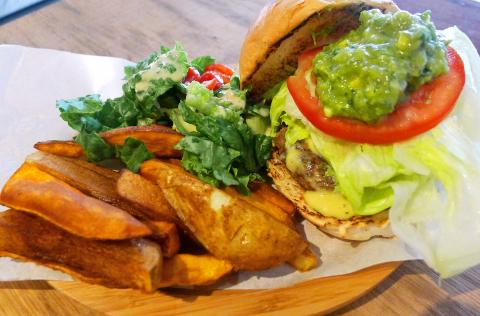
Photo: Olivia Wycech
While 100 percent vegan, the restaurant doesn’t try and trick you with food pretending to be something it’s not. Besides the trio of veggie burgers, the rest of the menu is a better reflection of Taipei’s bounty of farmers’ markets. The salads really focus on local and organic produce, with the MissGreen signature salad (NT$180/NT$220) being the most popular.
An array of greens comes topped with green beans and quinoa. The quinoa is slightly filled out with rice, perhaps understandable when you consider the price of quinoa on store shelves. The dressing on this signature dish is made with a pleasing combo of cucumber, onions and soymilk. Dressings vary from salad to salad and can be topped (NT$30) with quinoa, hummus, beans, roasted veggies or nuts. The larger option could be eaten as a meal.
Of the four wraps, I preferred the avocado power wrap (NT$200). The curry wrap (NT$180) didn’t have enough of a bona fide curry flavor. Both, unfortunately, were quite small and while they come with a side salad, didn’t fill me up.
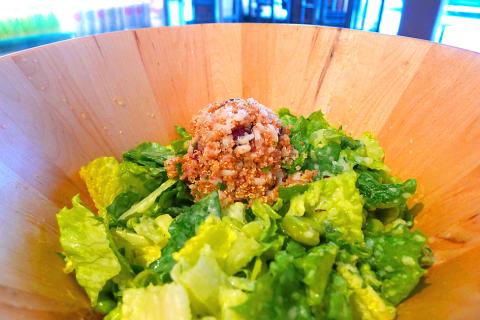
Photo: Olivia Wycech
The burgers on the other hand are just right and so good that I found myself constantly craving the deep-fried veggie burger (NT$300). It’s made from black beans and soy-beans, and the only difference between it and the MissGreen burger (NT$280) is that it’s deep fried (the other is pan fried), slightly more expensive and comes with guacamole. It comes with a small salad but the thick fresh-cut sweet potato fries make up for that. The buns are also vegan.
Juices, shakes and detox drinks can be added for NT$100 to any main course. The juices (NT$55 to NT$130) can be tailor-made for specific dietary needs.
On my first trip, I had the FillUp (NT$110) with wheatgrass but found it to be a bit watery for a green juice. The shakes, however, I order repeatedly.
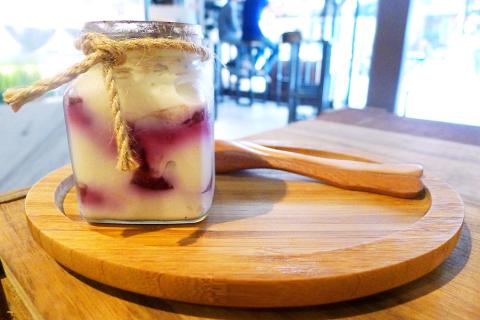
Photo: Olivia Wycech
The MissGreen banana (NT$160) is thick with bananas, soymilk, and the flavor of almonds — and nothing more. My friends ordered the MissGreen berries (NT$180) but were disappointed. I tried it, however, and thought it was exactly as advertised, berries in their true form. Organic teas, coffees, wine, beers and canned kombucha, a fermented drink (NT$120 to NT$300), are also available.
Sometimes, dessert is the best part of the meal. The luscious flavor of coconut cream is the foundation of the vegan and organic berries mousse (NT$170), which is also made with soy, and the natural sweetness of the white whip is perfectly balanced by the tartness of the berries. It seems they are now making it with mango, and the menu does change with the seasons. Hopefully, the clean eating trend continues to take off and more health food eateries follow.
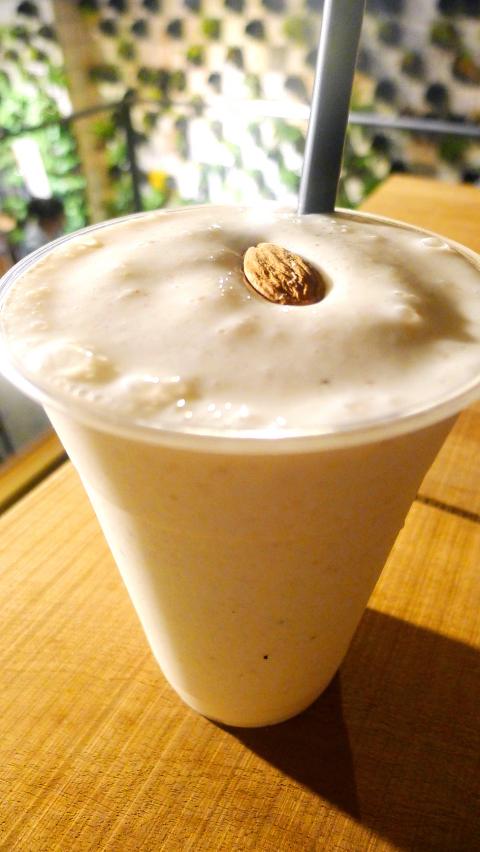
Photo: Olivia Wycech

Taiwan’s English education system is being pulled apart by three opposing forces. Bilingual Nation 2030 pulls students toward English and global communication. Artificial Intelligence (AI) readiness pulls them toward digital judgment, verification and AI-mediated work. But Taiwan’s old exam culture pulls them back toward memorization, grammar drills, timed reading and correct answers. If the education system keeps using old exams to define success, it risks producing graduates who are neither genuinely bilingual nor genuinely AI-ready, but trained for tasks machines can already perform. The first force is Bilingual Nation 2030. Launched in 2018, the policy aimed to “help Taiwan’s workforce connect
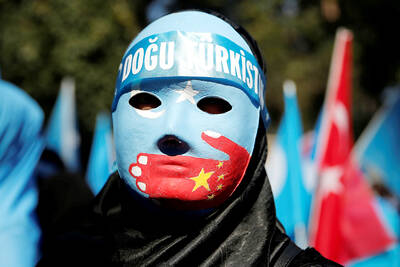
It seems every few days one bumps into one of those “real man” comments in which Taiwan is urged to “face reality” or similar, and “make a deal,” with the speaker implying that soon it will be too late. “Deal” advocates always present themselves as having a superior grip on reality, and the manly ability to make the “hard choice.” Their testosterone-laden language often echoes that of Taiwan sellout advocates. Note that such commentary always specifies a process (“make a deal, work with, make progress”), never the end state of what occupation by a violent authoritarian colonialist state will entail. In
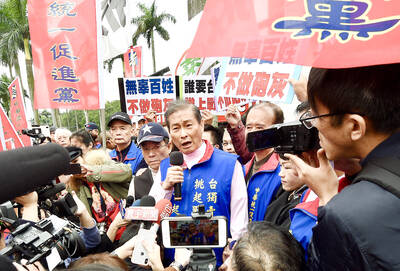
There are shadowy cabals plotting to sell out Taiwan to be annexed by China, by invasion if necessary. Fortunately, they are buffoons. In 2019, former Bamboo Union gangster and founder of the China Unification Promotion Party (CUPP), Chang An-le (張安樂, colorfully known as “White Wolf”), led a protest at the Legislative Yuan against comments made by then-premier Su Tseng-chang (蘇貞昌) that in the event of an attack by China, he would never surrender, but would protect the nation by fighting to the end, even if he only had a broom. Chang had party members bring a wooden casket that they
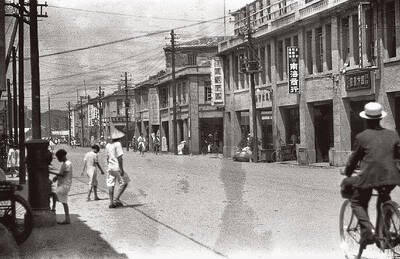
June 1 to June 7 "If all Taiwanese were as afraid of dying as you, then what would happen?” Physician Shih Chiang-nan (施江南) reportedly said this to his wife Chen Chiao-tung (陳焦桐) after she urged him to stop intervening on behalf of Taiwanese soldiers stranded overseas after serving in the Japanese Army during World War II. Shih had clashed with high-ranking officials over the issue, engaged in several heated arguments with Taiwan governor-general Chen Yi (陳儀) and allegedly shouted at general Ko Yuan-fen (柯遠芬), chief of staff of the Taiwan Garrison Command, over


 RSS
RSS