


Cambodia’s floating villages have adapted to the ebb and flow of Southeast Asia’s largest lake for generations, but modernization and a scarcity of fish are now threatening their traditional way of life.
Houses, schools, hairdressers and even dentists — entire communities bob around on the Tonle Sap, whose waters rise and fall dramatically with the seasons.
The huge lake, nourished by the mighty Mekong river, is home to hundreds of thousands of people eking out a simple — but for many rewarding — existence.
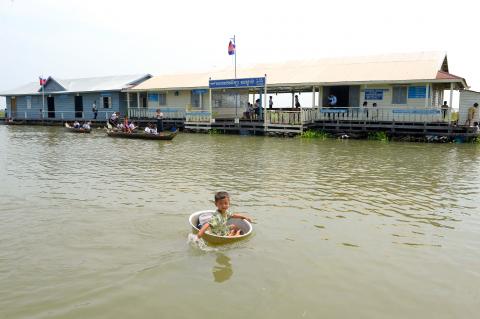
Photo: AFP
“Life in the floating village is much better,” said fisherman Sok Bunlim, who was born and raised in the lake community of Chhnork Trou, where fleets of canoes and small motorboats ferry people around.
The community of fishermen has been living atop the Tonle Sap since the time of their great grandparents, and many older residents cannot imagine any other life.
“If we move onto land, I wouldn’t know how to plant rice. I wouldn’t know how to plough. It is really hard,” Bunlim, 62, told AFP while repairing his broken net.
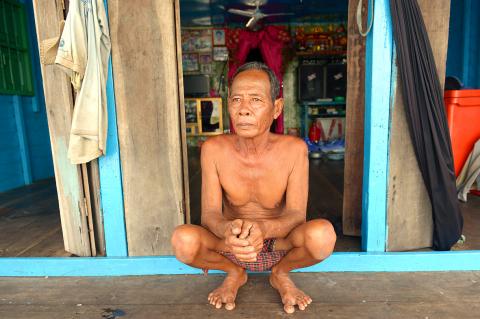
Photo: AFP
Modern life has not passed them by completely — nowadays many people have stereo systems, televisions and small motorboats.
But they still mostly depend on fishing or rowing around the village in canoes to sell food to earn a living.
The Tonle Sap is a source of sustenance and survival for more than one million people living on or around the lake, which has at least 149 species of fish, the Mekong River Commission (MRC) says.
It transforms between the dry and wet seasons, with the inundated area growing from about 3,500 square kilometers at its smallest to 14,500 square kilometers at the height of the floods, according to the MRC, a regional intergovernmental body.
The lake’s minimum depth rises from about half a meter in April to as much as nine meters in September and October.
So people living on the lake have to be ready go with the flow — quite literally — by allowing their homes to float.
Yet as fish stocks start to disappear, so too are the residents of the lake-top villages.
“I can’t catch enough fish,” said fisherman Yorng Sarath, 25.
“If the wind is calm, I can catch around five kilos of fish a day. When there is strong wind I can only catch around one kilo, and then I have to come back as I can’t lay out my net. I can’t earn enough money to last me all day.”
The father of two said that once he has saved enough money he plans to move to dry land to find work.
LANDWARD BOUND
Life on the lake does move with the tides of time but many modern luxuries are hard to come by, and for young people dry land can hold greater appeal.
Roughly 400 families — a fifth of the population — have left Chhnork Trou over the last couple of years in search of a better life on land, according to community leader Samrith Pheng.
“In the past there were a lot of fish so people wanted to live here. Now the fish stock is going down they can’t depend on the fishing,” Pheng said.
“The young generations such as my children and grandchildren don’t want to live in the floating villages anymore,” he added.
The lake yields about 200,000 to 218,000 tonnes of fish a year —nearly half of the total annual catch of inland fish for the whole of Cambodia, according to a 2006 estimate cited by the MRC.
More recent figures, as well as estimates of how much fish stocks have fallen, are hard to come by and much of the evidence is anecdotal.
Conservationists warn that human population growth, habitat destruction and upstream dams are also threats to the lake’s fisheries and wildlife.
In an attempt to prevent further depletion of stocks, the government in 2012 banned large-scale commercial fishing in the lake in a victory for local communities.
“We are working hard to improve fish stocks,” said Nao Thourk, head of the Cambodian government’s fisheries department, who estimates that about 1.5 million people fish on the Tonle Sap.
But illegal fishing — sometimes using electrocution — remains a major cause for concern.
“If we look at the magnitude of the fishing offences today, we don’t expect fish stocks to increase,” said Om Sovath, executive director of the Fisheries Action Coalition Team (FACT), which promotes sustainable resource management.
The exact number of people living in the floating houses on the lake is unknown, but officials and activists say tens of thousands of families call the bobbing villages home.
Yet beyond fishing or running a shop, job prospects are scarce, and with growing demands for a good education and better opportunities, the traditional way of life could become a thing of the past.
“I can’t say what the future holds for this floating community,” said fisherman Bunlim.
Ajay Verma, a consultant gastroenterologist at Kettering general hospital in Northamptonshire, says our gut is a “complex machine.” “It is constantly providing us with the nutrition we need, initially to grow and develop, and then for us to survive, thrive and repair from injury and illness.” How can we keep it functioning well? Put simply: “Make sure what you put into it is balanced, and that you clear out its waste products adequately,” Verma says. “In a general gastroenterology clinic, the most common conditions we see are irritable bowel syndrome (IBS), gastroesophageal reflux disease, inflammatory bowel disease and constipation,” says Nisha
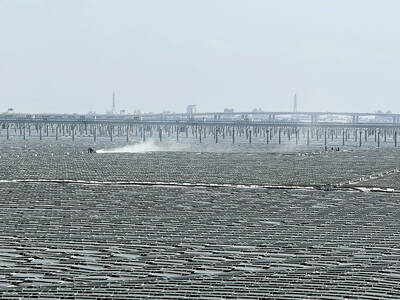
The arithmetic is straightforward and uncomfortable. By the end of 2025, Taiwan had committed itself to a 50-30-20 electricity mix — half natural gas, 30 per cent coal, 20 per cent renewables. The Ministry of Economic Affairs’s (MOEA) own monthly energy reports tell a different story. Natural gas reached 47.8 per cent of generation last year. Coal stood at 35.4 per cent, comfortably above its target ceiling. Renewables came in at 13.1 per cent, well short of the 20 per cent Taipei had pledged a decade earlier. Installed renewable capacity reached roughly half of the 12 gigawatts (GW) the government

Last week US President Donald Trump was asked by a reporter whether he would speak on the phone to the President of Taiwan. “l’ll speak to him. I speak to everybody. We have that situation very well in hand,” Trump said. This marked the second time in a couple of weeks he had said he would talk to the President of Taiwan. In 2016 he famously took a call from then-president Tsai Ing-wen (蔡英文), when he was president-elect. Despite warnings that the apocalypse was nigh because of a phone call, the world quickly forgot about the conversation between two democratically-elected presidents.
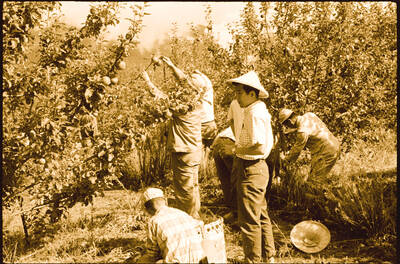
May 25 to May 31 Few believed that apples could be cultivated on a commercial scale in Taiwan’s high mountains. When horticulturalist Cheng Chao-hsiung (程兆熊) first proposed the idea in 1955, both American and Taiwanese colleagues dismissed it as implausible, arguing that temperate fruit could not be reliably grown on a subtropical island, especially on rugged terrain. However, it was this terrain in the Central Mountain Range where many Chinese Civil War veterans were resettled in the late 1950s. With limited job prospects and no family in Taiwan, they were placed on cooperative farms aimed toward self-sufficiency. Some say the conditions


 RSS
RSS