


On Nov. 30, tens of thousands of protesters brought a highly contentious issue out of the closet and into the public domain. They called on the government to oppose proposals that would in effect make same-sex unions in Taiwan legal, claiming that doing so would undermine traditional family values.
Amid this strong opposition, first-time documentary filmmaker Shane Hsiung (熊怡婷) documents what it means to be gay and Christian in The Pink Elephant (粉紅色大象), an interview-driven film based on discussions with people in her church group.
Hsiung has been going to the same church in Taipei for more than a year, attending Sunday services and group gatherings regularly.
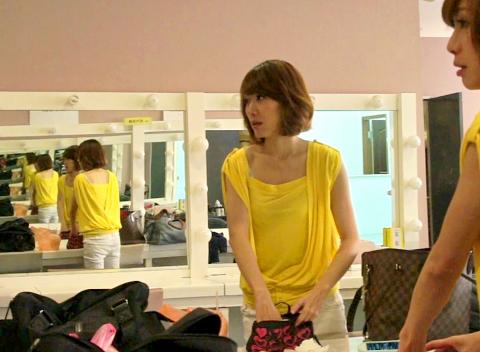
Photo courtesy of Shane Hsiung
“Even though the minister of my church opposes same-sex marriage, this is a tolerant church where we feel accepted,” Hsiung said.
THE ELEPHANT IN THE ROOM
Hsiung decided to film The Pink Elephant after signing up for a workshop on documentary film.

Photo courtesy of Shane Hsiung
“I know how I feel about being a lesbian and a Christian. I am curious about how others feel, about how they find peace and balance in Christianity,” she said.
The documentary has Hsiung’s church group discuss their faith, sexuality and emotional struggles in relationships.
Meanwhile, their group leader discusses the dilemmas she encounters leading them.
Other people in the 23-minute film include Hsiung’s girlfriend, who she took to attend the group meetings, and the group leader’s sister, who is a lesbian but not a Christian.
GROUP LEADER
Hsiung says she felt encouraged to film the documentary because of the leader of her church group, a full-time housewife and a volunteer at the church.
“She doesn’t judge us,” said Hsiung, adding that talking about what it means to be a lesbian and Christian only became possible in the group.
While other churches discourage homosexuals from joining, Hsiung says hers doesn’t.
“Someone in the group once said that if it were not for our group leader, she would have left the church. A lot of us share that thought,” she said.
Hsiung said she had planned to interview the church’s minister, who is aware of the group and what they discuss, but later backed out over fears of a public backlash. The church’s name doesn’t appear in this article or the film to protect the identity of the group members.
Hsiung says the minister’s rejection doesn’t affect her film because she believes it examines something beyond “gays fighting for their own rights” or “gay Christians pressured by the church,” which for her are conventional issues.
Even though the church opposes same-sex unions, Hsiung believes her faith lies in God, not the minister or church. Asked why she bothers to go to the church at all, she says it is a habit that she developed to nurture her faith.
ROAD TO FAITH
Hsiung’s church group meets once a week to study the Bible, discuss personal and life issues and pray. More than half of the 10 members are lesbians.
Hsiung hasn’t always been a Christian. She began attending services because she was attracted to a church member surnamed Lee (whose name has been changed to protect her identity). Through Sunday services and group gatherings, Hsiung started reading the Bible. When the church encouraged her to be baptized, she had one question in mind: Does God love homosexuals?
The night before the baptism, Hsiung called Lee to express her concerns.
“I told her that I wouldn’t start loving men after my baptism. It is just not possible,” Hsiung said.
Not knowing how to reply, Lee sought council from a church elder, who said intimate relations with members of the same sex are forbidden.
“That answer made no sense to me,” Hsiung said.
She went through with the baptism, however, because Lee convinced her that God loves everyone unconditionally. She later left the church to worship at the current church where the documentary was filmed.
When asked why she didn’t join the gay-friendly Tong-Kwang Light House Presbyterian Church (同光同志長老教會), Hsiung said she looked into it before but remains satisfied with her current church.
“I think identity, faith and emotional struggles are what we all share as a human being. Christians are a minority [in Taiwan], and so are homosexuals. I don’t want my film to only resonate with them,” Hsiung said.
For more details visit www.facebook.com/thehappinessproject.tw, or call Miss Chen, tel: 0935-094-369, for screening times.
Towering high above Taiwan’s capital city at 508 meters, Taipei 101 dominates the skyline. The earthquake-proof skyscraper of steel and glass has captured the imagination of professional rock climber Alex Honnold for more than a decade. Tomorrow morning, he will climb it in his signature free solo style — without ropes or protective equipment. And Netflix will broadcast it — live. The event’s announcement has drawn both excitement and trepidation, as well as some concerns over the ethical implications of attempting such a high-risk endeavor on live broadcast. Many have questioned Honnold’s desire to continues his free-solo climbs now that he’s a

As Taiwan’s second most populous city, Taichung looms large in the electoral map. Taiwanese political commentators describe it — along with neighboring Changhua County — as Taiwan’s “swing states” (搖擺州), which is a curious direct borrowing from American election terminology. In the early post-Martial Law era, Taichung was referred to as a “desert of democracy” because while the Democratic Progressive Party (DPP) was winning elections in the north and south, Taichung remained staunchly loyal to the Chinese Nationalist Party (KMT). That changed over time, but in both Changhua and Taichung, the DPP still suffers from a “one-term curse,” with the

Lines between cop and criminal get murky in Joe Carnahan’s The Rip, a crime thriller set across one foggy Miami night, starring Matt Damon and Ben Affleck. Damon and Affleck, of course, are so closely associated with Boston — most recently they produced the 2024 heist movie The Instigators there — that a detour to South Florida puts them, a little awkwardly, in an entirely different movie landscape. This is Miami Vice territory or Elmore Leonard Land, not Southie or The Town. In The Rip, they play Miami narcotics officers who come upon a cartel stash house that Lt. Dane Dumars (Damon)

Today Taiwanese accept as legitimate government control of many aspects of land use. That legitimacy hides in plain sight the way the system of authoritarian land grabs that favored big firms in the developmentalist era has given way to a government land grab system that favors big developers in the modern democratic era. Articles 142 and 143 of the Republic of China (ROC) Constitution form the basis of that control. They incorporate the thinking of Sun Yat-sen (孫逸仙) in considering the problems of land in China. Article 143 states: “All land within the territory of the Republic of China shall


 RSS
RSS