


There is something yesteryear about the labyrinth of ancient alleyways and smoke-filled temple entrances that crisscross Greater Tainan’s city center amid the chaos of jumbled colonial-era architecture. As if to complete the time-traveling illusion, giant hand-painted billboards depicting the silver screen’s latest offerings dominate the entrance outside the city’s immaculately maintained Chuan Mei (全美) cinema.
Nestled on a corner of the bustling Yongfu Road (永福路) — just a stone’s throw from the Official God of War Temple (祀典武廟) and close to the crumbling fort of Chihkan (赤崁樓) — the cinematic venue has been in operation for nearly 65 years. A traditional popcorn dispenser and a clunky ticketing machine lend additional authenticity to the cinema’s cozy art-deco entrance.
With a nearby sidewalk operating as his studio, Tainan native and sign-maker Yan Jhen-fa (顏振發) daubs thick globules of oil paint onto a meter-square panel. The 61-year-old’s paint-encrusted hands guide the brush as he finishes off a section of the canvas for a re-run of Life of Pi.

Photo: Sam Sky Wild
“I’ve been doing this for over 40 years,” Yan says without lifting his eyes from the giant canvas.
“When I was a little boy I used to see adverts for films in the newspaper and I instinctively began copying them. Back then sign-painters did everything … at that time we did all the advertisements.”
After pleading with an aunt to introduce him to a sign-painter, Wu left his rural village and made his way to the bright lights of Tainan.
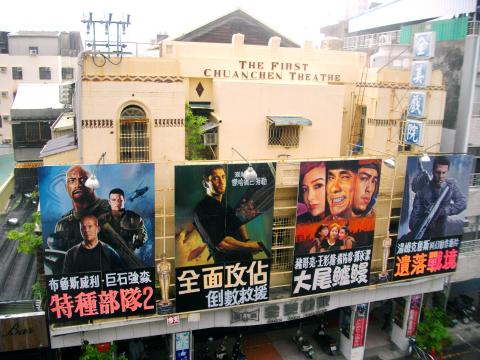
Photo: Sam Sky Wild
“It took me ten years until I could paint a complete sign,” says Yan who spent much of his youth as an apprentice in the trade.
Dying Art
As pedestrians sidestep Yan’s paint-splattered blanket and pots, he continues working yellows and reds into the section of the poster. It’s a laborious and detailed task.

Photo: sam sky wild
“Nowadays young people don’t want to do this kind of work,” explains Yan who teaches art and painting skills. “I teach students to draw but not like this — not so big. The problem is that you need a big space and you need lots of training and skill. Also, you are standing all day and it can be dangerous — you need to climb on the roof to mount the boards.”
Listening nearby, the cinema’s youthful general manager — and the facility’s third-generation owner — Wu Yu-tien (吳堉田) nods his head in agreement.
“This is our problem,” laments Wu, who says that when Yan decides to throw in the towel there is unlikely to be anyone to replace him.
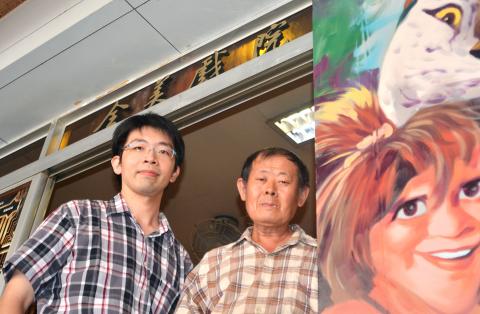
Photo: Sam Sky Wild
Traditional theater
Wu says that while there are commercial pressures to divide the cinema into smaller multiplex-style viewing units, his grandfather’s dream helps the family maintain focus.
“My grandfather had a dream and he insisted the movie theater has a big screen … this gives the audience a good view and it’s nicer when so many people laugh together.”
Wu is adamant that the cinema stays on track and says it is an important part of Tainan’s local community. “We want to show that we are local … we can help to keep this culture, this style alive … We just want to maintain our traditions.”
There are some tricks, concedes Wu, and that includes showing re-runs of popular films once the cost of the distributor’s film reels have dropped in price. The old-school establishment is also canny at attracting students and children, and during the summer break cartoons are shown throughout the day at discount prices.
Encouraging younger audiences to appreciate the experience of film-watching is important says Wu, especially if Taiwan wants to build its homegrown film-making industry.
“Hollywood films are still the most popular [screened at the cinema] because they have good marketing and promotion … But local films need to progress. Warriors of the Rainbow: Seediq Bale was good, but it was an exception.”
Surging interest
Recent figures from Taiwan’s Ministry of Culture verify Wu’s experience and show that in 2011 nearly one in five trips to the cinema nationally were to see Taiwan-made films — a total percentage boosted by the hugely successful historic drama Seediq Bale.
Between 2007 and last year Taiwanese cinema audience numbers have shown marked fluctuation: 2009 was a low point with a reported 505,880 cinema visitors whereas 2011 saw a staggering 5,967,392 tickets sold. Last year a relatively impressive 3,614,992 visits were made.
Taiwanese cinema audiences are very much moved by content with a national flavor, and this could help give the industry the boost it needs, according to Ellen Co (柯慧貞) from the Ministry of Culture’s Motion Picture Division.
“The first surge appeared in 2008, when the film Cape No. 7 by Wei Te-sheng (魏德聖) took the local box offices by storm. The film set the record for the best Taiwanese-made film in our film history and is regarded the starting point of the recent revitalization of local film industry.”
Yan has nearly completed the final panel and is preparing to put the last element of his four-piece pictorial jigsaw in place — a delicate operation involving joists, swings and a fair bit of sweat and toil.
Propping the completed canvas against a wall of the 450-seat cinema, Yan explains that the advantage of painting over a standard printed advert is that it allows for extra creativity.
“We can zoom in on one area of the image for example — with a brush you can paint and play with the image, add extra shadow and bring areas to life, for example.”
Yan — whose favorite film, both to paint and watch, was Raiders of the Lost Ark — says he has limited interest in modern CGI-soaked cinema. Like his hero Indiana Jones, Yan is a one-man operation and it would seem that the artisan will bow from the stage alone — taking his skills with him when he leaves.
For now though Yan quietly trundles on. “I remember once I painted a billboard with the actor Mok Siu-chung (莫少聰). He saw the image and really liked it. We didn’t take a picture so now it’s just a memory, but I love my job and have many good memories.” Yan scrapes a ball of yellow paint from under a nail and then begins to clear the pavement of his well-worn gear with another poster finished and another day drawing to a close.

Most heroes are remembered for the battles they fought. Taiwan’s Black Bat Squadron is remembered for flying into Chinese airspace 838 times between 1953 and 1967, and for the 148 men whose sacrifice bought the intelligence that kept Taiwan secure. Two-thirds of the squadron died carrying out missions most people wouldn’t learn about for another 40 years. The squadron lost 15 aircraft and 148 crew members over those 14 years, making it the deadliest unit in Taiwan’s military history by casualty rate. They flew at night, often at low altitudes, straight into some of the most heavily defended airspace in Asia.

This month the government ordered a one-year block of Xiaohongshu (小紅書) or Rednote, a Chinese social media platform with more than 3 million users in Taiwan. The government pointed to widespread fraud activity on the platform, along with cybersecurity failures. Officials said that they had reached out to the company and asked it to change. However, they received no response. The pro-China parties, the Chinese Nationalist Party (KMT) and Taiwan People’s Party (TPP), immediately swung into action, denouncing the ban as an attack on free speech. This “free speech” claim was then echoed by the People’s Republic of China (PRC),
Many people in Taiwan first learned about universal basic income (UBI) — the idea that the government should provide regular, no-strings-attached payments to each citizen — in 2019. While seeking the Democratic nomination for the 2020 US presidential election, Andrew Yang, a politician of Taiwanese descent, said that, if elected, he’d institute a UBI of US$1,000 per month to “get the economic boot off of people’s throats, allowing them to lift their heads up, breathe, and get excited for the future.” His campaign petered out, but the concept of UBI hasn’t gone away. Throughout the industrialized world, there are fears that
Like much in the world today, theater has experienced major disruptions over the six years since COVID-19. The pandemic, the war in Ukraine and social media have created a new normal of geopolitical and information uncertainty, and the performing arts are not immune to these effects. “Ten years ago people wanted to come to the theater to engage with important issues, but now the Internet allows them to engage with those issues powerfully and immediately,” said Faith Tan, programming director of the Esplanade in Singapore, speaking last week in Japan. “One reaction to unpredictability has been a renewed emphasis on


 RSS
RSS