

Fine vegetarian food is rare in Taipei, but there is artistry at work on the menu at Metro Bodhi. They have fashioned a plant-based menu that is homely yet elegant. The restaurant was started by a Buddhist organization in the belief that Buddhism does not have to be ascetic, but can be about living a full life and enjoying what it has to offer.
The restaurant is rather large with three floors for seating. It’s elegant but modestly decorated in a Buddhist fashion. Bronze statues and tea lights adorn the otherwise clean walls, creating a warm atmosphere amid plenty of literature and wines that are available for sale. The tableware is embellished with golden place settings and deep burgundy serviettes, which appear modest but still modern enough to give the restaurant a refined appeal. It resembles an upscale family restaurant.
The spicy tomato chickpea soup (NT$120) doesn’t pack much heat, but is well seasoned with herbs that give it an earthier taste than your classic tomato soup. There are three salads to choose from, my favorite being the fresh mozzarella, roasted garlic and red wine onion salad with Modena vinaigrette (NT$160 for a single serving, NT$320 for 2 to 3 people). Modena essentially means balsamic, so this salad has a dominant sweet Italian zing. If you prefer bitter flavors, try the chayote salad with grapefruit, mint olive oil dressing and aged white wine vinaigrette (NT$160 for a serving, NT$320 for 2 to 3 people). Chayote is similar to squash, but is more bland. Together, the components release a pungent yet refreshing burst of flavor on the palette.
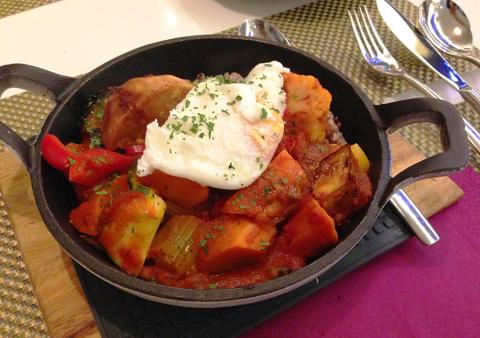
Photo by Olivia Wycech
From the appetizer menu, the goat cheese with avocado and banana dressing (NT$360) is highly recommended. It’s a small serving but worth every dollar. Diced avocado and creamy goat cheese sit atop a bed of sprouts, raisins and nuts, with a dollop of banana puree sweetened with honey, spiced with nutmeg and soured with white wine. The mushrooms with balsamic vinaigrette (NT$160) are nothing more than their description, but are sauteed until perfectly coated in a thick and not-too-sweet reduction.
The five slices of bread (NT$200) are a unique spin on a restaurant regular, as a variety of thick grains and spreads are served in a range from sweet to savory. The potato wedges (NT$100) are simple but worth ordering for the dip. A seriously strong jalapeno relish-type dip accompanies the spuds, which also comes as a side to the cumin bread sandwich (NT$280), which is topped with a poached egg and generous amounts of mozzarella cheese. The cumin was quite mild and was balanced nicely by a topping of creamed mushrooms.
The restaurant offers three sizzling pans, and both the menu and myself recommend the Ofeakwu (NT$295). In fact, it was my favorite item of the day and I immediately went home and tried to replicate this native Nigerian dish. Wild rice, various beans, seasonal vegetables and a poached egg are covered in a simple tomato sauce that makes it somewhat of a stew. The flavors are so wholesome and robust that even hardcore carnivores won’t complain.

Photo by Olivia Wycech
Metro Bodhi’s interpretation of pizza is more like a flatbread with toppings, which once again gives off more of an earthier taste. The lack of oil makes it drier than what you expect from pizza, but also means you can better taste the toppings like the explosive taste of pesto on the arugula pizza (NT$300). It’s perfect for those who enjoy the concept of pizza but usually pass on an oil-drenched deep-dish style.
There are a variety of fresh juices on the menu, like the cucumber juice (NT$120) and lemon juice (NT$150), but the real gems are the teas. The brown sugar galangal tea (NT$150 per cup, NT$200 per pot) tasted like your typical sweet milk tea but with an added zest of ginger. If milk tea is too heavy for you, the lemon-yogurt tea (NT$200 per pot) is more delicate with just a touch of creaminess. And for dessert, the cheesecake (NT$180) is what drew the most oohs and aahs. It’s creamier than most cheesecakes and has subtle hints of orange in every bite.
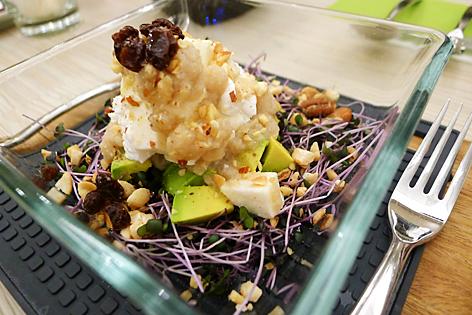
Photo by Olivia Wycech
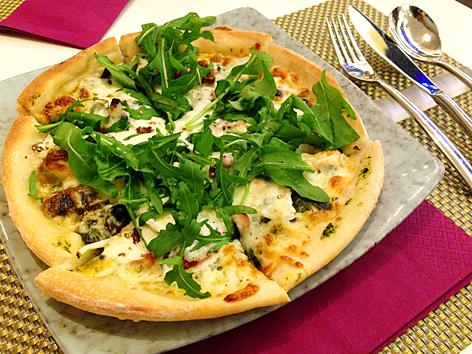
Photo by Olivia Wycech
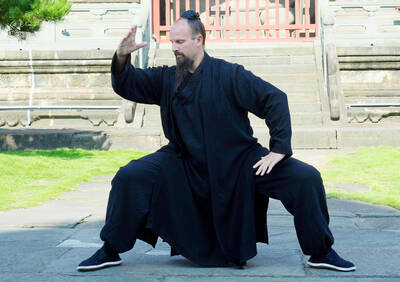
There was a time when Chinese master Yuan Shimao thought martial arts were all about punching and kicking. As a young practitioner, he focused on speed and strength. “I trained that way for many years without becoming still enough to search within myself,” said Yuan, who founded a kung fu academy in central China in 2004. “But as you gradually settle into stillness, you begin to understand what the scriptures mean by spirit,” he added. “You can begin to rediscover yourself.” That process is known as “entering the Dao” in martial arts. It is a guiding principle at Yuan’s academy in the sacred

Oct. 12 to Oct. 18 After 11 years in prison on Green Island, Yen Shih-hung (顏世鴻) was finally due for release when a camp guard asked him for NT$20,000 to help pay his bride price. Yen refused. The next day, officials deemed that he had “failed to improve his thinking” and ordered him to undergo further political reeducation on Siaoliouciou (小琉球), where prisoners were also subjected to forced labor. He spent another 19 months there before regaining his freedom in January 1964. Yen’s punishment stemmed from his joining the Taiwan Provincial Student Affairs Committee

Cognitive warfare, says the Ministry of National Defense (MND), is the People’s Republic of China’s (PRC) use of “political, economic, cultural, military and legal means, with the intent to divide internal unity and undermine social stability” in Taiwan. Last week offered several examples. PRC media in October last year reported that the Chongqing Municipal Public Security Bureau had opened an investigation into Democratic Progressive Party (DPP) Legislator Puma Shen (沈伯洋), the DPP’s mayoral candidate for Taipei in next month’s election, for “Taiwan independence” activities. This was a cognitive warfare ploy, designed to unsettle the targeted person and to establish the idea

As skyscrapers claw at the sky across the nation’s major cities, urban renewal efforts continue. Planners face a daunting environment. Nearly 60 percent of the housing stock is over 30 years of age, with Penghu, Yunlin and Chiayi counties exhibiting the highest average building ages, all over 40 years. In Taipei, 673,000 residences — over 70 percent of all homes — are over 30 years old, with an average age of 39.1 years. Taiwan’s shining office towers conceal a world of aging homes badly in need of replacement. Rising housing prices are killing more than just the future of Taiwan’s young.


 RSS
RSS