


Dream pop, post-rock and electronica wrapped up in a tightly woven package: Fans of Taiwanese indie pop couldn’t ask more of Feather River (羽毛河), the second album from We Save Strawberries (草莓救星).
The six-piece group, which formed in 1998, has long enjoyed a cult following for its picture-perfect indie pop sound. The mainstream has also taken notice — We Save Strawberries is one of the nominees for best band at this year’s Golden Melody Awards.
We Save Strawberries draws from the Beatles and British alt-rock in its sound, with songs mostly driven by electric guitars, drums and bass and adorned with sampled beats and synthesizers.

The band’s most alluring element is its siren and bandleader, Labi Wu (吳嘵萓). She has an icy cool, yet intimate, voice that slowly draws you in on tracks like Bus No. 11 and Plaque Youth (瘟疫青年).
Wu sings mostly in Mandarin, and at times it’s clear she has the knack for Mando-pop hooks, as on Something About You, a somewhat radio-friendly tune.
She avoids sounding saccharine, however, and is not afraid to get weird and edgy. Wu adopts a quivering voice, as if on the verge of a nervous breakdown, on Love Spender (白馬敗家子). This tune, sung in English, reads like a surreal dream that threatens to become a nightmare with its lyrics about heartbreak and jealousy, encapsulated by the line, “I can’t believe/I can’t believe/You kissed me yesterday/I can’t breath/I can’t breath/You kissed her tonight.” A native English speaker might find some of the lyrics nonsensical and grating, but Wu’s delivery hits the mood spot on.
We Save Strawberries saved the best for last on this album, almost to its detriment. The first half of the album doesn’t feel glued together: The first eight tracks stand well on their own, but it wasn’t until hearing Boom Your Ears (轟爆你的耳朵), a sparkling post-rock instrumental, that I felt charged with anticipation to hear more. The title track, driven by sampled beats and a violin-led melody, is a beautiful closer to the album.
— David Chen

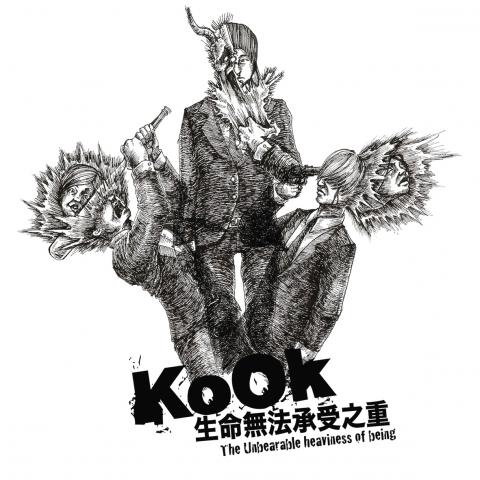
Grunge is alive and well, at least for the fans of KoOk (庫克樂團). This trio from Kaohsiung has been around in one form or another since 1999 and just released its second album of guitar-drenched rock, The Unbearable Heaviness of Being (生命無法承受之重).
There’s no irony intended with the album title, in case you’re looking for a Milan Kundera reference. Lead singer and guitarist Leslie Liang (梁智雄) means it on the title track when he sings, “The unbearable heaviness of being/is pressing down upon me/Can’t escape, I can only accept it” (生命無法承受之重/壓著我/無法逃開只能接受).
The song is filled with pure angst and smells a lot like Nirvana, right down to the guitar distortion and crashing drums. Grow Up (獨立世代) has a similar vibe.
Overall, though, KoOk doesn’t get too carried away with its adoration of Seattle-style rock. The band manages to sound original on tracks like the album opener, Super Distortion, a classic garage rock romp with a catchy chorus.
The subject matter of Unbearable revolves around alienation, anger and depression. But there are brighter moments such as the relatively upbeat, mid-tempo ballad Because of You and the acoustic guitar-driven My Boundless Sky (向下望的天空), one of the album’s strongest tracks.
In general, KoOK’s music lends itself to the sort of catharsis that some seek in heavy metal. The soaring, high-octane jams on tracks such as Silence (無聲世界) and Sense of Security (安全感) simply feel good to listen to, despite the sense of despair in the lyrics.
— David Chen
Get behind that computer, and jam. That’s what Unfamiliar Friends Party (不熟的朋友派對) — a group of four DJ hipsters armed with MacBooks, MIDI controllers and an electric guitar — have been doing for the past several years.
Their music has been described as video game soundtracks that you can dance to, and the six-song EP Headstrong (頭好壯壯) fits the description well. If you wish the 1980s had never ended, you’ll probably like this band.
On the opening track Young to Die, Unfamiliar Friends taps into a new wave dance groove. You can barely make out the lyrics sung by DJ Koko, as his smoothly delivered vocals sit underneath the mix, but it doesn’t really matter. A pumping techno beat is adorned with a kaleidoscope of beeping synthesizers and dirty-sounding electric guitar chords, and the mood is perfectly suited to a dance floor on a Saturday night.
Speed Dating sounds like something straight out of a 1980s Nintendo game, with its aquatic synthesizer riffs and heavily compressed snare drum snaps. Bamboo Run follows in the same vein, with a rousing organ melody that builds in drama toward the end.
For those not into dance music, Unfamiliar Friends will sound like they just recycle the same techno beats over and over again — thump, thump, thum-thum thump — but the fun is in how they dress up the groove.
— David Chen
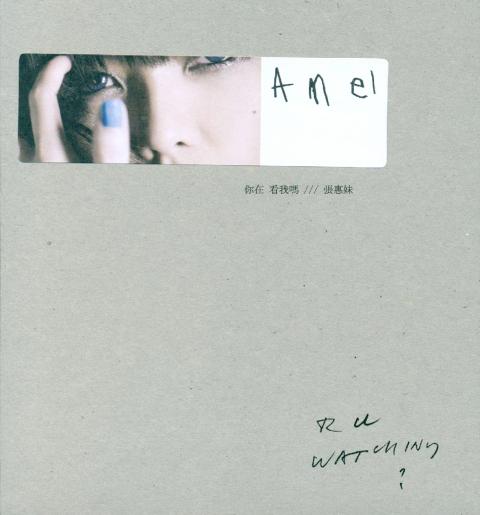
Although Mando-pop’s supreme diva Chang Hui-mei (張惠妹, better known as A-mei, 阿妹) has purportedly put her alter ego Amit (阿密特) on hold, Amit’s innovative spirit has apparently stayed with her. For with R U Watching? (你在看我嗎), A-mei continues to push the envelope.
The pop queen divides the album’s 10 tracks into two parts: the first all ballads and the second dance tunes.
The lead single What Times Is It (都什麼時候了) is by far the most fascinating ballad A-mei has released. The song features a stream-of-consciousness, feminist outcry against a lover’s misdeeds — the lyrics were penned by Hong Kong master lyricist Lin Xi (林夕), who was the designated lyricist for Faye Wong (王菲) albums — and moody chorus lines that sound more like a film score than a KTV pop hit. A-mei bravely jettisons the bel canto, soaring vocal style associated with her trademark Listen to the Sea (聽海) to adopt a jazzy, tension-fraught voice capable of expressing the song’s emotional theme.
In the third single, My Dear Beloved (我最親愛的), A-mei revisits the understated vocals and simple melodic lines reminiscent of the pastoral charm in her earlier hit Green Grass Until the End of Sky (芳草碧連天).
The album’s five ballads also achieve an edgy, metropolitan sensitivity unseen before in A-mei’s oeuvre.
A-mei has become confident enough in her abilities to discard her identity as a multi-octave songstress and instead use her impressive vocals to tell stories musically.
Although she still hasn’t established herself as a hip electronica queen in the league of Jolin Tsai (蔡依林), singles such as Thirsty (渴了) (also the theme song for her Coca-Cola ads) and High Character (High咖) see the pop diva excelling in synth-driven, retro-style dance anthems that should please her dance-hungry fans.
— Andrew C.C. Huang

Michael slides a sequin glove over the pop star’s tarnished legacy, shrouding Michael Jackson’s complications with a conventional biopic that, if you cover your ears, sounds great. Antoine Fuqua’s movie is sanctioned by Jackson’s estate and its producers include the estate’s executors. So it is, by its nature, a narrow, authorized perspective on Jackson. The film ends before the flood of allegations of sexual abuse of children, or Jackson’s own acknowledgment of sleeping alongside kids. Jackson and his estate have long maintained his innocence. In his only criminal trial, in 2005, Jackson was acquitted. Michael doesn’t even subtly nod to these facts.

Writing of the finds at the ancient iron-working site of Shihsanhang (十 三行) in New Taipei City’s Bali District (八里), archaeologist Tsang Cheng-hwa (臧振華) of the Academia Sinica’s Institute of History and Philology observes: “One bronze bowl gilded with gold, together with copper coins and fragments of Tang and Song ceramics, were also found. These provide evidence for early contact between Taiwan aborigines and Chinese.” The Shihsanhang Web site from the Ministry of Culture says of the finds: “They were evidence that the residents of the area had a close trading relation with Chinese civilians, as the coins can be

The March/April volume of Foreign Affairs, long a purveyor of pro-China pablum, offered up another irksome Beijing-speak on the issues and solutions for the problems vexing the People’s Republic of China (PRC) and the US: “America and China at the Edge of Ruin: A Last Chance to Step Back From the Brink” rang the provocative title, by David M. Lampton and Wang Jisi (王緝思). If one ever wants to describe what went wrong with US-PRC relations, the career of Wang Jisi is a good place to start. Wang has extensive experience in the US and the West. He was a visiting

The January 2028 presidential election is already stirring to life. In seven or eight months, the primary season will kick into high gear following this November’s local elections. By this point next year, we will likely know the Democratic Progressive Party (DPP) candidate and whether the Taiwan People’s Party (TPP) will be fielding a candidate. Also around this time, the Chinese Nationalist Party (KMT) will either have already completed their primary, or it will be heading into the final stretch. By next summer, the presidential race will be in high gear. The big question is who will be the KMT’s


 RSS
RSS