


With its wood and brick decor, dim chandeliers and an open kitchen, Galley Gong Bistro (ㄍㄚ ㄌㄧ ㄍㄨㄥ餐廳) comes across as a home away from home.
The restaurant, named after the Hoklo (commonly known as Taiwanese) phrase “Let me tell you” (我跟你講), serves what coproprietor and chef Hunter DiLeo describes as “French peasant cooking,” or “hearty staples.”
The menu changes daily according to whatever DiLeo brings back from his morning trip to the fresh food markets.
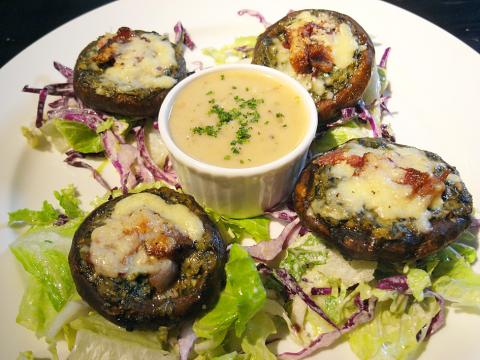
PHOTO: David Chen, Taipei Times
On recent visits over the past few weeks, selections have included penne served with chicken and a broccoli cream sauce (NT$550), panfried pork chops with “Mongolian” sauce (NT$550 for 8oz/NT$750 for 12oz) and grilled wahoo (NT$600), a type of mackerel with a mild-tasting white flesh similar to that of tuna.
Except for the pasta, main courses come with cooked vegetables such as fresh peas or zucchini, and garlic and leek mashed potato.
I’ve liked everything I tried, from the wahoo fish, which was marinated in citrus fruit juice, grilled and then baked, to the liver pate with applesauce chutney that was part of a tapas plate (NT$200). DeLeo also makes an excellent chili, which is NT$150 per bowl.
Galley Gong takes the open kitchen concept to heart. DiLeo works in full view and welcomes input from diners.
On a visit earlier this week, I chatted with the chef while watching him prepare my order of stuffed mushrooms (NT$500), which were filled with bacon, sauteed spinach, cheddar cheese and anchovies and served with a creamy white sauce.
DiLeo, a 32-year-old American expat who trained as a chef at L’Ecole Culinaire in St Louis, Missouri, says he holds “no secrets,” and believes his patrons “should know what they’re eating.”
He raved about fresh ingredients available at Taiwanese markets (“The pork here is outstanding”) and makes them the focus of Galley Gong’s main course menu. There are a few exceptions to his local produce mantra, though. He uses imported butter in his cooking, and lots of it. Then there are items like the Italian anchovies marinated in white wine and olive oil, but no complaints here — they added a brilliant touch to the stuffed mushrooms.
Don’t be discouraged if nothing takes your fancy on the menu. DiLeo says he tries to accommodate any off-menu requests if the ingredients are to hand.
Another big part of Galley Gong’s homey vibe comes from its bar, which is manned by coproprietor and manager, British expat Warren Hamilton.
Though the restaurant has only been open for several months, the spacious bar, made from a beautiful chunk of salvaged wood, gives the place a lived-in feel. Non-smokers need not fear as there’s a separate smoking room at the back of the restaurant.
House wines are NT$180 per glass and NT$900 per bottle. Beers on tap include Guinness Stout (NT$220 a pint, or 473ml) and Orion (an Okinawan brew, NT$180 for 510ml). As for imported bottled beers, there’s Ramblers’ Ruin Real Ale for NT$220 and three varieties of Samuel Smith for NT$250 each.
One minor quibble: The dining tables are too small to accommodate larger parties. On one visit, I dined with four people, and there was barely any room when all of our dishes arrived. You’re better off sitting at the bar in this case.
The kitchen is open from 5pm until 10pm, but DiLeo will stick around if you call ahead. For now, DiLeo and Hamilton make up the entire staff, but plan to hire waiters and open for lunch.
The restaurant is located in an alley off of Fuxing South Road, just north of Xinyi Road. There is no Web site yet, but Hamilton often posts the day’s menu on forumosa.com.
All in all, Galley Gong’s humble approach, honest fare and comfy atmosphere make it a perfect locale for those looking for a casual evening out.

Taiwan’s English education system is being pulled apart by three opposing forces. Bilingual Nation 2030 pulls students toward English and global communication. Artificial Intelligence (AI) readiness pulls them toward digital judgment, verification and AI-mediated work. But Taiwan’s old exam culture pulls them back toward memorization, grammar drills, timed reading and correct answers. If the education system keeps using old exams to define success, it risks producing graduates who are neither genuinely bilingual nor genuinely AI-ready, but trained for tasks machines can already perform. The first force is Bilingual Nation 2030. Launched in 2018, the policy aimed to “help Taiwan’s workforce connect

It seems every few days one bumps into one of those “real man” comments in which Taiwan is urged to “face reality” or similar, and “make a deal,” with the speaker implying that soon it will be too late. “Deal” advocates always present themselves as having a superior grip on reality, and the manly ability to make the “hard choice.” Their testosterone-laden language often echoes that of Taiwan sellout advocates. Note that such commentary always specifies a process (“make a deal, work with, make progress”), never the end state of what occupation by a violent authoritarian colonialist state will entail. In

There are shadowy cabals plotting to sell out Taiwan to be annexed by China, by invasion if necessary. Fortunately, they are buffoons. In 2019, former Bamboo Union gangster and founder of the China Unification Promotion Party (CUPP), Chang An-le (張安樂, colorfully known as “White Wolf”), led a protest at the Legislative Yuan against comments made by then-premier Su Tseng-chang (蘇貞昌) that in the event of an attack by China, he would never surrender, but would protect the nation by fighting to the end, even if he only had a broom. Chang had party members bring a wooden casket that they
June 1 to June 7 "If all Taiwanese were as afraid of dying as you, then what would happen?” Physician Shih Chiang-nan (施江南) reportedly said this to his wife Chen Chiao-tung (陳焦桐) after she urged him to stop intervening on behalf of Taiwanese soldiers stranded overseas after serving in the Japanese Army during World War II. Shih had clashed with high-ranking officials over the issue, engaged in several heated arguments with Taiwan governor-general Chen Yi (陳儀) and allegedly shouted at general Ko Yuan-fen (柯遠芬), chief of staff of the Taiwan Garrison Command, over


 RSS
RSS