


The aftermath of a death for friends and family is a topic ripe for pop psychology and easy tears. The response to suicide allows still more room for anguished browbeating and blame. Mia Hansen-Love’s The Father of My Children (Le Pere de Mes Enfants) does not succumb to these temptations, and reaches for a more profound wisdom that offers a deeper comfort but no answers about why a person should decide to take his or her own life. While loosely based on real people in the writer-director’s own circle, this is not so much a biopic but an existential meditation.
We are introduced to Gregoire Canvel, a busy film producer, in a long tracking sequence in which he walks and drives from Paris to his home in the country, almost continually on the phone, dealing, solving problems, even telling a white lie to his wife. He gets home to a family that he clearly loves, and which clearly loves him ... but work continues to intrude.
Unhurriedly, even as Canvel tackles the tasks of running a small but busy production house, we realize that his business is in trouble. Too much money is going out. We also learn about his love of cinema and his determination to support directors he believes in, whatever their commercial track record.
Canvel is a man comfortable in his professional skin, and it is easy for him to hide the mounting pressure from friends and family. Finally, almost suddenly, it becomes too much. He takes his own life.
The second half of the film deals with the fallout of this act, both professionally and personally. Everyone is appalled at the death, but this is balanced with personal feelings of those left behind, not least staff at his company who find themselves out of a job virtually overnight. The recrimination and anger that a husband and father could act in so selfish a manner are worked through by his wife and daughter, even as they figure out what to do with the production company that represented such an important part of Canvel’s life. In both halves of the film, The Father of My Children never forgets that life is not just about emotions,
but also about money, reputation and memory.
Canvel is portrayed as a man greedy for life, who lived it to the full both as a professional and a family man. At the core was a certain self-belief that drives all of us through the daily ups and downs of life, but when he felt that this had been irreparably hurt, he could find no way out. As his wife tells his angry and grieving children, daddy was so sad he forgot about us just for a moment. But in that moment, the whole world changed.
While The Father of My Children focuses on a single act of suicide, it is a film that is fiercely, almost defiantly, about life. Life with all its mundane business that shapes the person. It leads us not so much to sorrow over the misfortunes of others, but to reflect on what we value in life and how we might respond if it were taken away. While sensitive to the fate of its characters, the questions it poses are more philosophical than emotional.



What was the population of Taiwan when the first Negritos arrived? In 500BC? The 1st century? The 18th? These questions are important, because they can contextualize the number of babies born last month, 6,523, to all the people on Taiwan, indigenous and colonial alike. That figure represents a year on year drop of 3,884 babies, prefiguring total births under 90,000 for the year. It also represents the 26th straight month of deaths exceeding births. Why isn’t this a bigger crisis? Because we don’t experience it. Instead, what we experience is a growing and more diverse population. POPULATION What is Taiwan’s actual population?

For the past five years, Sammy Jou (周祥敏) has climbed Kinmen’s highest peak, Taiwu Mountain (太武山) at 6am before heading to work. In the winter, it’s dark when he sets out but even at this hour, other climbers are already coming down the mountain. All of this is a big change from Jou’s childhood during the Martial Law period, when the military requisitioned the mountain for strategic purposes and most of it was off-limits. Back then, only two mountain trails were open, and they were open only during special occasions, such as for prayers to one’s ancestors during Lunar New Year.
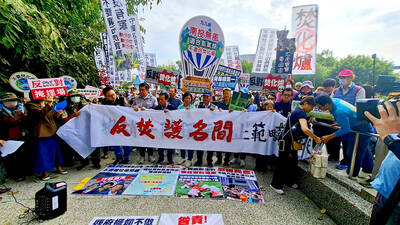
A key feature of Taiwan’s environmental impact assessments (EIA) is that they seldom stop projects, especially once the project has passed its second stage EIA review (the original Suhua Highway proposal, killed after passing the second stage review, seems to be the lone exception). Mingjian Township (名間鄉) in Nantou County has been the site of rising public anger over the proposed construction of a waste incinerator in an important agricultural area. The township is a key producer of tea (over 40 percent of the island’s production), ginger and turmeric. The incinerator project is currently in its second stage EIA. The incinerator

It sounded innocuous enough. On the morning of March 12, a group of Taichung political powerbrokers held a press conference in support of Deputy Legislative Speaker Johnny Chiang’s (江啟臣) bid to win the Chinese Nationalist Party (KMT) primary in the Taichung mayoral race. Big deal, right? It was a big deal, one with national impact and likely sent shivers down the spine of KMT Chairwoman Cheng Li-wun (鄭麗文). Who attended, who did not, the timing and the messaging were all very carefully calibrated for maximum impact — a masterclass in political messaging. In October last year, the Democratic Progressive Party (DPP)


 RSS
RSS