


Classical music can be “too serious” for Chang Kai-ya (張凱雅), who started studying piano at the age of four. This is one reason the 39-year-old pianist became interested in pop and eventually turned to jazz as a full-time profession.
Chang revisits her musical roots in a newly released album, Jazz Promenade, for which she adapted well-known pieces from classical composers such as Beethoven, Mendelssohn and Debussy for a jazz ensemble.
Chang, who teaches at Shih Chien University, says the album was inspired in part by her students. She noticed some of them were switching from classical music to jazz “because they think jazz is easy.” But this isn’t necessarily true, she said.
One common misperception among students of classical music and music teachers unfamiliar with jazz, says Chang, is that improvisation is merely “playing what you want to” and that there is little technique required in the genre. She points to Bill Evans, Chick Corea and Herbie Hancock as examples of accomplished jazz musicians who received extensive classical training.
“I want to tell everybody [with this album] that classical [music] is important and also, with classical, you don’t have to always be serious, like you’re at a concert hall,” she said.
As the title suggests, the album has a playful, relaxing feel, full of breezy Latin and be-bop grooves. A closer listen reveals familiar melodies, which many will have likely heard before, even if the names aren’t recognizable: Sunset in Bonn is Chang’s rearrangement of Beethoven’s Sonata Pathetique; German Garden lightens up Mendelssohn’s somber and brooding Violin Concerto with a snappy beat; Orbit brings a swing feel to Jupiter from Holst’s The Planets suite.
The work was co-produced by Chang and her husband and collaborator, violinist Hsieh Chi-pin (謝啟彬). The pair founded the annual Taipei International Jazz Festival in 2004,
an event that takes place every summer, as well as a summer jazz camp for aspiring
young musicians.
Chang and Hsieh devote much of their time to music education, and Jazz Promenade was designed in part to serve as a teaching tool with an accompanying book of musical scores. In addition to private lessons and their classes at Shih Chien University, the two are frequent guests at high schools across the nation, where they teach not only jazz, but also pop music appreciation.
Recently, they have also been sharing their ideas and teaching techniques with high school music teachers at a training center run by the Ministry of Education.
It is easy to imagine Chang and Hsieh engaging a classroom. Their faces light up when they talk about music of any style, be it jazz, rock or hip-hop. At a moment’s notice, they fluently scat, hum and beat-box a wide range of rhythms and melodies, often smiling and laughing as they do so.
More importantly, they have a knack for distilling abstract musical concepts into down-to-earth explanations. In talking about Chang’s new album, Hsieh mentioned how jazz chords can add particular “colors” to classical music pieces. I asked how they explained this to
non-musicians without getting too technical.
Without hesitation, Chang described what typical chords sound like: a major seventh chord feels “light.” A ninth chord is like “a little wind” blowing. A thirteenth chord sounds like a “truck” crashing through
the music.
Hsieh offered another metaphor: jazz chords serve the function of adding “spiciness” to a song. A musician chooses a chord according to how much “heat” is desired, whether it’s slightly spicy (xiaola, 小辣) or numb-inducing spicy (mala, 麻辣).
With the new album, Chang and Hsieh also hope to show that classical music and jazz both draw on the same set of skills.
“We tell our students that composing is slower improvisation on paper, and improvisation is instant composing that comes out of the mind directly,” said Hsieh. “But they’re both the same thing — constructing and composing ideas.”
Mashing genres together is nothing new for Chang and Hsieh, who also hold an occasional concert series at Riverside Cafe (河岸留言) called JACK, or “jazz plus rock,” in which they add jazz elements to well-known classic rock and pop songs. Their repertoire includes Led Zeppelin’s Immigrant Song, The Jackson Five’s Going Places and Ozzy Osbourne’s Iron Man.
“You can see a lot of imagination in her song arrangements,” said Riverside owner and veteran session guitarist Geddy Lin (林正如), who has played with Chang and Hsieh in the JACK series.
He praises Chang as a “passionate” and “unique” pianist and composer. “She can
take traditional source material and turn it into a jazz vocabulary, which makes things very interesting.”
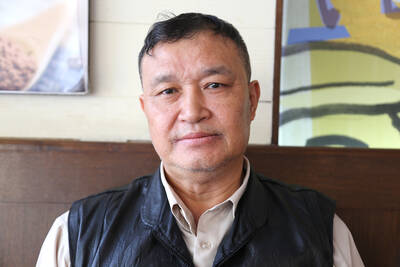
Taiwan has next to no political engagement in Myanmar, either with the ruling military junta nor the dozens of armed groups who’ve in the last five years taken over around two-thirds of the nation’s territory in a sprawling, patchwork civil war. But early last month, the leader of one relatively minor Burmese revolutionary faction, General Nerdah Bomya, who is also an alleged war criminal, made a low key visit to Taipei, where he met with a member of President William Lai’s (賴清德) staff, a retired Taiwanese military official and several academics. “I feel like Taiwan is a good example of
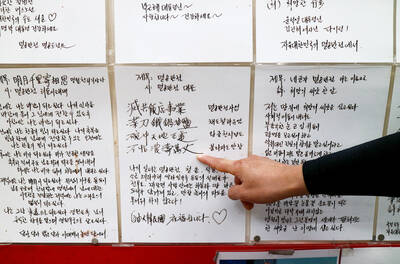
“M yeolgong jajangmyeon (anti-communism zhajiangmian, 滅共炸醬麵), let’s all shout together — myeolgong!” a chef at a Chinese restaurant in Dongtan, located about 35km south of Seoul, South Korea, calls out before serving a bowl of Korean-style zhajiangmian —black bean noodles. Diners repeat the phrase before tucking in. This political-themed restaurant, named Myeolgong Banjeom (滅共飯館, “anti-communism restaurant”), is operated by a single person and does not take reservations; therefore long queues form regularly outside, and most customers appear sympathetic to its political theme. Photos of conservative public figures hang on the walls, alongside political slogans and poems written in Chinese characters; South

Institutions signalling a fresh beginning and new spirit often adopt new slogans, symbols and marketing materials, and the Chinese Nationalist Party (KMT) is no exception. Cheng Li-wun (鄭麗文), soon after taking office as KMT chair, released a new slogan that plays on the party’s acronym: “Kind Mindfulness Team.” The party recently released a graphic prominently featuring the red, white and blue of the flag with a Chinese slogan “establishing peace, blessings and fortune marching forth” (締造和平,幸福前行). One part of the graphic also features two hands in blue and white grasping olive branches in a stylized shape of Taiwan. Bonus points for
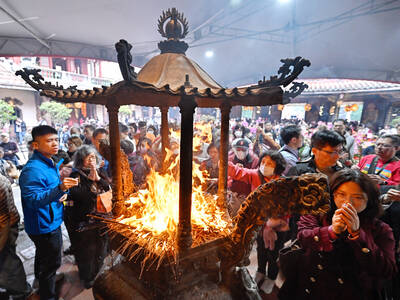
Taipei Mayor Chiang Wan-an (蔣萬安) announced last week a city policy to get businesses to reduce working hours to seven hours per day for employees with children 12 and under at home. The city promised to subsidize 80 percent of the employees’ wage loss. Taipei can do this, since the Celestial Dragon Kingdom (天龍國), as it is sardonically known to the denizens of Taiwan’s less fortunate regions, has an outsize grip on the government budget. Like most subsidies, this will likely have little effect on Taiwan’s catastrophic birth rates, though it may be a relief to the shrinking number of


 RSS
RSS