


One of the longest media stakeouts finally came to an end this week when photos of Andy Lau (劉德華) and Carol Chu (朱麗倩) holding hands hit the front pages of the Chinese-language tabloids. Chu has long been rumored to be Lau’s secret love, but the relationship had never been publicly acknowledged by either party. The image of Lau and Chu, hands firmly clasped, in Kuala Lumpur’s airport on their way back to Hong Kong, was one press photographers had been waiting to capture for 24 years.
The occasion of this revelation was the funeral of Chu’s father. To avoid disruption to the funeral, all references to Lau’s decades-long connection with the family were omitted from the event, but Lau, for reasons that are still unclear, decided that it was time for the secret to be conclusively let out of the bag, making his first public appearance as Chu’s partner.
Rumors of the relationship have long been present in the media, with many pointedly referring to Chu as Mrs Lau
(劉太太), although the couple have not married. Lau’s reluctance to have an acknowledged partner is closely linked with his image as one of the Chinese-speaking world’s biggest male sex symbols. Based on comments left on Lau’s many fan sites, it seems that fans have been overwhelmingly supportive of the star’s decision to give Chu what many regard as her rightful status.
Lau’s relationship with the media has never been easy given the huge interest his slightest action creates. Under pressure from Chu’s family to regularize the relationship, it was reported that Lau intended to marry Chu in April, even going so far as handing over a house worth more than NT$30 million as a dowry. Leaks to the press about the forthcoming nuptials angered Lau to such an extent that he called the marriage off, making the particularly hurtful comment that he wasn’t sure if he loved Chu enough to make the commitment of marriage.
Lau is not the only superstar who has worked hard to keep a long-standing relationship secret. Jackie Chan’s (成龍) relationship with Joan Lin (林鳳嬌) was only acknowledged quite recently (though they married in 1982), partly as a result of son Jaycee Fong (房祖名) emerging as a celebrity in his own right. In 2000, Taiwan’s own Jackie Wu (吳宗憲), who had long been thought to be single, was exposed as not only having a wife, but also four children, all of whom he had kept out of the media limelight. While both Wu and Chan were notorious for their numerous extramarital affairs, a situation that may have prompted their reluctance to open up about their domestic lives, Lau has never been strongly associated with any woman other than Chu. There is ongoing speculation as to whether Lau already has a child by Chu.
Meanwhile, A-mei (張惠妹), or rather A-mit (阿密特), as she is now known after the release of her new experimental album, is basking in the glow of success. Although struggling to hang on to a place in the wrong half of the Top 20, the announcement last week that her new album will be re-released with a number of cuts after the original was given an 18+ rating for the nudity and sexual content of the accompanying DVD, will give her plenty of kudos. The refrain “It’s bullshit” will be removed from the song Black Eats Black (黑吃黑) in the new edition. In compensation, a new song with Taiwanese lyrics will be added, capitalizing on the huge popularity of the Wu Bai (伍佰) inspired Come If You Dare (好膽你就來), which also features on the album. A-mei has clearly arrived as an artist pushing at the boundaries of the acceptable in Mando-pop, though watching the unexpurgated tracks on YouTube, it’s hard to see anything particularly transgressive, and A-mei’s take on female domination and sex as a power game is unlikely to shock anyone but a government censor.
In other music news, Sodagreen (蘇打綠) is hemorrhaging money in the making of its upcoming album Summer.Wild (夏.狂熱) after producer Will Lin (林暐哲) lost NT$900,000 in cash he was carrying while taking care of post-production in London. Hopefully the band will be able to make some of this money back in its concerts at Taipei Arena on Sept. 19 and Sept. 20.

It’s only half the size of its more famous counterpart in Taipei, but the Botanical Garden of the National Museum of Nature Science (NMNS, 國立自然科學博物館植物園) is surely one of urban Taiwan’s most inviting green spaces. Covering 4.5 hectares immediately northeast of the government-run museum in Taichung’s North District (北區), the garden features more than 700 plant species, many of which are labeled in Chinese but not in English. Since its establishment in 1999, the site’s managers have done their best to replicate a number of native ecosystems, dividing the site into eight areas. The name of the Coral Atoll Zone might
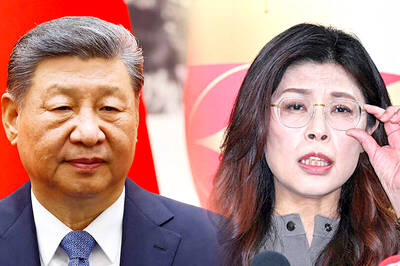
On Monday morning, in quick succession, the Chinese Communist Party (CCP) and the Chinese Nationalist Party (KMT) released statements announcing “that the Central Committee of the Communist Party of China and General Secretary Xi Jinping (習近平) have invited KMT Chairwoman Cheng Li-wun (鄭麗文) to lead a delegation on a visit to the mainland” as the KMT’s press release worded it. The KMT’s press release added “Chairwoman Cheng expressed her gratitude for the invitation and has gladly accepted it.” Beijing’s official Xinhua news release described Song Tao (宋濤), head of the Taiwan Work Office of the CCP Central Committee, as
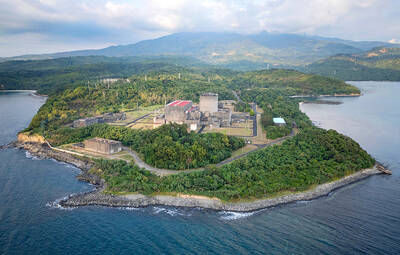
Nuclear power is getting a second look in Southeast Asia as countries prepare to meet surging energy demand as they vie for artificial intelligence-focused data centers. Several Southeast Asian nations are reviving mothballed nuclear plans and setting ambitious targets and nearly half of the region could, if they pursue those goals, have nuclear energy in the 2030s. Even countries without current plans have signaled their interest. Southeast Asia has never produced a single watt of nuclear energy, despite long-held atomic ambitions. But that may soon change as pressure mounts to reduce emissions that contribute to climate change, while meeting growing power needs. The
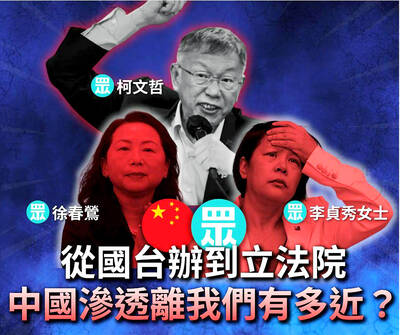
Last week saw Ko Wen-je (柯文哲), former Taipei mayor and founder of the Taiwan People’s Party (TPP), receive a 17-year sentence for crimes involving political corruption. This was only the opening round: the case is likely to drag on for several more years in appeals. Both the TPP and the Chinese Nationalist Party (KMT) are claiming that the prosecutors are engaging in a political witch hunt, green terror, fascism and so forth. It is easy to see this as a kind of compensation. After all, otherwise they would have to admit that the rather impressive collection of evidence against Ko actually


 RSS
RSS