


Busy day at work? No time to pick up a present for a friend’s birthday? You don’t need a secretary — just contact one of Taiwan’s thousands of errand runners. They will not only buy a tie for your dad, pick up a cake from the bakery, or line up for hours to secure a pair of limited supply Levi’s, but also sweep your deceased relative’s grave or even pose as a pseudo boyfriend to fool your parents.
In these tough economic times, errand running, a profession that began a few years ago in Taiwan, is a mushrooming business.
There are about 1 million people registered as errand runners in Taiwan and 10,000 active runners, according to the estimates of industry experts. Short-term work assignments, which usually pay NT$150 an hour, are helping many people survive the economic downturn.
“With the economy being bad, we’ve actually seen a higher demand for errand runners because companies want the cheapest cost, so they hire us instead of say a delivery company, which charges more,” said Lawrence Lee (李政達), founder of Parttime (跑腿幫), the first errand running group in Taiwan.
For no fee, anyone can register online to be an errand runner. If they want benefits entitling them to business cards and insurance against broken or lost items, they only need to pay a one-time fee of NT$1,000. There are no middlemen fees.
And all they need is a computer and access to Web sites where errand requests are posted. The first to reply to a customer’s online request usually gets the job.
The only job qualification is that one be flexible and punctual.
“In 2004 when we started this group, we had only a handful of members, now we have 30,000 members and about 3,000 active members,” said Lee, whose group is one of Taiwan’s biggest.
“This is a reflection of the economy,” Lee said.
Some of the errand runners had been laid off from factories, while others had been unable to find stable work for some time.
TWO BIRDS, ONE STONE
It’s a profession that allows them to make ends meet and kill time while continuing to look for a more stable job. They also get to meet a wide variety of people. Some tasks, such as waiting in line for an item, even allow errand runners to do other things at the same time, such as returning phone calls or writing music, as one of them is doing.
Chang You-wu (張耀五), 35, one of the best-known and most successful errand runners in Taiwan, manages to make NT$30,000 to NT$40,000 a month, which helps him and his wife pay their NT$20,000 a month mortgage.
His favorite job is lining up.
“The longest time I’ve lined up is 24 hours, for 12 days. It was for tickets for Taiwan’s pop band Mayday’s (五月天) concert last December. There were only 100,000 tickets available. I helped 100 people buy tickets. I could only run off for brief bathroom breaks, I couldn’t take showers, so I took a bottle of water to wash myself,” Chang said, adding that he made tens of thousands of NT dollars that time.
“To be a successful pao tui (跑腿) (Chinese name for errand running), the more you know, the more opportunities you have,” Chang said.
Most errand runners have no problems making at least NT$3,000 to NT$5,000 a month, while the average is around NT$20,000 per month, Lee said.
Lately, because a lot of people have been laid off or put on unpaid leave, and are consequently turning to running errands for a living, there has been increased competition for assignments and the profession is not as lucrative as it once was.
“It’s hard because there are too many errand runners and you must face the computer every day to catch the jobs,” said Chang.
One errand runner, Cheng Jun (程俊), a 29-year-old who used to work at a factory that has relocated to China, said he was unemployed for a year before he became an errand runner.
“This is unstable income, but as long as you’re willing, there are opportunities. Sometimes I make more than what I used to make in the factory,” said Cheng.
The biggest challenge is meeting customers’ various demands, Cheng said.
“Sometimes at 2am, they would like a pork rib takeout meal. If you don’t go out and get it for them, then next time they won’t call you,” said Cheng.
On a recent day, he waited in line all night for one client, slept for just three hours, and then got up to help another client paint an apartment.
“I don’t mind. I need to make more money because my girlfriend will give birth in August,” Cheng said.
Others are spying on the prices of their clients’ business rivals, looking for lost pets, representing busy clients at wedding banquets, burning incense at temples, going on blind dates to check out the other party, making doctor’s appointments, delivering
flowers, and showing up to sing Happy Birthday.
Errand runners are paid extra if they do difficult tasks such as waiting in line overnight.
The highest amount paid to an errand runner is reported by local media to be NT$1,200 an hour. However, that was an unusual case in which the errand runner rushed to deliver a forgotten item to their client at the airport.
Some assignments can be repetitive, such as dialing up a telephone number repeatedly to make an appointment with someone popular, such as a fortune-teller at a temple.
Lee believes this profession could one day result in a narrowing of the growing wealth gap in Taiwan because it allows low-income people with lots of time to trade their time for money without the hassles of traditional jobs.
“In traditional job markets, you have to go through job interviews and take tests and the middleman ends up taking a chunk of money from you. Without the need for a middleman or company, this allows people to make money easier and faster,” Lee said.
“If Taiwan can promote the errand economy, then Taiwanese society will be more normal. It will destroy the M-[shape] society [where the rich get richer, the poor get poorer and the size of the middle class decreases],”
Lee said.
Regardless of how rich the rich get, they still always need to hire people to help them because they have no time, Lee added.
“More and more people are hiring errand runners,” Lee said. “Whether it’s the middle of the night or in a rainstorm, the errand runners get the job done. People are very thankful.”
JOB SATISFACTION
For errand runner Cheng, the joy of the job is more valuable than the NT$30,000 to NT$40,000 he makes on average each month. For one of his assignments, he picks up and delivers prescriptions for people with chronic illnesses who are immobile and need medication regularly, but whose family members are too busy.
“They, especially the elderly people, are really happy to see a young person coming by to help them,” Cheng said. “It feels like I’m helping people, like I’m doing social work sometimes.”
Meanwhile Chang has grand plans.
“I want to make it international, to help the many people who need jobs. I want to set up a global errand running service in Singapore and mainland China,” Chang said. “To me it’s fun, makes money and helps people.”
Note: If you need an errand runner, post a request on www.parttime.com.tw.
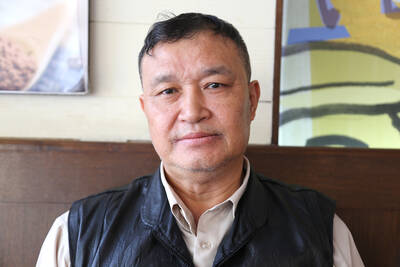
Taiwan has next to no political engagement in Myanmar, either with the ruling military junta nor the dozens of armed groups who’ve in the last five years taken over around two-thirds of the nation’s territory in a sprawling, patchwork civil war. But early last month, the leader of one relatively minor Burmese revolutionary faction, General Nerdah Bomya, who is also an alleged war criminal, made a low key visit to Taipei, where he met with a member of President William Lai’s (賴清德) staff, a retired Taiwanese military official and several academics. “I feel like Taiwan is a good example of
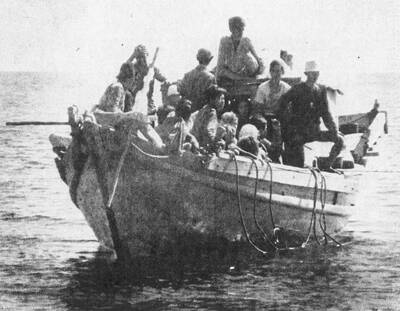
March 2 to March 8 Gunfire rang out along the shore of the frontline island of Lieyu (烈嶼) on a foggy afternoon on March 7, 1987. By the time it was over, about 20 unarmed Vietnamese refugees — men, women, elderly and children — were dead. They were hastily buried, followed by decades of silence. Months later, opposition politicians and journalists tried to uncover what had happened, but conflicting accounts only deepened the confusion. One version suggested that government troops had mistakenly killed their own operatives attempting to return home from Vietnam. The military maintained that the
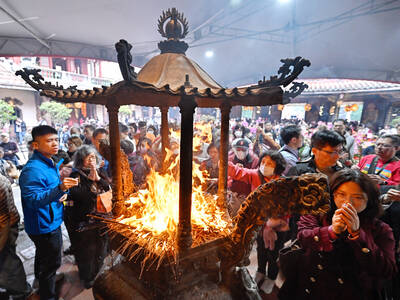
Taipei Mayor Chiang Wan-an (蔣萬安) announced last week a city policy to get businesses to reduce working hours to seven hours per day for employees with children 12 and under at home. The city promised to subsidize 80 percent of the employees’ wage loss. Taipei can do this, since the Celestial Dragon Kingdom (天龍國), as it is sardonically known to the denizens of Taiwan’s less fortunate regions, has an outsize grip on the government budget. Like most subsidies, this will likely have little effect on Taiwan’s catastrophic birth rates, though it may be a relief to the shrinking number of

Since its formation almost 15 years ago, Kaohsiung rock band Elephant Gym (大象體操) has shattered every assumption about contemporary popular music, and their story is now on screen in a documentary titled More Real Than Dreams. It’s an unlikely success story that says a lot about young people in Taiwan — and beyond. For a start, their sound is analog. In the film, guitarist Tell Chang (張凱翔) proudly says: “There is no AI in our sound.” His sister, bass player KT Chang (張凱婷) is the true frontwoman — less for her singing abilities than for her thunderous sound on the instrument. Fast like


 RSS
RSS