


It was one of those ghastly days — collapsing into bed at 4am after an official trip, up again too soon for a cabinet meeting on the economic crisis, and then an interview with a British journalist. When she arrives for our meeting, Yulia Tymoshenko, Ukraine’s prime minister and Europe’s second most powerful woman, has not even had time to produce the trademark peasant-style plait that normally hovers on her head like a halo: her hair is combed into a loose bun.
Tymoshenko first came to international attention during Ukraine’s so-called Orange Revolution in 2004. She and the pro-Western presidential candidate, Viktor Yushchenko, stood on the barricades for 13 days with tens of thousands of supporters demanding a re-run of elections. The supreme court decided there had been fraud and after a new election he became president and she prime minister.
But the two soon fell out, and Yushchenko sacked Tymoshenko in August 2005. Since then their long-running feud has been a major disappointment for the young people who put them in power, and the despair of foreign governments, EU officials and investors.
Appointed prime minister again after winning parliamentary elections in 2007, Tymoshenko now misses no opportunity to criticize her former ally for “purposely impeding the government’s work.” She is looking forward to the elections, due in January: “We will definitely run for president and we are bound to win,” she says.
She is ahead in the polls, but Ukraine’s economic woes have dented her ratings. The recession has hit eastern Europe very hard, and Ukraine and Latvia have suffered most of all. Sales of Ukraine’s main export, steel, are down by 40 percent. Real wages started to slip in December and by February were down by 13% from the year before. Unemployment is forecast to reach 10 percent — and this is probably an underestimate.
It has all come as a shock, especially to the country’s new middle class. The economy has been booming for five years and hundreds of thousands of them took loans to buy cars and flats in US dollars. But Ukraine’s currency, has now lost 40 percent of its value, and families will struggle to repay their inflated debts.
On top of that looms the constant crisis over gas. Ukraine hit the world headlines in January when Russia cut supplies owing to unpaid Ukrainian bills. Ukraine then cut supplies to much of the rest of Europe. Tymoshenko has made three trips to Moscow to resolve the crisis, the most recent one last week. Now she claims there is no chance of another cut-off “because we achieved a true breakthrough by concluding a contract with Russia for 10 years. We have completely removed any political implications from the gas price and gas transit calculation formulas. Ukraine has become dramatically more independent, both economically and politically.”
The woman once regarded in Moscow as an enemy (in Vladimir Putin’s early years in power there was an arrest warrant against her) is now seen as the Kremlin favorites. They like her role in balancing Ukrainians’ pro-EU aspirations with a keen sense of Russia’s interests and the need for co-operation, unlike Yushchenko “who never misses a chance to poke Moscow in the eye,” in the words of a European diplomat.
Even if the gas crisis is history, the wider economic crisis is ever present. Deadlock in the Ukrainian parliament meant that Tymoshenko had to use governmental decrees to pass various measures, including steeper taxes on tobacco and alcohol, to curb the ballooning budget deficit. Thanks to her tough approach, the IMF has agreed to release US$2.7 billion in a loan aimed at stabilizing the economy and restoring confidence. Analysts now see little risk of a total collapse of the economy, but recovery will be slow.
Was there a chance of street protests, I ask, an economic orange revolution? “In this newly democratic society if people are unhappy with something they have the right to take to the street — we respect this,” she says. “We have people protesting in front of government buildings and the government listens. But I would like the government and the people to stand tall. By taking to the streets we cannot eliminate the global economic crisis. We have to work hard.”
Sometimes dubbed the “gas princess,” Tymoshenko was typical of the first wave of capitalists in the dying months of the Soviet Union. A leader of the young communist league, the Komsomol, she took the route of many other colleagues in starting small businesses by privatizing Komsomol assets, in her case in her native Dnipropetrovsk, a steel town in eastern Ukraine. She and her husband (she married at 18) also copied videos in their living room and rented them out or sold them.
Thanks to her new capital plus good contacts, she became managing director of the grandly named Ukrainian Petrol Corporation in 1991, and four years later the president of United Energy Systems (UES), a company which imported Russian gas and sold Ukrainian products in Russia. She became a multimillionaire.
In 1996, she became a member of parliament for the party led by Pavlo Lazarenko whose government had awarded UES its main import license. He later left Ukraine to escape money-laundering charges, only to be convicted in California. In 1999 she founded her own party and emerged as a battler against corruption. Her zeal was rewarded with arrest in 2001 by the authoritarian regime of Leonid Kuchma for alleged fraud. She spent six weeks in jail, not knowing if it could be six or 16 years, until a judge ordered her release.
“Prison was a transformational experience. She came out a radical,” says Taras Kuzio, the editor of Ukraine Analyst. Now she portrays herself as the first person to fight corruption. “Ukrainians cannot help noticing that our 17 years of independence have not been a period of sustained reform. They are really only beginning now: profound reforms with respect to investment climate, pensions, and energy efficiency as well as efforts to improve the environment,” she says.
The constant battles between Yushchenko and the various prime ministers which followed the orange revolution have heightened calls for constitutional reform. The main opposition party led by Viktor Yanukovych, wants to move to a parliamentary system with a largely ceremonial president. Tymoshenko’s party is talking to them about the changes. This itself is a huge shift from 2004 when she and Yanukovych were on opposite sides of the barricades. Ukraine’s media is full of speculation that the constitution may be changed so that she remains as prime minister with Yanukovich as a weak president.
One element in a deal with Yanukovych, who is firmly against NATO membership, could be a shift in Tymoshenko’s support for joining the alliance. The Kremlin would be delighted. Ukrainian analysts suggest they could agree on a constitutional change saying Ukraine will keep its present “non-bloc status” rather than seeking to enter NATO. Diplomats say she has back-pedaled since demanding a “membership action plan” from NATO last year.
Ukraine can not live “in a security vacuum,” Tymoshenko tells me. But she highlights the obstacles to NATO membership — barely 20 percent support among the Ukrainian public, and division between Europe’s NATO members over the wisdom of getting Ukraine in. In the meantime Tymoshenko and her team are focusing on improving ties with the EU.
So, why no plait? “I got home at 4am and didn’t have time to produce it. I think women have to change their hairstyle from time to time.” Interviewers sometimes ask if its artificial or genuine. What’s the answer? “It is real.” Giggling, she fiddles at the back of her head, bringing down a Rapunzel-style cascade of blonde hair.
I make my excuses and leave.

Taiwan’s English education system is being pulled apart by three opposing forces. Bilingual Nation 2030 pulls students toward English and global communication. Artificial Intelligence (AI) readiness pulls them toward digital judgment, verification and AI-mediated work. But Taiwan’s old exam culture pulls them back toward memorization, grammar drills, timed reading and correct answers. If the education system keeps using old exams to define success, it risks producing graduates who are neither genuinely bilingual nor genuinely AI-ready, but trained for tasks machines can already perform. The first force is Bilingual Nation 2030. Launched in 2018, the policy aimed to “help Taiwan’s workforce connect

It seems every few days one bumps into one of those “real man” comments in which Taiwan is urged to “face reality” or similar, and “make a deal,” with the speaker implying that soon it will be too late. “Deal” advocates always present themselves as having a superior grip on reality, and the manly ability to make the “hard choice.” Their testosterone-laden language often echoes that of Taiwan sellout advocates. Note that such commentary always specifies a process (“make a deal, work with, make progress”), never the end state of what occupation by a violent authoritarian colonialist state will entail. In
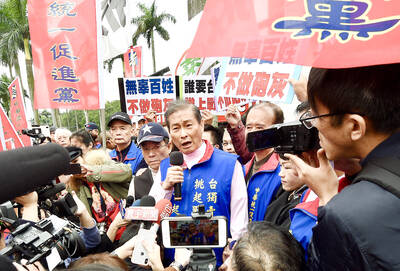
There are shadowy cabals plotting to sell out Taiwan to be annexed by China, by invasion if necessary. Fortunately, they are buffoons. In 2019, former Bamboo Union gangster and founder of the China Unification Promotion Party (CUPP), Chang An-le (張安樂, colorfully known as “White Wolf”), led a protest at the Legislative Yuan against comments made by then-premier Su Tseng-chang (蘇貞昌) that in the event of an attack by China, he would never surrender, but would protect the nation by fighting to the end, even if he only had a broom. Chang had party members bring a wooden casket that they
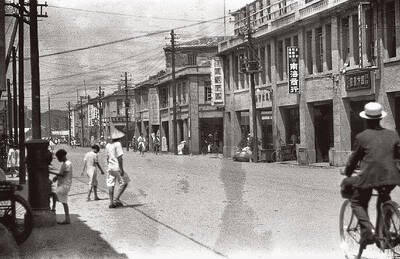
June 1 to June 7 "If all Taiwanese were as afraid of dying as you, then what would happen?” Physician Shih Chiang-nan (施江南) reportedly said this to his wife Chen Chiao-tung (陳焦桐) after she urged him to stop intervening on behalf of Taiwanese soldiers stranded overseas after serving in the Japanese Army during World War II. Shih had clashed with high-ranking officials over the issue, engaged in several heated arguments with Taiwan governor-general Chen Yi (陳儀) and allegedly shouted at general Ko Yuan-fen (柯遠芬), chief of staff of the Taiwan Garrison Command, over


 RSS
RSS