


Catherine Johnson is downing an energy drink that promises to provide “energy, stamina, focus and drive.” But does she really need any more? The playwright based in Bristol, southwest England, went from being a tearaway teenager, expelled from school after a stand-off with the headmaster over a revealing top, to the author of Mamma Mia!, one of the most successful musicals ever. Johnson also wrote the screenplay for the film version, which became the highest-grossing British movie of all time.
It’s a career trajectory most writers could only dream of. Yet Johnson, 51, with a glossy, chestnut bob and a warm, open manner, says she still sometimes gets out of bed feeling like a failure. “Every time I start a new work, I feel a complete lack of confidence,” she says. “It must be because I’ve had less years of being a success than I had of being a failure. For a lot of my life, I felt a complete letdown.”
Johnson left school with little to sustain her but poor exam results and a love of writing that had been encouraged by weekly visits, with her father, to the Bristol Old Vic theater. For years, it seemed that success as a writer was beyond her grasp. “Writing was the only thing I was good at,” she says, “but I also wanted to hang out with the bad boys. I had a good few years when I ran away from things and sometimes life ran away from me.” An early marriage ended in divorce; when another relationship broke up, she found herself a single mother in her 30s, barely able to afford nappies.
She was considering training to be a probation officer when another trip to the Bristol Old Vic — to see Jim Cartwright’s 1980s play Road, about northern English working-class life — changed her life. “I suddenly realized I could write about people like me, living real, messy lives,” says Johnson. She rushed home and, within two weeks, had written Rag Doll, a play about child abuse in a local family. It won an award and went on to be a success at London’s Bush theater. Other successes at the Bush followed. Then, in 1997, the playwright and director Terry Johnson, her sometime mentor, heard about a proposed musical based around the songs of Abba — and recommended Johnson to the show’s producer, Judy Craymer. Mamma Mia! was born.
Now Johnson’s back where it all started — at the Bristol Old Vic’s studio space, with a new play, Suspension, about a girl who is about to get married wondering if her special day can possibly be complete without the presence of her father, with whom she has never had any contact. The plot will sound familiar to the millions who’ve seen Mamma Mia!. But Suspension is rooted firmly in Bristol, where Johnson has lived all her adult life. Like many there, she was hit hard by the sudden closure of the Bristol Old Vic in summer 2007 — an act that put the future of the UK’s longest continuously producing theater in jeopardy (the main theater remains closed, awaiting major redevelopment).
“I was really emotional about it,” she says, “so when [board chairman] Dick Penny asked if I’d write a play for the theater, I said ‘yes.’ I was walking back over Clifton suspension bridge after meeting with him, and the play just popped into my head. From the bridge, you can see the Avon Gorge hotel, which is a popular venue for weddings; and I remembered that there had been a protest by aggrieved divorced dads on the bridge. Somehow the two came together. I wrote it quickly — as if I had a rocket up my ass.”
The success of Mamma Mia! may have brought Johnson financial security, but she still has her feet firmly on the ground. She admits to lying in the bath fantasizing about being whisked away to Los Angeles to be a feted screenwriter, but believes that staying in Bristol and fitting writing in around raising her children has had a beneficial effect on her work. “Of course, it has its downsides,” she says. “I’d like to be the one to write the big play about the recession, but the truth is I’m much more interested in everyday life, by the way we all just get by.”
Johnson still seems genuinely astonished by her good fortune, as if she had nothing to do with the success of Mamma Mia! Even now, she says she would never have been the first choice to write the screenplay if her contract had not demanded that she get a shot at it, and that she would almost certainly have been sacked if producer Judy Craymer hadn’t stood by her. Right to the bitter end, it was a fight with the studio to defend her and Craymer’s vision of a movie about “real older women who are overweight, over-stressed, drunk and needing each other.” She fought hard for the movie’s ending, in which all the cast return for one last exuberant number. The studio felt this was “cheesy wotsits with knobs on” that would only be seen by cleaners sweeping up popcorn. How wrong they were.
“Going to the red carpet premiere was fun,” she says, “but on those kinds of occasion, you’re always thinking your frock is too tight or your shoes pinch. Seeing it in the place where I grew up was much more fun. Everyone fantasizes about returning in a Rolls-Royce to the place that they left in failure. Well, seeing Mamma Mia! at a small local cinema was my Rolls-Royce moment.”

Taiwan’s overtaking of South Korea in GDP per capita is not a temporary anomaly, but the result of deeper structural problems in the South Korean economy says Chang Young-chul, the former CEO of Korea Asset Management Corp. Chang says that while it reflects Taiwan’s own gains, it also highlights weakening growth momentum in South Korea. As design and foundry capabilities become more important in the AI era, Seoul risks losing competitiveness if it relies too heavily on memory chips. IMF forecasts showing Taiwan widening its lead over South Korea have fueled debate in Seoul over memory chip dependence, industrial policy and
“China wants to unify with Taiwan at the lowest possible cost, and it currently believes that unification will become easier and less costly as time passes,” wrote Amanda Hsiao (蕭嫣然) and Bonnie Glaser in Foreign Affairs (“Why China Waits”) this month, describing how the People’s Republic of China (PRC) is playing the long game in its quest to seize Taiwan. This has been a favorite claim of many writers over the years, easy to argue because it is so trite. Very obviously, if the PRC isn’t attacking Taiwan, it is waiting. But for what? Hsiao and Glaser’s main point is trivial,
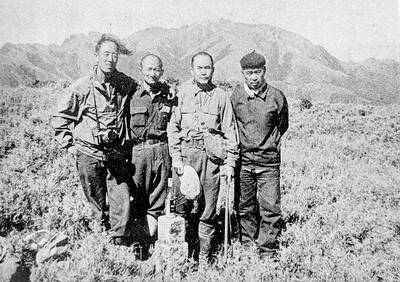
May 18 to May 24 Gathered on Yangtou Mountain (羊頭山) on Dec. 5, 1972, Taiwan’s hiking enthusiasts formally declared the formation of the “100 Peaks Club” (百岳俱樂部) and unveiled the final list of mountains. Famed mountaineer Lin Wen-an (林文安) led this effort for the Chinese Alpine Association (中華山岳協會). Working with other experienced climbers, he chose 100 peaks above 10,000 feet (3,048m) that featured triangulation points and varied in difficulty and character. The list sparked an alpine hiking craze, inspiring many to take up mountaineering and competing to “conquer” the summits. A common misconception is that the 100 Peaks represent Taiwan’s 100 tallest

And so, in the wake of US President Donald Trump’s trip to the People’s Republic of China (PRC), all the experts on the Strait of Hormuz suddenly became experts on US-China-Taiwan relations. The Internet has certainly expanded human knowledge. Lots of these sudden experts made noise this week about Trump’s words after the meeting with PRC dictator Xi Jin-ping (習近平). Trump is going to sell out Taiwan! Longtime Taiwan commentator J. Michael Cole summed the situation up neatly in the Guardian: “We need to keep in mind that he has a tendency to say many things — sometimes contradicting himself within


 RSS
RSS