


Jasper Huang (黃嘉祥) says his bovine sculpture expresses different aspects of Taiwan: the cow itself represents the country’s agricultural past, colorful embroidery draped over the cow’s back points to the work of its artisans, and the Swarovski crystals embedded in the cow’s hide symbolize the consumerism of its urban centers.
“Taiwan is a young country and I wanted my sculpture to reflect common symbols from the past until today,” said Huang, a 31-year-old who in 2000 took top honors at fashion design competition held by Elle Magazine.
Like Huang’s Who Is the Next Rocking Cowboy? (誰是下一個 Rocking Cowboy?), many of the other 108 life-size fiberglass cows scattered throughout Taipei as part of CowParade Taipei 2009 also address aspects of Taiwanese culture, art or society. Taipei is the second Asian city to host the public art exhibit, after Tokyo, which, according to organizers, has over the past decade seen more than 5,000 cows designed by roughly 10,000 artists attract half a billion viewers at five dozen exhibitions throughout the globe’s major cities.
Jerry Elbaum, president of the for-profit CowParade Holding Corp, said the cows have become a global art institution, partly because of their uniqueness and also because CowParade fosters art education. Each CowParade concludes with a gala during which selected cows are auctioned off to the highest bidder, events that have raised a total of US$25 million for charitable causes, Elbaum said. The Taipei auction will be held in April.
“Taipei is the finest CowParade that has [yet] been produced,” said the former attorney, who took courses on Chinese art history in college. “I have never seen an array of art that I have seen in this exhibit. It’s such a top level of perfection and creativity. I have yet to see a cow [in Taipei] that I didn’t like.”
But not everyone, it seems, loves the three-dimensional bovine canvases. From Madrid to Stockholm, the exhibit has seen its fair share of accidental damage, theft and vandalism — so much so that a “cow hospital” is now a part of many exhibits.
“It’s mostly vandalism,” Elbaum said before going through a litany of examples. During the New York exhibit in 2001, a group of pranksters were caught attempting to lift a cow into the back of a pickup truck in the early hours of the morning. In 2002 hooligans damaged cows in London’s Piccadilly Circus. Last year in Madrid several cows were completely destroyed.
When the exhibit appeared in Stockholm in 2004, a group called The Militant Graffiti Artists of Stockholm took the position that CowParade was not art and demanded that the company issue a statement saying so. “If we did not make a statement that CowParade was not art they would kidnap one of our cows and behead it,” Elbaum said with a grin. They gave him 48 hours to respond.
Elbaum refused and two days later a headless cow appeared in a popular shopping mall — an event that made headlines in the US. The sculptor reattached the head and the cow went on to command the highest price at the auction. “It wasn’t a particularly good piece of art,” Elbaum said, “but it had a good story behind it.”
Elbaum expects a certain amount of vandalism and general wear and tear in Western cities, but he is flabbergasted by the destruction that has been inflicted on the herd in Taipei. “Having been [to Taipei] a couple of times, I couldn’t have imagined seeing much damage to the cows,” he said. “People respect art here and they are not going to damage them. But it’s happened.”
The numbers are indeed startling. “About 50 to 60 percent” have been damaged, said Aaron Yu (游博霖), an account executive with Pilot Integrated Marketing (先勢公關), one of the Taiwanese firms organizing the event.
Qisada Design (佳世達設計團隊), an artist collective, affixed thousands of black and white keyboard keys to their cow to create The World in the Eyes of Technology (科技世界), which is located across from Taipei City Hall. Some of the keys have fallen off because parents encourage their children to climb the sculpture so they can snap photographs.
Artist Tsui Yung-yen’s (崔永嬿) creation, The Circus of Den-Den-Ciao-Jean (蹬蹬腳尖兒馬戲劇團之牛不懂馬戲), is located in the plaza outside a Fubon Bank branch on the intersection of Civil Boulevard (民大道) and Dunhua North Road (敦化北路). The cow is painted yellow with red flowers and topped with three circus performers. Tsui said the thumb of one character has been badly damaged and a decorative ring has gone missing. Twice. “I think it’s my design problem,” Tsui said. “It’s public art and artists should know that people are passionate and very excited about the cows ... It’s damage caused by excited children and parents wanting to take pictures.”
Tsui said she spent a lot of time looking at cows from other cities and discovered that Taiwanese artists have more of a tendency to embellish the three basic fiberglass templates — standing, reclining and grazing — with decorative details.
She thinks what makes the Taipei cows fine works of art is also what causes them to damage easily. “The cows in [Taipei] are more delicate because most ... are designed by artists,” she said. “Artists here look at [the cows] as works of fine art. We knew they were going to be put on the street but we didn’t imagine they would be damaged.”
Organizer Aaron Yu said Taipei residents, unlike the artists, see the cows as toys, not art. “They’re curious about the cows,” he said. “They rarely see this sort of [thing] and they think it’s an opportunity for them to play.”
However, he noted that “no cows have been stolen, lit on fire or seriously damaged,” and no act of vandalism has been reported.
And while CowParade Taipei doesn’t have its own “cow hospital,” there is a team of “doctors” who roam the city fixing damaged members of the herd.

Taiwan’s English education system is being pulled apart by three opposing forces. Bilingual Nation 2030 pulls students toward English and global communication. Artificial Intelligence (AI) readiness pulls them toward digital judgment, verification and AI-mediated work. But Taiwan’s old exam culture pulls them back toward memorization, grammar drills, timed reading and correct answers. If the education system keeps using old exams to define success, it risks producing graduates who are neither genuinely bilingual nor genuinely AI-ready, but trained for tasks machines can already perform. The first force is Bilingual Nation 2030. Launched in 2018, the policy aimed to “help Taiwan’s workforce connect

It seems every few days one bumps into one of those “real man” comments in which Taiwan is urged to “face reality” or similar, and “make a deal,” with the speaker implying that soon it will be too late. “Deal” advocates always present themselves as having a superior grip on reality, and the manly ability to make the “hard choice.” Their testosterone-laden language often echoes that of Taiwan sellout advocates. Note that such commentary always specifies a process (“make a deal, work with, make progress”), never the end state of what occupation by a violent authoritarian colonialist state will entail. In
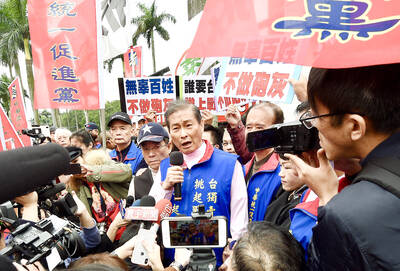
There are shadowy cabals plotting to sell out Taiwan to be annexed by China, by invasion if necessary. Fortunately, they are buffoons. In 2019, former Bamboo Union gangster and founder of the China Unification Promotion Party (CUPP), Chang An-le (張安樂, colorfully known as “White Wolf”), led a protest at the Legislative Yuan against comments made by then-premier Su Tseng-chang (蘇貞昌) that in the event of an attack by China, he would never surrender, but would protect the nation by fighting to the end, even if he only had a broom. Chang had party members bring a wooden casket that they
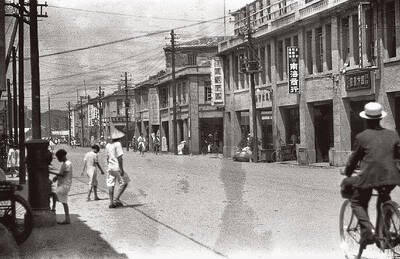
June 1 to June 7 "If all Taiwanese were as afraid of dying as you, then what would happen?” Physician Shih Chiang-nan (施江南) reportedly said this to his wife Chen Chiao-tung (陳焦桐) after she urged him to stop intervening on behalf of Taiwanese soldiers stranded overseas after serving in the Japanese Army during World War II. Shih had clashed with high-ranking officials over the issue, engaged in several heated arguments with Taiwan governor-general Chen Yi (陳儀) and allegedly shouted at general Ko Yuan-fen (柯遠芬), chief of staff of the Taiwan Garrison Command, over


 RSS
RSS