


“When you go see a magician … it’s not what they do but how they do it within a particular constraint. I think if anything, a poem above all is a performance.”
So said Steve Bradbury over a glass of red wine at a restaurant on Yong Kang (永康) Street. The lanky National Central University (國立中央大學) English professor with a penchant for silk shirts is passionate about poetry. You feel it in the range of poets he peppers his anecdotes with and the support he lends to events such as the Taipei Poetry Festival, which is being held this week.
“For most poems,” he continued, “if you summarize what they say, they are often saying very conventional things: ‘I love you,’ or ‘you’re a shit’ or ‘I’m so sad you’re dead.’ A lot of poems have very conventional themes and topics so most poems are a sort of performance on an established theme.”
Bradbury edits Full Tilt (fulltilt.ncu.edu.tw), an online journal devoted to promoting contemporary East Asian poetry, translation and art forms such as painting, film and graphic novels. More than anything else, however, the journal’s mission is to expose East Asian poets to an international audience through translations that are faithful not just to the meaning of the poem but their sound and feel in the pleasure of the reading moment.
The journal has published interviews about process of translation with translation bigwigs such as Howard Goldblatt (Chinese), John Nathan (Japanese) and Michael Berry (Korean), and some of Asia’s finest contemporary poets such as Taiwan’s Hsia Yu (夏宇), China’s Yu Jian (于堅) and South Korea’s Kim Hyesoon — the latter two of which will read at this year’s Taipei Poetry festival (go to www.taipeipoetry.org for details in English and Chinese).
Creating interest
A poetic translator in his own right, Bradbury can often be found in a coffee shop close to Da-an Forest Park (大安森林公園) pouring over a volume of poetry or translating a poem. In addition to publishing numerous translations in literary journals, Bradbury has published three volumes of poetry in translation, the most recent of which is Feelings Above Sea Level: Prose Poems From the Chinese of Shang Qin, which is available at Tang Shan bookstore (唐山書店).
He first came to Taiwan in 1983 to improve his conversational Mandarin after receiving a bachelor’s degree in Chinese from San Francisco State University, where he studied under Goldblatt, the preeminent translator of contemporary Chinese fiction, who inspired him to become a translator and encouraged him to go to Taiwan.
After a year-and-a-half in Taipei, Bradbury moved to Japan to improve his Japanese. He worked as a translator and editor until he returned to the US in 1987 for graduate studies, obtaining a master’s in Chinese and a doctorate in English from the University of Hawaii.
“When you translate a poem from a contemporary writer and publish it in a journal you are in competition with every other poet in the world and there are fabulous translators and fabulous poets in Europe in the Middle East and Latin America. I think it’s very important to translate for the reader because we have to create interest,” he said, explaining his approach to translating from Chinese to English.
Bradbury feels that East Asian poetry doesn’t have much of a following because scholars are often too concerned with explaining the poem rather than generating a readership for it.
“You can translate for Chinese [academic] journals and get published, but who’s reading it?” he said. Moreover, with few exceptions, Western scholars of East Asian poetry are mainly interested in teaching and translating classical poetry. “Translators of contemporary European poetry [for example] … balance readability with scholarly accuracy and they generate a real readership, not just students,” he noted.
He added that there is little institutional support in Taiwan for poetry — in contrast to the US where contemporary poetry appears on the syllabi of most literature courses and there are hundreds of creative writing programs. In the latter, students attend workshops where they are expected to read “tonnes and tonnes” of poetry and literary theory and critique each other’s writing. As a result, there has been a kind of “poetry renaissance” in the US over the past decade.
“Perhaps only one of every 25 creative-writing graduates in the US [will find work in a university]. But this person will be able to make a living out of it ... The universities are not only supporting the writing of poetry but they also have poetry journals and poetry publishers,” he said. “But not here.”
The good old days
The lack of institutional support for poetry in Taiwan, Bradbury said, is largely a recent phenomenon.
“Before the liberalization of the media, every newspaper in the country was 12 pages long and one whole page was devoted to literature, a portion of which was poetry. Some of the poets of that era such as Yu Guangzhong (余光中) are still household names. And they would be invited to give talks in universities.” For “[t]he younger generation, if you are writing a poem, you don’t have any support, beside the literary competitions that United Daily News (聯合報) and a few other newspapers hold once or twice a year,” he said.
“To be sure, there are still plenty of Chinese-language journals burning a candle for local poetry, but most are dedicated, by and large, to advancing the careers of frumpy septuagenarians, who may have been stellar poets in their day but are hardly up to the task of galvanizing younger generations of readers accustomed to a steady diet of the Apple Daily (蘋果日報), cable television and the World Wide Web,” he said later in an e-mail exchange.
Of course, Bradbury isn’t suggesting a return to Martial Law. But he believes Taiwan’s academic system has failed to nurture creative writing.
Bradbury said that without events like the current poetry festival, “poetry wouldn’t even make the obituary column.”
A little too pessimistic, it seems. The festival enjoys a high profile, particularly since the addition of cinema to the program, a phenomena increasingly common in East Asia.
“Films have been a part of the festival since Hung Hung (鴻鴻) started curating it three years ago, in part as a marketing strategy to draw in younger people, but also because many of the best poets writing in Chinese today, Hung Hung among them, are in fact filmmakers,” Bradbury said.
“I’ll probably get shot for saying this, but if it weren’t for Hsia Yu, Hung Hung and a handful of other poets associated with the Poetry Now (現在詩) coalition, we could all pack up and go home,” he said.
Perhaps, but Bradbury is doing his part to keep Taiwan’s bards in the public eye.

Taiwan’s English education system is being pulled apart by three opposing forces. Bilingual Nation 2030 pulls students toward English and global communication. Artificial Intelligence (AI) readiness pulls them toward digital judgment, verification and AI-mediated work. But Taiwan’s old exam culture pulls them back toward memorization, grammar drills, timed reading and correct answers. If the education system keeps using old exams to define success, it risks producing graduates who are neither genuinely bilingual nor genuinely AI-ready, but trained for tasks machines can already perform. The first force is Bilingual Nation 2030. Launched in 2018, the policy aimed to “help Taiwan’s workforce connect
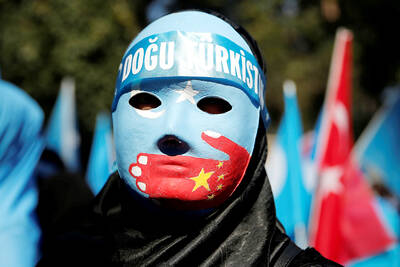
It seems every few days one bumps into one of those “real man” comments in which Taiwan is urged to “face reality” or similar, and “make a deal,” with the speaker implying that soon it will be too late. “Deal” advocates always present themselves as having a superior grip on reality, and the manly ability to make the “hard choice.” Their testosterone-laden language often echoes that of Taiwan sellout advocates. Note that such commentary always specifies a process (“make a deal, work with, make progress”), never the end state of what occupation by a violent authoritarian colonialist state will entail. In
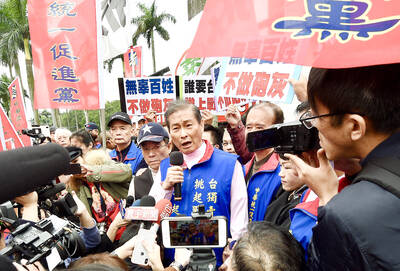
There are shadowy cabals plotting to sell out Taiwan to be annexed by China, by invasion if necessary. Fortunately, they are buffoons. In 2019, former Bamboo Union gangster and founder of the China Unification Promotion Party (CUPP), Chang An-le (張安樂, colorfully known as “White Wolf”), led a protest at the Legislative Yuan against comments made by then-premier Su Tseng-chang (蘇貞昌) that in the event of an attack by China, he would never surrender, but would protect the nation by fighting to the end, even if he only had a broom. Chang had party members bring a wooden casket that they
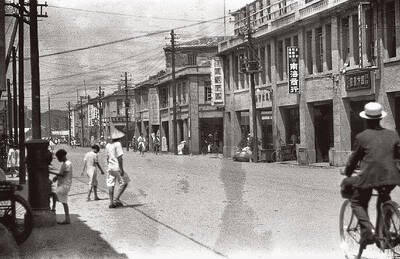
June 1 to June 7 "If all Taiwanese were as afraid of dying as you, then what would happen?” Physician Shih Chiang-nan (施江南) reportedly said this to his wife Chen Chiao-tung (陳焦桐) after she urged him to stop intervening on behalf of Taiwanese soldiers stranded overseas after serving in the Japanese Army during World War II. Shih had clashed with high-ranking officials over the issue, engaged in several heated arguments with Taiwan governor-general Chen Yi (陳儀) and allegedly shouted at general Ko Yuan-fen (柯遠芬), chief of staff of the Taiwan Garrison Command, over


 RSS
RSS