


“Next time you come, it will be better, God willing,” says Yasser Herbawi, the 76-year-old owner of the first and only Palestinian keffiyeh factory. It’s hard to see how. Last year, the distinctive black-and-white checked scarves became a surprise global trend, knotted around the necks of the most fashion-savvy. At the same time, the family-run company that produces this symbol of the Palestinian national struggle has been slowly grinding to a halt.
“It’s the Chinese imports,” explains Yasser, sitting amid piles of keffiyehs at the Herbawi factory storeroom, just outside Hebron in the West Bank. “In the 70s we could barely keep up with demand, but by the mid-90s cheap Chinese scarves started coming in, because of globalization and GATT.” Yasser’s sons Abdel Atheem, 50, and Judeh, 43, nod in agreement and curse the trade tariff-busting deal. “We were forced to lower our prices and today we are working to a fraction of our capacity because we cannot compete.” The factory used to produce more than 1,000 scarves a day, but now makes less than 100 — and struggles to sell those. A shutdown seems almost inevitable.
Needless to say, the Herbawi family isn’t much enamored with the cheap imports that first swamped and then stole their market. “They are not the same quality,” says Yasser as he picks up a keffiyeh and spreads it across his knees, reverently feeling the light, dimpled cotton between his fingers. “Our product is better, much better. We take care of it and use only natural products, and it is beautiful.” This textiles factory, which Yasser started 40 years ago, supplied the entire West Bank and Gaza — orders for scarves, robes and jackets, all fashioned from the same check, would also arrive from neighboring Arab countries. Of course, the company creates much more than a specific cotton weave. “We are making the symbol of Palestine,” says Yasser. “This scarf is the history and the heritage of our country.”
The black-and-white square keffiyeh is Syrian in origin and is the head garment of choice for traditional, rural Arab males of a certain age. It was the 1930s Arab revolt against the British Mandate and Zionist organizations in Palestine that first established the scarf as a resistance symbol: it was worn in solidarity, and to make it difficult for the authorities to weed out orchestrators of the rural-led uprising. By the 1960s, the scarf became emblematic of the nascent Palestinian national movement — it was the favored headwear of the Palestinian leader Yasser Arafat and habitually worn by other symbols of the Palestinian resistance such as Leila Khaled. Then a red-and-white Jordanian version surfaced, taken up by Palestinian Marxists to differentiate themselves within the wider nationalist movement. More recently, its meaning changed again: “The Marxists in Palestine have all but disappeared and the ones who replaced them are the Islamists,” explains Samir Awad, political scientist at the West Bank’s Bir Zeit university. “Now it’s the Hamas guys who put on the red-and-white, just because they don’t want to be associated with Fatah.”
Around the Middle East, traditional, rural Arab men do still wear the keffiyeh, in the traditional way — as a headpiece, with the aqal ring holding it in place. But Awad says that these days, it is less widely used as a neckwear nationalist emblem by the younger generation of Palestinians. He provides one possible explanation: “The image of the keffiyeh as a symbol of resistance was tarnished by events in Afghanistan and Iraq, where it is used by terrorists, by anyone who wants to hide their face,” he says. “It is very annoying, but there is no monopoly on the keffiyeh.” The common appearance of the keffiyeh in suicide bomber videos has doubtless caused the two concepts to fuse in the minds of some observers.
For some years now, the keffiyeh has carried activist-chic credentials for anti-war protesters and supporters of the Palestinian cause across several continents. But it is more recently that the scarves have gained their full fashion stripes. “We noticed club kids were wearing them about a year-and-a-half ago,” says Melanie Rickey, fashion news director at Grazia magazine. “They were dyeing them fluorescent colors, and it was seen as a bit risque.” Picking up on the trend, Balenciaga brought out a designer keffiyeh last summer. “What did they do, smother it with gold?” asks Abdel Atheem at the Herbawi factory when he hears of its US$5,553 price tag. “If I tried to sell the scarves for US$18, nobody would listen,” says Yasser of the product, which gets a local market price of around US$5.50. “And ours is the real thing.”
The designer endorsement was a bit like the Midas touch — high street stores such as Topshop and American Apparel were soon churning out “black-and-white woven cotton” scarves for roughly the same sum that Yasser laments would cause his customers to turn a deaf ear. “After a while people just thought, ‘These are nice scarves,’” says Rickey, “so that by this time last year, every teenage girl from London to Scotland had one.” The keffiyeh as fashion item might now be on the wane, but Rickey thinks that the popular neckpiece started a paradigm-shifting trend — a retailer’s dream scenario: it took the scarf out of a winter-wardrobe context and into the realm of all-year-round accessory. “The fastest selling accessory is the summer scarf,” she explains. “Some stores carry 30 to 40 different patterns — customers just can’t get enough of them.”
The high street has moved on from the black-and-white weave; Rickey says the current hot stock is glitter-thread-shot hippy scarves. Such faddishness is what makes it tough to interpret the craze for keffiyehs as ideological expression or act of Palestinian solidarity — in fact, fashion scarf-wearers often confess to being clueless over the politics of the checkered fabric. Still, that didn’t stop the trend being read as inflammatory and insulting in some quarters. Earlier this year, American Apparel pulled its line of “anti-war woven scarves,” which had been a bestseller, after receiving complaints. “Due to the sensitive nature of this item, we will no longer offer it for sale,” the company announced. “We apologize if we offended anyone, this was by no means our intention.”
In May, Dunkin’ Donuts pulled one of its online adverts because Rachael Ray, the celebrity chef that featured in it, was wearing a fashionably knotted keffiyeh. Slamming the scarves as “jihadi chic” and “hate couture,” popular American blogger and columnist, Michelle Malkin, one of the key campaigners against the black-and-white checks, wrote: “Fashion statements may seem insignificant, but when they lead to the mainstreaming of violence — unintentionally or not — they matter.”
Whatever the intention, the global surge in sales has had no impact on the fortunes of the ailing Herbawi factory. The textiles company does not export and, even at a local level, foreign competitors are holding sway. In the market stalls of Jerusalem’s Old City, a Hebron factory-made keffiyeh is a rare sight among the scarves on sale to tourists. “For sure, I prefer the local product,” says market vendor Saleh abu Ghazela, who stocks the Herbawis’ new line of pastel multi-colored checks alongside Chinese versions of the traditional color combination. “But very few customers care about the quality or ask where the scarf comes from, and I have to cater to the market’s demands.”
All of which explains why most of the looms aren’t even switched on at the Herbawis’ factory. Fifteen machines used to operate daily for 18 hours, but now only one section of the vast factory is lit and just four clacking looms turn giant reels of thread into long flats of cloth. A factory technician moves between them, snipping rogue strands and making constant adjustments to the weave. “He has been our employee for 40 years,” says Judeh Herbawi, of their last remaining staff member. “It is because of him that we stay open.” Beyond this square of light, rows of grand machinery emblazoned with the label “Suzuki Loom” stand silent in the shadows, swathed in thick, yellow factory dust. Old swatches of keffiyeh fabric are still stretched out upon these once industrious machines — and underneath the powdery dust, the distinctive pattern so symbolic of the Palestinian national cause has all but faded away.

Yesterday, the Democratic Progressive Party (DPP) nominated legislator Puma Shen (沈伯洋) as their Taipei mayoral candidate, the Chinese Nationalist Party (KMT) put their stamp of approval on Wei Ping-cheng (魏平政) as their candidate for Changhua County commissioner and former legislator Tsai Pi-ru (蔡壁如) of the Taiwan People’s Party (TPP) has begun the process to also run in Changhua, though she has not yet been formally nominated. All three news items are bizarre. The DPP has struggled with settling on a Taipei nominee. The only candidate who declared interest was Enoch Wu (吳怡農), but the party seemed determined to nominate anyone
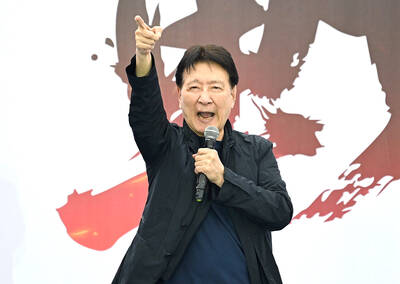
In a sudden move last week, opposition lawmakers of the Chinese Nationalist Party (KMT) and Taiwan People’s Party (TPP) passed a NT$780 billion special defense budget as a preemptive measure to stop either Chinese leader Xi Jinping (習近平) or US President Donald Trump from blocking US arms sales to Taiwan at their summit in Beijing, said KMT heavyweight Jaw Shaw-kong (趙少康), speaking to the Taipei Foreign Correspondents Club on Wednesday night in Taipei. The 76-year-old Jaw, a political talk show host who ran as the KMT’s vice presidential candidate in 2024, says that he personally brokered the deal to resolve
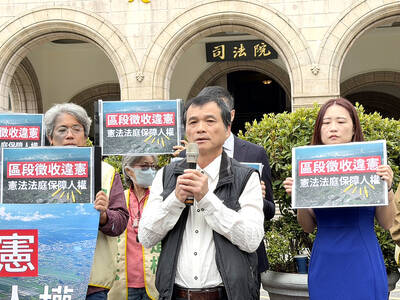
What government project has expropriated the most land in Taiwan? According to local media reports, it is the Taoyuan Aerotropolis, eating 2,500 hectares of land in its first phase, with more to come. Forty thousand people are expected to be displaced by the project. Naturally that enormous land grab is generating powerful pushback. Last week Chen Chien-ho (陳健和), a local resident of Jhuwei Borough (竹圍) in Taoyuan City’s Dayuan District (大園) filed a petition for constitutional review of the project after losing his case at the Taipei Administrative Court. The Administrative Court found in favor of nine other local landowners, but
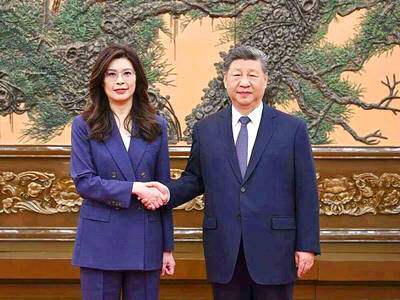
The Chinese Nationalist Party (KMT), alongside their smaller allies the Taiwan People’s Party (TPP), are often accused of acting on behalf of the Chinese Communist Party (CCP). Some go so far as to call them “traitors.” It is not hard to see why. They regularly pass legislation to stymie the normal functioning of the ruling Democratic Progressive Party’s (DPP) administration, and they have yet to pass this year’s annual budget. They slashed key elements of the government’s proposed NT$1.25 trillion (US$40 billion) special military budget, and in the smaller NT$780 billion package they did pass, it is riddled with provisions that


 RSS
RSS