


Instrumentalists of the National Symphony Orchestra (NSO) like working under the internationally renowned conductor Gunther Herbig for two reasons, I gather. One of them is that he has a natural authority on the podium that makes them give of their best. The other is that, when he stops the orchestra in rehearsals, he invariably puts his finger on what’s wrong. The musicians understand this because as often as not they too know what the particular problem is in advance.
Herbig has recently been appointed the NSO’s Artistic Advisor and Principal Guest Conductor until 2010, and is currently in Taiwan to conduct three concerts. The first of these takes place in Taipei’s National Concert Hall this afternoon.
When I spoke to him earlier this week I began by asking him where he spent his youth. Internet sites had disagreed, I found, one stating it was the former East Germany, the other the former Czechoslovakia.
“Both are correct in essence,” Herbig replied. “I was actually born in what is now the Czech Republic. But we were Germans and my family later moved to East Germany where I was brought up.”
Born in 1931, Maestro Herbig was able to move to the West in 1984. Was that difficult, I asked.
“We managed it because I had permission to conduct in Western Europe and the US. But how to get our three children out was the problem. Eventually we managed it, but we were unbelievably lucky. Without the help of the US government I believe it never would have been possible.”
He first visited Taiwan in 1991, he told me, with the Toronto Symphony Orchestra. They played two concerts in the National Concert Hall. Then last year he was invited to conduct two programs with the NSO, and at around that time was asked if he would be interested in the post of Musical Director. Because of other commitments he found it impossible to accept, but agreed to the idea of advising on the whole NSO program and visiting three times a year to conduct. He’ll be here again in December, and then in late spring 2009.
“So far virtually all I’ve seen of Taiwan is my hotel room and this concert hall,” he said.” But I’m looking forward to getting to know Taiwan’s incredible cultural heritage of Chinese art and culture during the times I’m here.”
I asked what the NSO’s strengths were.
“The orchestra has a very high standard,” he said. “It possesses what I call a professional quality — a determination to be as good as possible.”
Didn’t that apply to all orchestras, I asked.
“No,” replied Herbig. I couldn’t help smiling, but thought it was better to leave it at that.
“The NSO has a young spirit,” he continued. “They’re enthusiastic, and they already have a wide repertoire.”
They had a Composer in Residence, he added — David Chesky, the only American jazz composer ever to have been nominated for a Grammy Award in the Best Contemporary Classical Composition category. He should certainly widen the orchestra’s horizons.
I next asked about musical life for classical musicians in the US and Europe.
“Standards are very high in the US,” Herbig said. “Sponsorship accounts for around 40 to 45 percent of funding there, whereas in Europe government support is more usual. In the UK it’s somewhere between the two, with support from the National Lottery and a little from government in the form of the Arts Council.”
I asked him about classical music in Asia, and whether it interested the young.
“The young are likely to be more interested if one of their peers is appearing, for instance as a guest soloist. There are an incredible number of young pianists, violinists and cellists emerging at the moment worldwide, often from Asian backgrounds. Japan used to be an important source, and now China is coming to the fore.
“It’s true what’s often said, that the future of classical music lies in East Asia. Interest here is far higher than in the US. The level of instrumental training here in Taiwan is exceptionally high.”
What plans did he have for opera, I asked.
“It hasn’t been officially announced yet,” Herbig said, “but let’s say that one of the most popular operas ever written will be performed by the NSO next year. Yes, there was an idea for a production of Debussy’s Pelleas et Melisande, but this has now been shelved. The music is wonderful, but there’s almost no action, and that isn’t much to the taste of modern audiences.”
Maestro Herbig has his home in the Detroit and Lake Michigan area. I asked him how he liked it. Wasn’t it rather industrial?
“Oh no. Detroit is the center for much of the American automobile industry — General Motors, Ford and Chrysler have their headquarters there. But that doesn’t mean that their vehicles are all built there. They’re built all over the world these days, including in China.
“We live practically in the woods. The climate is a central continental type. It’s not unlike Taiwan’s in the summer — hot and humid. In the winter it’s very cold — a bit like Siberia.”
Was the proximity of the automobile industry in Michigan good for sponsorship of local orchestras?
“When the economy is strong, yes. But at the moment, well, it’s rather different.”
When I asked Maestro Herbig what he did for recreation he looked rather surprised. Perhaps music was such an all-embracing passion it sufficed for both work and recreation, as it does with so many musicians. There was silence. Did he canoe on the lake perhaps, or play chess, I asked.
“Ah yes, I play chess,” Herbig replied laconically. And again, I left it at that.
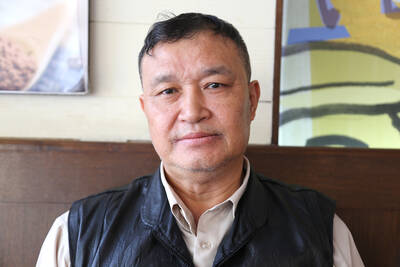
Taiwan has next to no political engagement in Myanmar, either with the ruling military junta nor the dozens of armed groups who’ve in the last five years taken over around two-thirds of the nation’s territory in a sprawling, patchwork civil war. But early last month, the leader of one relatively minor Burmese revolutionary faction, General Nerdah Bomya, who is also an alleged war criminal, made a low key visit to Taipei, where he met with a member of President William Lai’s (賴清德) staff, a retired Taiwanese military official and several academics. “I feel like Taiwan is a good example of

March 2 to March 8 Gunfire rang out along the shore of the frontline island of Lieyu (烈嶼) on a foggy afternoon on March 7, 1987. By the time it was over, about 20 unarmed Vietnamese refugees — men, women, elderly and children — were dead. They were hastily buried, followed by decades of silence. Months later, opposition politicians and journalists tried to uncover what had happened, but conflicting accounts only deepened the confusion. One version suggested that government troops had mistakenly killed their own operatives attempting to return home from Vietnam. The military maintained that the
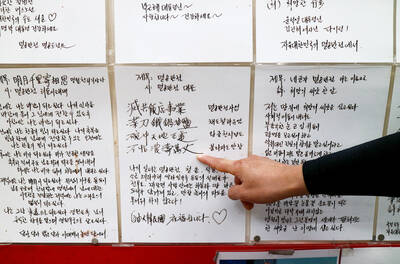
“M yeolgong jajangmyeon (anti-communism zhajiangmian, 滅共炸醬麵), let’s all shout together — myeolgong!” a chef at a Chinese restaurant in Dongtan, located about 35km south of Seoul, South Korea, calls out before serving a bowl of Korean-style zhajiangmian —black bean noodles. Diners repeat the phrase before tucking in. This political-themed restaurant, named Myeolgong Banjeom (滅共飯館, “anti-communism restaurant”), is operated by a single person and does not take reservations; therefore long queues form regularly outside, and most customers appear sympathetic to its political theme. Photos of conservative public figures hang on the walls, alongside political slogans and poems written in Chinese characters; South
Taipei Mayor Chiang Wan-an (蔣萬安) announced last week a city policy to get businesses to reduce working hours to seven hours per day for employees with children 12 and under at home. The city promised to subsidize 80 percent of the employees’ wage loss. Taipei can do this, since the Celestial Dragon Kingdom (天龍國), as it is sardonically known to the denizens of Taiwan’s less fortunate regions, has an outsize grip on the government budget. Like most subsidies, this will likely have little effect on Taiwan’s catastrophic birth rates, though it may be a relief to the shrinking number of


 RSS
RSS