


The world economy has seen globalization collapse once already. The gold standard era — with its free capital mobility and open trade — came to an abrupt end in 1914 and could not be resuscitated after World War I. Are we about to witness a similar global economic breakdown?
The question is not fanciful. Although economic globalization has enabled unprecedented levels of prosperity in advanced countries and has been a boon to hundreds of millions of poor workers in China and elsewhere in Asia, it rests on shaky pillars. Unlike national markets, which tend to be supported by domestic regulatory and political institutions, global markets are only “weakly embedded.”
There is no global anti-trust authority, no global lender of last resort, no global regulator, no global safety nets, and, of course, no global democracy. In other words, global markets suffer from weak governance, and therefore from weak popular legitimacy.
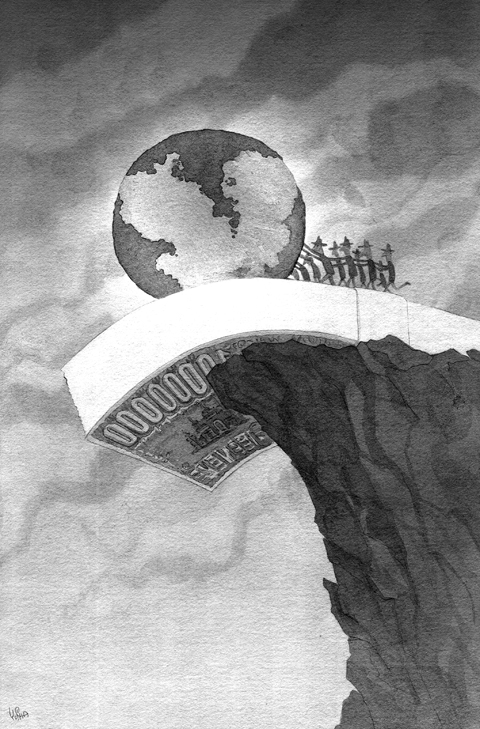
Recent events have heightened the urgency with which these issues are discussed. The presidential electoral campaign in the US has highlighted the frailty of the support for open trade in the world’s most powerful nation. The subprime mortgage crisis has shown how lack of international coordination and regulation can exacerbate the inherent fragility of financial markets. The rise in food prices has exposed the downside of economic interdependence without global transfer and compensation schemes.
Meanwhile, rising oil prices have increased transport costs, leading analysts to wonder whether the outsourcing era is coming to an end. And there is always the looming disaster of climate change, which may well be the most serious threat the world has ever faced.
So if globalization is in danger, who are its real enemies?
There was a time when global elites could comfort themselves with the thought that opposition to the world trading regime consisted of violent anarchists, self-serving protectionists, trade unionists, and ignorant, if idealistic youth. Meanwhile, they regarded themselves as the true progressives, because they understood that safeguarding and advancing globalization was the best remedy against poverty and insecurity.
But that self-assured attitude has all but disappeared, replaced by doubts, questions and skepticism. Gone also are the violent street protests and mass movements against globalization. What makes news nowadays is the growing list of mainstream economists who are questioning globalization’s supposedly unmitigated virtues.
So we have Paul Samuelson, the author of the postwar era’s landmark economics textbook, reminding his fellow economists that China’s gains in globalization may well come at the expense of the US; Paul Krugman, today’s foremost international trade theorist, arguing that trade with low-income countries is no longer too small to have an effect on inequality; Alan Blinder, a former US Federal Reserve vice chairman, worrying that international outsourcing will cause unprecedented dislocations for the US labor force; Martin Wolf, the Financial Times columnist and one of the most articulate advocates of globalization, writing of his disappointment with how financial globalization has turned out; and Larry Summers, the US Treasury chief and former US president Bill Clinton administration’s “Mr Globalization,” musing about the dangers of a race to the bottom in national regulations and the need for international labor standards.
While these worries hardly amount to the full frontal attack mounted by the likes of Joseph Stiglitz, the Nobel Prize-winning economist, they still constitute a remarkable turnaround in the intellectual climate. Moreover, even those who have not lost heart often disagree vehemently about the direction in which they would like to see globalization go.
For example, Jagdish Bhagwati, the distinguished free trader, and Fred Bergsten, the director of the pro-globalization Peterson Institute for International Economics, have both been on the frontlines arguing that critics vastly exaggerate globalization’s ills and under-appreciate its benefits. But their debates on the merits of regional trade agreements — Bergsten for, Bhagwati against — are as heated as each one’s disagreements with the authors mentioned above.
None of these intellectuals is against globalization, of course. What they want is not to turn back globalization, but to create new institutions and compensation mechanisms — at home or internationally — that will render globalization more effective, fairer and more sustainable. Their policy proposals are often vague (when specified at all) and command little consensus.
However, confrontation over globalization has clearly moved well beyond the streets to the columns of the financial press and the rostrums of mainstream think tanks. That is an important point for globalization’s cheerleaders to understand, as they often behave as if the “other side” still consists of protectionists and anarchists.
Today, the question is no longer, “Are you for or against globalization?” The question is, “What should the rules of globalization be?” The cheerleaders’ true sparring partners today are not rock-throwing youths but their fellow intellectuals.
The first three decades after 1945 were governed by the Bretton Woods consensus — a shallow multilateralism that permitted policymakers to focus on domestic social and employment needs while enabling global trade to recover and flourish. This regime was superseded in the 1980s and 1990s by an agenda of deeper liberalization and economic integration.
That model, we have learned, is unsustainable. If globalization is to survive, it will need a new intellectual consensus to underpin it. The world economy desperately awaits its new Keynes.
Dani Rodrik, a professor of political economy at Harvard University, is the first recipient of the Social Science Research Council’s Albert Hirschman Prize.
COPYRIGHT: PROJECT SYNDICATE

What was the population of Taiwan when the first Negritos arrived? In 500BC? The 1st century? The 18th? These questions are important, because they can contextualize the number of babies born last month, 6,523, to all the people on Taiwan, indigenous and colonial alike. That figure represents a year on year drop of 3,884 babies, prefiguring total births under 90,000 for the year. It also represents the 26th straight month of deaths exceeding births. Why isn’t this a bigger crisis? Because we don’t experience it. Instead, what we experience is a growing and more diverse population. POPULATION What is Taiwan’s actual population?

After Jurassic Park premiered in 1993, people began to ask if scientists could really bring long-lost species back from extinction, just like in the hit movie. The idea has triggered “de-extinction” debates in several countries, including Taiwan, where the focus has been on the Formosan clouded leopard (designated after 1917 as Neofelis nebulosa brachyura). National Taiwan Museum’s (NTM) Web site describes the Formosan clouded leopard as “a subspecies endemic to Taiwan…it reaches a body length of 0.6m to 1.2m and tail length of 0.7m to 0.9m and weighs between 15kg and 30kg. It is entirely covered with beautiful cloud-like spots

For the past five years, Sammy Jou (周祥敏) has climbed Kinmen’s highest peak, Taiwu Mountain (太武山) at 6am before heading to work. In the winter, it’s dark when he sets out but even at this hour, other climbers are already coming down the mountain. All of this is a big change from Jou’s childhood during the Martial Law period, when the military requisitioned the mountain for strategic purposes and most of it was off-limits. Back then, only two mountain trails were open, and they were open only during special occasions, such as for prayers to one’s ancestors during Lunar New Year.

A key feature of Taiwan’s environmental impact assessments (EIA) is that they seldom stop projects, especially once the project has passed its second stage EIA review (the original Suhua Highway proposal, killed after passing the second stage review, seems to be the lone exception). Mingjian Township (名間鄉) in Nantou County has been the site of rising public anger over the proposed construction of a waste incinerator in an important agricultural area. The township is a key producer of tea (over 40 percent of the island’s production), ginger and turmeric. The incinerator project is currently in its second stage EIA. The incinerator


 RSS
RSS