


Pete Seeger pulled his black Toyota Highlander into the Staples parking lot here and plucked some signs from the back seat, including one with “Peace” spray-painted in large orange letters. With that, he slung his banjo over his shoulder like an old musket and marched toward the intersection of Routes 9, a bustling six-lane thoroughfare, and 9D, the “Hudson Valley POW-MIA Memorial Highway.”
But before the 89-year-old folk singer flashed his anti-war signs to passing drivers from this no-man’s land — a patch of green about an hour north of New York City on the Hudson River — he bent over again and again, picking up litter.
“This is my religion now,” said Seeger. “Picking up trash. You do a little bit wherever you are.”

PHOTO: NY TIMES NEWS SERVICE
Seeger, the man behind the founding of the Clearwater Festival, which was held over the weekend at Croton Point Park, appeared there yesterday.
But for the last four years, most Saturdays he has been keeping his vigil in Wappingers Falls, New York.
He is usually not recognized by the hundreds of drivers who whiz by. It is a long road from 1969, when to protest the Vietnam War he sang John Lennon’s Give Peace a Chance at the foot of the Washington Monument.
“After two minutes, thousands were singing,” he recalled. “After three minutes, four minutes, a hundred thousand were singing. At the end of eight minutes, all five hundred thousand were singing.”
These days, fewer than a dozen protesters usually participate, while nearly as many who support the war in Iraq hold a counterdemonstration across Route 9. Seeger, a political activist who has traveled the world, rarely ventures farther than the few kilometers from here to his home in Beacon, New York. He stays close to his wife, Toshi Seeger, 85, who fractured vertebrae in a fall a few years ago.
On this particular Saturday, Seeger chatted easily with Chris Miller of Poughkeepsie. “He’s an ex-Army member,” Seeger said, “and they’re trying to send him over again.”
Miller, 38, served as a therapist for four years before receiving an honorable discharge in January 2006. But on Dec. 22, 2007, he said, he received orders to return to Iraq.
Miller said he had spent countless hours listening to Seeger’s stories, like the one about how his car windows were shattered in Peekskill in 1949 as he and his family left a performance he had given with the singer Paul Robeson, who was thought to have Communist sympathies. Or the one about the Vietnam veteran who said he had come to a concert in the Catskills to kill Seeger because of his anti-war stance, but was turned around by the performance and made his way backstage to tell of his transformation.
“I smiled and shook his hand,” Seeger said. “I had my banjo. We sat down and sang, Where Have All the Flowers Gone?” Afterward, Seeger said, the man told him, “I feel clean now.”
Seeger said he wrote that song in the mid-1950s accompanied by the same banjo he totes around today.
As for Miller: “Seeing what Pete has gone through and always standing up for what he believed in, despite the consequences, made my decision easier to resist the war. It made me comfortable that in the long run I’ll be all right.”
At one point, Seeger looked across the highway to the knot of counterdemonstrators. “They always have more flags,” Seeger said. “But our signs are more fun.” He said he crossed the street once about a year ago and talked to a veteran.
“I shook his hand and said, ‘I’m glad we live in a country where we can disagree with each other without shooting at each other.’ He had to shake my hand. He didn’t know what to say. I even picked up a little litter over there.”
He said that working for peace was like adding sand to a basket on one side of a large scale, trying to tip it one way despite enormous weight on the opposite side.
“Some of us try to add more sand by teaspoons,” he explained. “It’s leaking out as fast as it goes in, and they’re all laughing at us. But we’re still getting people with teaspoons. I get letters from people saying, ‘I’m still on the teaspoon brigade.’”

A recent report from the Environmental Management Administration of the Ministry of Environment highlights a perennial problem: illegal dumping of construction waste. In Taoyuan’s Yangmei District (楊梅) and Hsinchu’s Longtan District (龍潭) criminals leased 10,000 square meters of farmland, saying they were going to engage in horticulture. They then accepted between 40,000 and 50,000 cubic meters of construction waste from sites in northern Taiwan, charging less than the going rate for disposal, and dumped the waste concrete, tile, metal and glass onto the leased land. Taoyuan District prosecutors charged 33 individuals from seven companies with numerous violations of the law. This

As mega K-pop group BTS returns to the stage after a hiatus of more than three years, one major market is conspicuously missing from its 12-month world tour: China. The omission of one of the group’s biggest fan bases comes as no surprise. In fact, just the opposite would have been huge news. China has blocked most South Korean entertainment since 2016 under an unofficial ban that also restricts movies and the country’s popular TV dramas. For some Chinese, that means flying to Seoul to see their favorite groups perform — as many were expected to do for three shows opening

What is the importance within the Chinese Nationalist Party (KMT) of the meeting between Xi Jinping (習近平), the leader Chinese Communist Party (CCP), and Cheng Li-wun (鄭麗文), the leader of the KMT? Local media is an excellent guide to determine how important — or unimportant — a news event is to the public. Taiwan has a vast online media ecosystem, and if a news item is gaining traction among readers, editors shift resources in near real time to boost coverage to meet the demand and drive up traffic. Cheng’s China trip is among the top headlines, but by no means
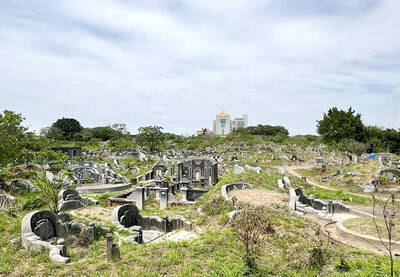
Apr. 13 to Apr. 19 From 17th-century royalty and Presbyterian missionaries to White Terror victims, cultural figures and industrialists, Nanshan Public Cemetery (南山公墓) sprawls across 95 hectares, guarding four centuries of Taiwan’s history. Current estimates show more than 60,000 graves, the earliest dating to 1642. Besides individual tombs, there are also hundreds of family plots, one of which is said to contain around 1,000 remains. As the cemetery occupies valuable land in the heart of Tainan, the government in 2018 began asking families to relocate the graves to make way for development. That


 RSS
RSS