


Day three and I’m feeling like part of a Pavlov experiment. Early in the afternoon, which is the time I usually have a snack, like a bowl of beef noodles or chicken leg with rice, the stomach pains begin — gnawing, dull throbs. Then the uncontrollable drooling at the mere thought of meat.
People choose to quit eating meat in all its varied manifestations for many reasons: religion, culture, ethics, politics, health. My editor assigned me the task for International Vegetarian Week, which ran from May 19 to May 25.
“Seven days? Big deal,” a friend says. This is especially true as the experiment is finite: after seven days there’s no obligation for me to continue eating a strictly vegetarian diet.
PHOTO: NY TIMES NEWS SERVICE
I don’t really see the challenge so much as becoming a vegetarian as I do quitting meat, an important distinction because this perspective implies leaving behind negative behavior rather than instilling positive habits.
Even though rainforests are being cut down to plant corn and maze to feed (rather than graze) the many animals that are then slaughtered, often using horrific methods, so that I have something to accompany my French fries, health is as good a reason as any to switch to a vegetarian diet.
“Who wants to think about that? I just want to eat my steak,” another friend says, neatly highlighting an important aspect of becoming a vegetarian: awareness. Success requires an awareness of what goes into your food, what to avoid and the repercussions of eating meat, which stretch far beyond the dinner table.
PHOTO: NY TIMES NEWS SERVICE
THE JOURNAL
Day 1 (Monday): Jumped into vegetarianism with gusto, which included spending considerable time in natural food stores purchasing organic tortillas and mixed grains, stocking the fridge full of roughage and trawling the Net for recipes.
After browsing meal options such as insanely easy vegetarian chili or vegetarian lasagna I realize I can eat exactly what I was eating before today, just by simply subtracting the meat.
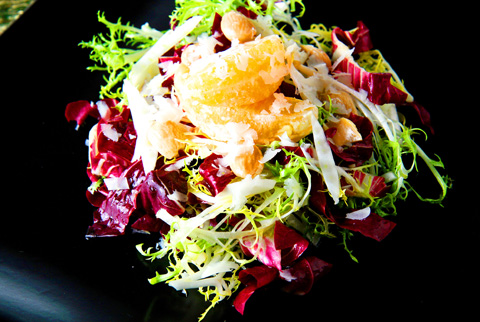
PHOTO: NY TIMES NEWS SERVICE
I also noticed, however, some more creative ideas such as baked eggplant with goat’s cheese and cream and miso broth with silken tofu and Asian greens (both of which can be found at www.taste.com.au/recipes/collections/vegetarian). I hadn’t thought of this before, but in terms of taste, switching to a vegetarian diet might not be so bad after all.
Day 2 (Tuesday): As I’ve made shedding a few kilograms part of eating a vegetarian diet, I’m becoming increasingly conscious of what is put in food. Today was lunch at one of those ubiquitous Buddhist vegetarian buffets that are a mainstay of Taipei’s restaurant scene.
Vegetarian they may be, but don’t expect to lose much weight or eat your way to health because these cafeteria-style eateries replace the meat with generous drizzles of oil, sprinklings of salt and lashings of ersatz mayonnaise. Still, quite tasty and filling.
Day 3 (Wednesday): “Just eat more often,” an acquaintance quipped in response to my incessant whining about hunger pains. “That’s what I do.”
Becoming a vegetarian involved listening to advice, often self-evident and therefore quite annoying, from well-intentioned although sometimes self-righteous friends. However, listen I did and spent considerable time today chopping up fresh carrot, cucumber and a variety of fruit for snacks, which makes suppressing hunger pains more convenient.
And then the pity set in. I feel sorry for vegetarians; they must spend far more time purchasing and preparing food than eating it.
Day 4 (Thursday): A Taiwanese friend took me to a vegetarian hot pot restaurant. Vegetarian restaurants suffer from an identity crisis. The abundance of faux seafood and fake meat found at these restaurants, and indeed the tofu burgers and bacon to be found in supermarkets, leads me to think that becoming a vegetarian is simply a matter of fooling yourself that you’re still eating meat. Poor deluded souls.
Day 5 (Friday): Got up early and feel great. The hunger pangs persist but, thanks to some forethought, I have a variety of “convenient foods” at hand.
Recently, however, my morning forays to the bathroom are less frequent and, I add regretfully, significantly less satisfying. This is odd, really, because my consumption of roughage and whole wheat bread has increased dramatically.
The same friend that provided advice on Day 3 invites me to an all-you-can-eat seafood restaurant. Even though he spent considerable time explaining the best way to suppress hunger a few days ago, it only took one day for him to forget that seafood is off the menu.
Day 6 (Saturday): Today I became a pescatarian, or a person who finds fish an acceptable part of a vegetarian diet.
It wasn’t intentional. Or a cop-out.
My partner made her famous, in our household at least, kimchi soup with tofu. But an argument ensued when I noticed dried fish floating in the fiery soup. “It’s necessary to bring out the correct flavors,” she said in defense. “Just don’t eat the fish.” So I guess I was a pseudo-seafood eater or a vegetarian with pescatarian tendencies.
Day 7 (Sunday): The final day of my vegetarian sojourn. I reflect on my meat-free week and realize it wasn’t so difficult after all. Although the cost of cooking at home is significantly more expensive than picking up a lunch box daily, I feel healthier, lost three kilograms and found a new topic of conversation.
Will I remain a vegetarian? I have little intention to return to a meat diet and even if I do I’ll stick to chicken or fish.
Postscript: Several days after completing the diet, some friends invited me to the Lai Lai Sheraton — renowned amongst avid carnivores — for a buffet dinner. It was a ploy to put me in temptation’s way.
There was prime rib, roast chicken, a variety of Indian curries and a huge mouth-watering variety of seafood and sashimi. Having gone, by that time, over 10 days without eating meat, wolfing down a few of these dishes was a pleasant surprise to the taste buds. Less pleasant, however, was the shock to my system the next day.
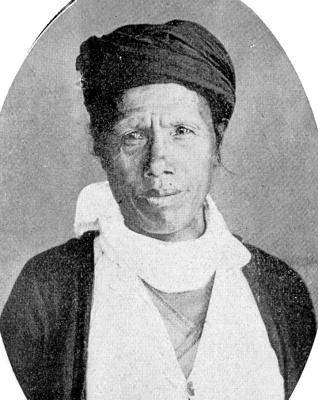
May 11 to May 17 Traversing the southern slopes of the Yushan Range in 1931, Japanese naturalist Tadao Kano knew he was approaching the last swath of Taiwan still beyond colonial control. The “vast, unknown territory,” protected by the “fierce” Bunun headman Dahu Ali, was “filled with an utterly endless jungle that choked the mountains and valleys,” Kano wrote. He noted how the group had “refused to submit to the measures of our authorities and entrenched themselves deep in these mountains … living a free existence spent chasing deer in the morning and seeking serow in the evening,” even describing them as

Yesterday, the Democratic Progressive Party (DPP) nominated legislator Puma Shen (沈伯洋) as their Taipei mayoral candidate, the Chinese Nationalist Party (KMT) put their stamp of approval on Wei Ping-cheng (魏平政) as their candidate for Changhua County commissioner and former legislator Tsai Pi-ru (蔡壁如) of the Taiwan People’s Party (TPP) has begun the process to also run in Changhua, though she has not yet been formally nominated. All three news items are bizarre. The DPP has struggled with settling on a Taipei nominee. The only candidate who declared interest was Enoch Wu (吳怡農), but the party seemed determined to nominate anyone

In a sudden move last week, opposition lawmakers of the Chinese Nationalist Party (KMT) and Taiwan People’s Party (TPP) passed a NT$780 billion special defense budget as a preemptive measure to stop either Chinese leader Xi Jinping (習近平) or US President Donald Trump from blocking US arms sales to Taiwan at their summit in Beijing, said KMT heavyweight Jaw Shaw-kong (趙少康), speaking to the Taipei Foreign Correspondents Club on Wednesday night in Taipei. The 76-year-old Jaw, a political talk show host who ran as the KMT’s vice presidential candidate in 2024, says that he personally brokered the deal to resolve
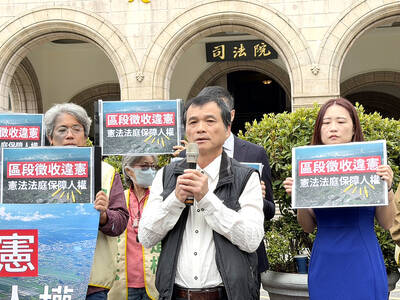
What government project has expropriated the most land in Taiwan? According to local media reports, it is the Taoyuan Aerotropolis, eating 2,500 hectares of land in its first phase, with more to come. Forty thousand people are expected to be displaced by the project. Naturally that enormous land grab is generating powerful pushback. Last week Chen Chien-ho (陳健和), a local resident of Jhuwei Borough (竹圍) in Taoyuan City’s Dayuan District (大園) filed a petition for constitutional review of the project after losing his case at the Taipei Administrative Court. The Administrative Court found in favor of nine other local landowners, but


 RSS
RSS