


Even though Nazareth, Pennsylvania, isn't quite the holy city its namesake is, pilgrims with a musical bent still go there every weekday in search of a potentially spiritual experience. They head to a quaint brick building, lured by the promise of taking a tour at the CF Martin & Co guitar factory.
More than 200 guitars are made at Martin each day, many more than when the company first opened in New York City in 1833 (it moved to Nazareth in 1839). But for any guitar player or music lover, getting to see the basic stages in the creation of a Martin moves them powerfully, putting some in touch with emotions they might have thought too inaccessible to be reached.
Martins are arguably the most coveted acoustic guitar on earth - satisfied customers include Bob Dylan, Neil Young and Freedy Johnston - and wherever pickers and grinners gather to resurrect time-honored chestnuts, from Helpless to Sugarfoot Rag, there's a good chance that there will be a Martin chiming in. A trip to the factory could almost be considered a journey to the Lourdes of twang.
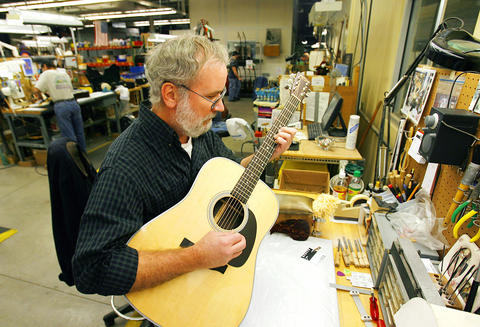
PHOTO: NY TIMES NEWS SERVICE
Given Martin's humble origins, today's factory is surprisingly large and modern, built in 1964. The barn-red Martin building replicates the facade of the first Nazareth factory, but from the outside it looks to be playing host-victim to an industrial plant large enough to churn out cars and trucks.
Inside, the Plek fret-dressing machine hums, lathes turn and sanders buzz as instruments are made in large numbers (81,000 last year). Plus, there's a spanking clean lobby, a gift shop, a guitar museum and a sparkling white bathroom that pipes in, fittingly enough, a bluegrass radio station.
The tour itself also makes use of modern headsets, so you can hear the guide's narrative above the impressive whine of guitars being birthed. But once the pilgrims make their way and start seeing guitars in various stages of completion, that holy look creeps back into their eyes. Sometimes, mixed with tears.
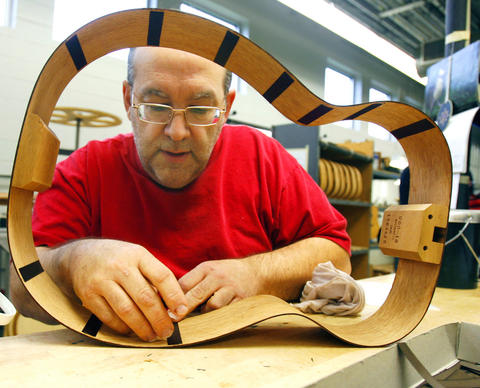
PHOTO: NY TIMES NEWS SERVICE
That was the case in October last year with Beverly Goskowski, from nearby Hellertown, whose horn-rims showed a studious side, but whose leather jacket whispered, "rebel." Goskowski really did think of her trip to Nazareth and Martin as something, well, related to the soul.
"I came here seven years ago with my granddad," she said. "He passed over the summer, and I guess I'm trying to recapture the fun we had when we first came. Or to say goodbye to him. I don't know which, really."
Goskowski said all this in a strangely amplified voice mangled by the headset. She wept a bit, removed her glasses, wiped her eyes and chuckled at the tender moment being distorted by a modern contraption.
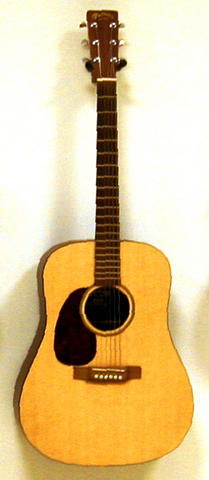
PHOTO: NY TIMES NEWS SERVICE
"Granddad, whose name was George Giltenboth, didn't play an instrument or anything, but he loved music," she said. "When we went on the tour, he kept grabbing the tour guide's arm, asking her to repeat certain facts, always calling her 'honey,' or 'dear.' He loved being here."
The tour guide on this day, a careworn but cheerful woman named Steph Tashner, who started here "11 years ago in the stringing department," took the group of eight, mostly guitar geeks, on a sort of fast-forwarded version of the making of a Martin. The tour started with discussions and descriptions of types of wood - the tops are usually made with spruce, the sides and backs with mahogany and rosewood - and ended with a look at a few finished instruments.
In between, the faithful watched Martin employees soak wood so it could be bent into the sides of guitars, use clothespins to glue the interior linings, smooth frets and stain bodies.
The employees number 560, ranging in appearance from old hippies with graying ponytails to women who would have fit right into a factory scene from Norma Rae. The once little company, which produced 368 guitars in 1898, now covers 18,500m2.
Covering the walls are pictures of some of its best-known customers, including Dylan, Young, Stephen Stills and Robbie Robertson. The 1960s just might have been less groovy without Martin guitars.
Prices for the factory-made guitars range from US$299 to many thousands of dollars. The most popular Martin model, the D-28, retails for US$2,849. And Martin still makes custom guitars that can cost more than US$100,000.
It's also possible to take a guitar there for repairs. That was why Jeffrey Lyons, a Toronto musician, was there.
"The action on the fretboard of my D-28 is higher than I'd like," Lyons said. "The guitar is buzzing too much when I play gigs. So, I thought I'd bring the ax down here to have them fine-tune it, leave it and then take the tour.
"Aside from that problem, though, the guitar is great. It has a really bright and consistent tone, and it's particularly good for ballads."
Underscoring Lyons' decision to bring in his imperfect guitar is a display on a wall near one of the factory's many workstations. There are bits and pieces of broken Martins glued there, surrounded by the words "Don't Let This Happen To You!"
Tashner nodded at the display and at Lyons. "We don't recommend that you fix your guitar yourself," she said with a wry smile.
Near the end of the tour it was also possible to see how technology had changed even the wooden-guitar industry. Behind a glass window, a long mechanical arm could be seen polishing the body of a nearly finished guitar.
"Yes, sometimes we have a robot do the work here," Tashner said. "Not only does it do a great job, but it is smart, ergonomically speaking. Better that a robot arm hold up and polish a guitar all day than a human one."
She didn't say, though, whether it could play a Lester Flatt G-run.
Headphones were collected and the pickers in the group assembled in the room where several sample Martins were available to play. Goskowski lingered there, still thinking about her grandfather.
Her cousin Scott Honeychurch, a Southerner wearing a black cowboy hat and boots, picked up a guitar. Almost on cue, as Goskowski started her story again, Honeychurch began playing random country licks that evolved into Wabash Cannonball, a perfect bit of scoring for Goskowski's tale.
"The first time I came here with my granddad, seven years ago, was right after my grandmother, his wife, died," she said. "Granddad wasn't much for socializing or leaving the house, and I thought this would be a good place to start the process. Especially since he loved music so much."
"I think he started feeling better about things just after he came on the tour. After that, he started accepting invitations to people's houses for dinner and, little by little, enjoying life again. I credit this place, in some small way, with keeping him alive," she added.
"So," she said, "I think I'm going to do this every once in a while. Make my pilgrimage to the Martin factory and take the tour. It's the best way I can think of to celebrate Granddad's life."
CF Martin & Co (510 Sycamore Street, 01-610-759-2837 www.martinguitar.com) is in the eastern Pennsylvania town of Nazareth.
Free small-group tours are conducted regularly from 11am to 2:30pm, Monday through Friday, first come, first served. Reservations are required for groups of more than 10; these tours are given from 8:00am to 10:30am and cost US$3 a person.

Taiwan’s overtaking of South Korea in GDP per capita is not a temporary anomaly, but the result of deeper structural problems in the South Korean economy says Chang Young-chul, the former CEO of Korea Asset Management Corp. Chang says that while it reflects Taiwan’s own gains, it also highlights weakening growth momentum in South Korea. As design and foundry capabilities become more important in the AI era, Seoul risks losing competitiveness if it relies too heavily on memory chips. IMF forecasts showing Taiwan widening its lead over South Korea have fueled debate in Seoul over memory chip dependence, industrial policy and

“China wants to unify with Taiwan at the lowest possible cost, and it currently believes that unification will become easier and less costly as time passes,” wrote Amanda Hsiao (蕭嫣然) and Bonnie Glaser in Foreign Affairs (“Why China Waits”) this month, describing how the People’s Republic of China (PRC) is playing the long game in its quest to seize Taiwan. This has been a favorite claim of many writers over the years, easy to argue because it is so trite. Very obviously, if the PRC isn’t attacking Taiwan, it is waiting. But for what? Hsiao and Glaser’s main point is trivial,
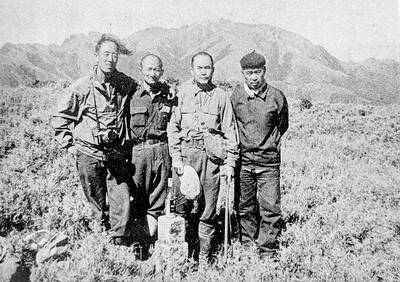
May 18 to May 24 Gathered on Yangtou Mountain (羊頭山) on Dec. 5, 1972, Taiwan’s hiking enthusiasts formally declared the formation of the “100 Peaks Club” (百岳俱樂部) and unveiled the final list of mountains. Famed mountaineer Lin Wen-an (林文安) led this effort for the Chinese Alpine Association (中華山岳協會). Working with other experienced climbers, he chose 100 peaks above 10,000 feet (3,048m) that featured triangulation points and varied in difficulty and character. The list sparked an alpine hiking craze, inspiring many to take up mountaineering and competing to “conquer” the summits. A common misconception is that the 100 Peaks represent Taiwan’s 100 tallest

And so, in the wake of US President Donald Trump’s trip to the People’s Republic of China (PRC), all the experts on the Strait of Hormuz suddenly became experts on US-China-Taiwan relations. The Internet has certainly expanded human knowledge. Lots of these sudden experts made noise this week about Trump’s words after the meeting with PRC dictator Xi Jin-ping (習近平). Trump is going to sell out Taiwan! Longtime Taiwan commentator J. Michael Cole summed the situation up neatly in the Guardian: “We need to keep in mind that he has a tendency to say many things — sometimes contradicting himself within


 RSS
RSS