

In the glow of casino lights around the Dominican Republic's tourist districts, streetwalkers wait for customers.
Behind the walls of Haiti's grossly overcrowded National Penitentiary, infectious diseases go uncounted and untreated.
On the island these countries share, two hours from American shores, the rates of the virus that leads to AIDS are the highest in this hemisphere.

PHOTO: NY TIMES NEWS SERVICE AND AP
But while the US has sent more than US$100 million dollars to fight HIV and AIDS on the island of Hispaniola in the last three years, those tackling the epidemic among sex workers and prison inmates there do it without US help.
Working with limited resources against seemingly insurmountable odds, those fighters on the frontlines of the epidemic contend that if AIDS is not confronted in these settings, the battle against it won't be won.
A tourist looking for sex in Santo Domingo can walk to a brothel behind the priciest hotel where a night with a stranger costs about US$85, or save money and walk in the other direction to pick up one of the streetwalkers lining the seawall strip.
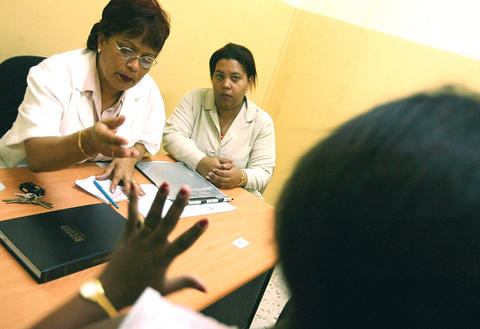
PHOTO: NY TIMES NEWS SERVICE AND AP
This impoverished island is a buyers' market where women sell sex to tourists, businessmen, sailors and prison inmates - and where HIV rates among sex workers are estimated to be at least triple the general population's nearly 2 percent rate.
Commercial sex is essentially legal here, where law requires hotel rooms rented by the hour be supplied with two condoms.
It is also entrenched enough in life here that sex workers organized a group - Movimiento de Mujeres Unida (MODEMU) - more than a dozen years ago to help each other.
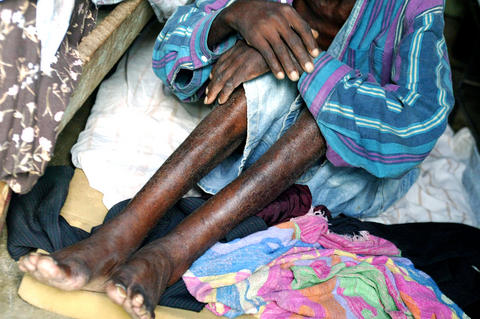
PHOTO: NY TIMES NEWS SERVICE AND AP
Among those at the highest risk in the HIV epidemic, they have taken a role in a search of solutions, participating in vaccine trials and teaching condom use, with support from drug companies, nonprofit organizations and their own government. They don't get money from the US, which last year sent US$6.4 million through the President's Emergency Plan For AIDS Relief (PEPFAR) to fight the epidemic here.
That is because a stipulation written into the terms of US foreign aid says anyone who doesn't condemn sex work can't get any of the money.
Critics call the policy the "anti-prostitution pledge" and say it keeps help from those who need it most.
"It's widely misunderstood," US global AIDS coordinator Ambassador Mark Dybul responded recently.
PEPFAR funds 120 programs that help sex workers, offering care and vocational training, he said.
Critics counter the language of the pledge is so vaguely worded that it scares organizations away from providing services to sex workers.
The pledge would be a difficult one for the retired and still active sex workers who make up MODEMU to take.
"We talk with the women equal to equal to get across our message. I say 'us' to a sex worker," said Juliana, a retired sex worker who preaches condom use to friends still working at brothels.
She is one of the founders of MODEMU and has recruited friends who are still active for vaccine trials and outreach work. One of her friends is a woman named Jocelyn who supports three children by serving sailors who arrive on ships from around the world. She also goes from town to town, demonstrating condom use to fellow sex workers and emphasizing sex workers must never negotiate whether to use them.
"Not for US$200, not for US$500!" she says.
Another friend brings extra condoms to the prison on visiting days, when she goes to serve inmates herself, and where HIV rates are estimated to be five times higher than those outside the walls. There, prisoners will pay about US$5 for a sex act and women try to serve enough inmates to leave with US$50.
Many women who visit the prison also work the streets serving tourists. It is an international issue that can't be solved by condemnation, say some working here, including doctors, social agency staff and sex workers themselves. They emphasize that options for poor women in this country are limited to housekeeping and factory work, when such jobs can be found.
Even some of those few options are closed to many women, says Sonia Pierre, founder of an organization fighting for the rights of Dominican women of Haitian descent. Discrimination against Haitian immigrants is a barrier to education, work and housing for those forced by even more crushing poverty to cross the border from the poorer country to the west.
Where the bright lights of the Dominican Republic's tourist strips might blind visitors to poverty and disease in that country, Haiti has no such facade.
But, according to many fighting the epidemic here, the country is doing better than its wealthier neighbor in getting antiretroviral medicine to those who need it. Haiti is one of PEPFAR's 15 focus countries, and officials say two long-standing programs now receiving PEPFAR money - GHESKIO, a Port-au-Prince clinic and the rural Zanmi Lasante - have set a standard that is part of a growing success story.
Still, while US$55 million in flowed into agencies and organizations in Haiti last year alone under PEPFAR, none of it went to the National Penitentiary, where infectious diseases flourish with few checks.
Prisons' HIV rates are estimated to run from three to 10 times higher than rates outside the walls, under better conditions than these.
Here, men awaiting trials that can be years in coming live packed so closely that some have no place to sit or lie down. Even cell blocks built in recent years with international money have no plumbing. And since a spring crime crackdown, overcrowding that long exceeded international standards has more than doubled to nearly 4,000 inmates in a place made to hold roughly 1,000.
"When I first came here, it was a desperate, desperate place," said John May, head of Health Through Walls, a nonprofit that brings supplies and health care systems to prisons in developing countries. May, who is also chief medical officer for the private South Florida-based Armor Correctional Health Services, started coming to this prison to help six years ago.
"It is still a desperate, desperate place," he said.
He discovered how bad the overcrowding had gotten in an April trip, when four men were brought to him with legs swollen from standing for weeks.
The virus that leads to AIDS spread through sexual assaults in cells meant to hold no more than a dozen inmates, now caging 60. Packed cells serve as incubators for drug-resistant tuberculosis.
The diseases kill some and give others a contagious keepsake to take with them when they get out.
And most of these prisoners will get out, May said.
Rioting in 2004 emptied the prison of all 1,500 inmates that it held then, and in escapes since, from a dozen to 600 prisoners at a time have disappeared into the general population. Many prisoners have tattoos, indicating they have spent time in the US, where they can then return.
With the prison filled beyond capacity, overworked and skeletal staff can't keep track of illness here, May said.
"The first priority is to deliver the care that's needed to those who are going to die unnecessarily," he said. "There are patients there who are going to die and who have died from conditions that are treatable."
May applied for a PEPFAR grant last year and was turned down. He is trying again this year.
US officials, including PEPFAR's Dybul, say they have discussed funding a program at the prison.
In the meantime, May brought rapid HIV tests to the prison during a September visit and returned two weeks later with antiretroviral medicine for a prisoner whose blood test results showed advanced AIDS.
"If the systems aren't going to come together," he said, "I need to treat this patient in front of me."

The Han Kuang exercises in August simulated the repelling of attackers from the People’s Republic of China (PRC). One scenario saw the PRC seizing Taipei International Airport (Songshan airport) in a daring helicopter assault. The airport is a key military operations center, and its seizure or destruction in a PRC invasion would be inevitable. Yet that is hardly the only conflict involving Songshan. Taipei Mayor Chiang Wan-an’s (蔣萬安) recent, surprising suggestion that the airport be converted to an AI park is just the latest variation on an old theme. Replacing Songshan airport with some kind of green or park space

In pandemic preparedness work, scientists like to focus on the technical challenges: identifying pathogens, diagnosing infections, understanding their effects and developing vaccines and treatments. Each step promises progress through human innovation, investment and planning. The WHO, for example, brings experts together to identify and prioritize emerging disease threats and collect the evidence needed to prepare for them. But preparedness depends on more than scientific innovation. As the past week has shown, politics is the elephant in the room in all of this. No one could have predicted we would be talking about pneumonic plague, and that the death of a single
The South China Morning Post (SCMP) article from earlier this month on how Beijing would govern a post-annexation Taiwan (Amber Wang, “Beijing’s policy advisers map out how post-reunification Taiwan could be governed,” Oct. 6, 2026) is a reminder that even “peaceful” (coerced) occupation by the People’s Republic of China (PRC) will beggar Taiwan. The “scholars” cited in the SCMP piece argued that Taiwan would be governed in a manner similar to Hong Kong. As I observed in my piece for Monday (“Beijing’s intimidation tactics in Taiwan and beyond,” Oct. 12, 2026), that claim is simply a form of cognitive warfare. One

Since Russia invaded more than four years ago, Ukraine has become a global leader in military drone innovation, enabling its forces to grind a much larger enemy to a stalemate. But this technological force multiplier has come with an unsettling vulnerability: Ukrainian drone makers are highly dependent on electronics made by China, a key Russian ally. Ukraine’s greatest fear is that the Chinese government could severely restrict its access to these critical parts. It also worries that Russian defense companies that need these same supplies could be given preferential treatment by Chinese factories. Over the past two years, Ukraine has sought to break


 RSS
RSS