


Gut's Dynamite Cabarets was one of the hot stocks of the 2008 spring-summer Tokyo Collection.
But unlike the tall, skinny and streamlined shapes typically seen on the catwalk, the clothes of Gut's Dynamite Cabarets were displayed by sexy and often lofty men, some posing as drag queens.
"All the clothes at my house are for occasions like crucial dates, the moment at which you have to be very sexy," said creative director Cabaret Aki.

"When you think of the underwear we design, you can tell. They are for those important moments," said Aki, who started the fashion house as a male underwear brand.
Japan has been trying to catch up with the world's other major fashion hubs like Paris, New York and Milan, throwing the Japan Fashion Week in Tokyo since 2005, with a major boost from the Industry Ministry.
The Tokyo Collection is the core of the week-long event, a head start for the world's 2008 spring-summer collections, with designers from veterans to new aces giving off the scent of exoticism in their shows at the event, which finished yesterday.
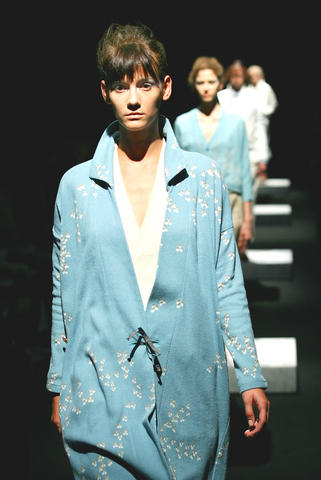
PHOTO: AFP
Among the few ladies' items at Gut's Dynamite Cabarets were its camisole dresses, which were feminine but assertive with thin shoulder straps and layers of frills down to just below the torso.
Gut's Dynamite Cabarets is all about flamboyance, decorated with countless red and black roses, cluttering gold chains and any kinky material you can think of like leather, feathers and fur.
The bling-bling strangely matched the catwalk tune of Frank Sinatra's My Way, as if everyone on stage was celebrating life itself.
Despite the cross-dressing show, Aki said he and his co-designer Jackal Kuzu created clothes that were ready to wear on the street.
"Many styles you see in the Tokyo Collection are luxurious but casual, and are very sophisticated," he said after the show. "We tried to keep a kinky touch to our clothes, which are still wearable in real life."
"Also, since this is the spring-summer collection, we added some scary feelings, like a ghost," he added.
Fashion house Matohu stood out among the 38 brands participating here for its Japanese touch.
While the Japanese look is often considered kawaii (cute), designer duo Hiroyuki Horihata and Makiko Sekiguchi took the theme of the Keicho era (1596-1615), a mere two decades in Japanese history that featured some outstanding style.
The style - humble like Japanese rituals but brilliant like the hue of green tea - swept the country's trend-conscious echelons of power at the time.
"We want to offer clothes that have something more than just looking cute or pretty in silhouette," Horihata said. "We want to add something more than simply the fashion."
In the latest collection, "something more" for Matohu is the foamy but rugged Shino style of earthenware that was in vogue back then.
"To give the touch of cracking which you see on the surface of the pottery, we printed the design on silk," said Sekiguchi.
"It's such a gentle and airy touch with some distorted feeling," Horihata said. "Knowing what Shino is or not makes such a difference to those who put on our clothes."
Horihata said he and Sekiguchi spend twice as much time to prepare for a single collection, seeking the best material to satisfy both the creators' artistic drive and consumers' practicality.
"Unless you can actually wear them, it would be useless," Horihata said.
"We also think about what our clothes will be like after being washed at home."
Norio Surikabe, the designer of Support Surface, whose pristine style and natural material of cotton and linen create an extremely streamlined silhouette, was more definitive.
"I think about how the people wearing them feel, so we use dry-touch linen for this season of high humidity," he said. "I do not compromise. People may say my style is plain, but for me, those who wear my clothes are the priority."
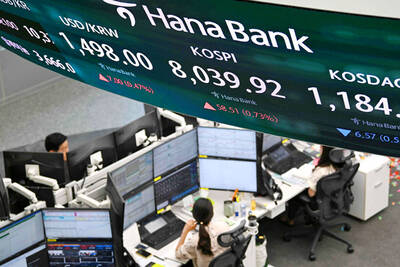
Taiwan’s overtaking of South Korea in GDP per capita is not a temporary anomaly, but the result of deeper structural problems in the South Korean economy says Chang Young-chul, the former CEO of Korea Asset Management Corp. Chang says that while it reflects Taiwan’s own gains, it also highlights weakening growth momentum in South Korea. As design and foundry capabilities become more important in the AI era, Seoul risks losing competitiveness if it relies too heavily on memory chips. IMF forecasts showing Taiwan widening its lead over South Korea have fueled debate in Seoul over memory chip dependence, industrial policy and
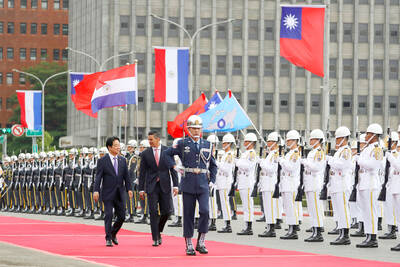
“China wants to unify with Taiwan at the lowest possible cost, and it currently believes that unification will become easier and less costly as time passes,” wrote Amanda Hsiao (蕭嫣然) and Bonnie Glaser in Foreign Affairs (“Why China Waits”) this month, describing how the People’s Republic of China (PRC) is playing the long game in its quest to seize Taiwan. This has been a favorite claim of many writers over the years, easy to argue because it is so trite. Very obviously, if the PRC isn’t attacking Taiwan, it is waiting. But for what? Hsiao and Glaser’s main point is trivial,
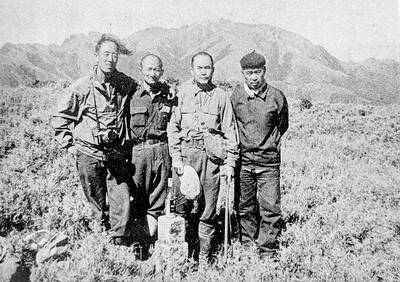
May 18 to May 24 Gathered on Yangtou Mountain (羊頭山) on Dec. 5, 1972, Taiwan’s hiking enthusiasts formally declared the formation of the “100 Peaks Club” (百岳俱樂部) and unveiled the final list of mountains. Famed mountaineer Lin Wen-an (林文安) led this effort for the Chinese Alpine Association (中華山岳協會). Working with other experienced climbers, he chose 100 peaks above 10,000 feet (3,048m) that featured triangulation points and varied in difficulty and character. The list sparked an alpine hiking craze, inspiring many to take up mountaineering and competing to “conquer” the summits. A common misconception is that the 100 Peaks represent Taiwan’s 100 tallest

And so, in the wake of US President Donald Trump’s trip to the People’s Republic of China (PRC), all the experts on the Strait of Hormuz suddenly became experts on US-China-Taiwan relations. The Internet has certainly expanded human knowledge. Lots of these sudden experts made noise this week about Trump’s words after the meeting with PRC dictator Xi Jin-ping (習近平). Trump is going to sell out Taiwan! Longtime Taiwan commentator J. Michael Cole summed the situation up neatly in the Guardian: “We need to keep in mind that he has a tendency to say many things — sometimes contradicting himself within


 RSS
RSS