


Under its most infamous ruler Qin Shi Huang (秦始皇), the Qin Dynasty (秦朝) was a time marked by the centralization of government and codification of laws. According to Lin Hui-lin (林惠玲), owner of Qin Wei Guang, it was also a time when the emperor systematically categorized the history and ingredients of many dishes from the region that is today called Shaanxi Province (陝西).
Lin tells this and a bevy of other stories as she explains the origins and uses of the tapestries adorning the celebrity-signed walls, the patterns on the tablecloths covering the hardwood tables and the dishes on the menu. Even the corn, red peppers and garlic hanging out front of the restaurant serve as the foundation for a story about differing weather conditions between steamy Taipei and temperate Xian (西安), Shaanxi's capital city. It's this attention to detail that has made Qin Wei Guan a staple on many a gourmand's list of eateries to frequent.
The food Lin serves is as hearty as her stories. As Shaanxi cuisine is influenced by the numerous Muslims living in the area, the menu consists mainly of beef, lamb, broad-cut noodles and paomo — a broth stewed for a day and served with un-leavened bread. To accommodate local palettes, Lin has added fish, pork, and tofu to the menu.
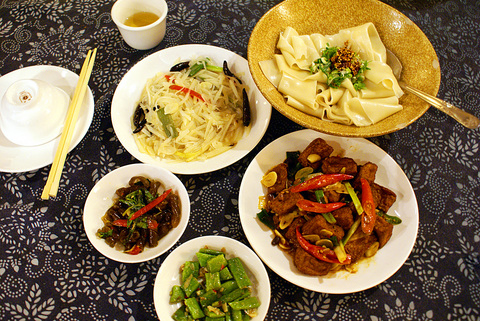
PHOTO COURTESY OF YULI KIM
We started off with Hu Pi Hui (NT$160) — a mixture of green pepper, fried tofu and hot bean sauce — and cut broad noodles (NT$90). Cut broad noodles are a staple of Shaanxi and ours were served in a large bowl with chopped green onions and Lin's special chili paste, which, when mixed together, was simple but delicious.
For the main course we ordered Zhi Zi Gu Pai, or spareribs/spices (NT$360), a dish that is marinated, steamed, fried and baked before being brought to the table. The outer skin is crispy with the meat inside moist and succulent.
Halfway through our meal two dessert pastries arrived at our table. After a minute, one of the servers noticed that the delicate desserts were getting cold and told us to eat them. Only later did Lin tell us that it is the custom to eat dessert halfway through dinner.
"The sugary dessert helps with digestion and increases the appetite so that more food can be eaten," Lin said.

Taiwan’s English education system is being pulled apart by three opposing forces. Bilingual Nation 2030 pulls students toward English and global communication. Artificial Intelligence (AI) readiness pulls them toward digital judgment, verification and AI-mediated work. But Taiwan’s old exam culture pulls them back toward memorization, grammar drills, timed reading and correct answers. If the education system keeps using old exams to define success, it risks producing graduates who are neither genuinely bilingual nor genuinely AI-ready, but trained for tasks machines can already perform. The first force is Bilingual Nation 2030. Launched in 2018, the policy aimed to “help Taiwan’s workforce connect
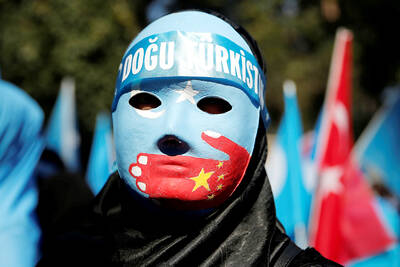
It seems every few days one bumps into one of those “real man” comments in which Taiwan is urged to “face reality” or similar, and “make a deal,” with the speaker implying that soon it will be too late. “Deal” advocates always present themselves as having a superior grip on reality, and the manly ability to make the “hard choice.” Their testosterone-laden language often echoes that of Taiwan sellout advocates. Note that such commentary always specifies a process (“make a deal, work with, make progress”), never the end state of what occupation by a violent authoritarian colonialist state will entail. In
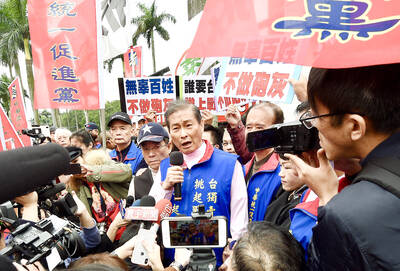
There are shadowy cabals plotting to sell out Taiwan to be annexed by China, by invasion if necessary. Fortunately, they are buffoons. In 2019, former Bamboo Union gangster and founder of the China Unification Promotion Party (CUPP), Chang An-le (張安樂, colorfully known as “White Wolf”), led a protest at the Legislative Yuan against comments made by then-premier Su Tseng-chang (蘇貞昌) that in the event of an attack by China, he would never surrender, but would protect the nation by fighting to the end, even if he only had a broom. Chang had party members bring a wooden casket that they
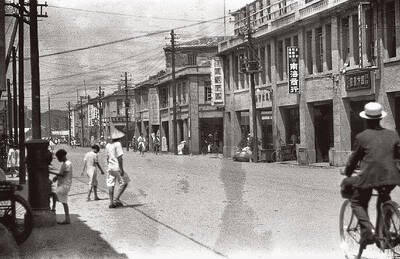
June 1 to June 7 "If all Taiwanese were as afraid of dying as you, then what would happen?” Physician Shih Chiang-nan (施江南) reportedly said this to his wife Chen Chiao-tung (陳焦桐) after she urged him to stop intervening on behalf of Taiwanese soldiers stranded overseas after serving in the Japanese Army during World War II. Shih had clashed with high-ranking officials over the issue, engaged in several heated arguments with Taiwan governor-general Chen Yi (陳儀) and allegedly shouted at general Ko Yuan-fen (柯遠芬), chief of staff of the Taiwan Garrison Command, over


 RSS
RSS