


It was about the time that Naomi Campbell wanted to scratch my eyes out (or so a trade glossy informed me) that it became clear to me that she was no ordinary model. It was 1996, and I had written an article for the New York Times Magazine about the English-born model of Jamaican (and Chinese) ancestry, enumerating her eccentricities and recounting a few of the seemingly numberless stories about the nutty behavior of this gorgeous, magnetic and nearly pathologically petulant young woman with serious anger-management issues.
Back then, Campbell had not yet started routinely chucking phones at her help or for that matter serving five-day sentences sweeping a Department of Sanitation depot for her misdeeds, as she did last week. But a Vanity Fair columnist had already termed her the "biggest brat in the modeling business," and she had been fired by an agency on the ground that "no money or prestige could further justify the abuse that has been imposed" on its staff and clients, and she had been informed that the agency would not employ her again if she were the "last model on earth."
They rehired her, of course, after just six months. And 10 years later it is obvious why. Tempestuous Naomi Campbell may also be fickle and grandiose (she once furiously refused a specially ordered sandwich at a four-star French restaurant, apparently because the crust was scratching her gums) and ostentatious and evidently immune to some fairly basic civic lessons.
PHOTOS: AGENCIES
But there is something else about Campbell that gets overlooked and that is clearly at the center of her enduring appeal. Unlike most models (an occupational misnomer if there ever was one), she represents a clear link to the famous beauties of the ages, flamboyant types like Georgina Cavendish, the alluring, spendthrift and gambling-addicted 18th-century Duchess of Devonshire; or Lady Diana Cooper, the actress and wife of the diplomat Duff Cooper, celebrated for her porcelain looks and equally for her tastes in morphine derivatives and men; or the movie actress Louise Brooks, who considered it a given that a woman was an idiot if she didn't play the genetic hand she'd been dealt by fate.
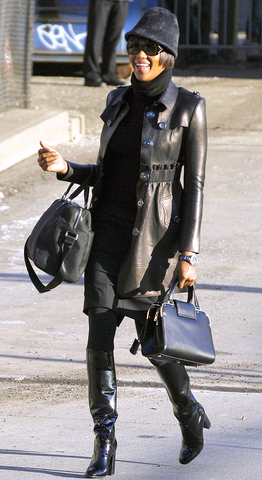
And that is why it was so entertaining to watch last week as Campbell paid her debt to society, turning up every day to do court-ordered community service in designer furs, boots, hats, bags and eyeglasses and hairstyles freshened constantly for her public appearances by Amoy Pitters, her hairdresser of many years.
There was a lot of moralistic clucking in the press, of course, particularly when the gossip columns passed on rumors that MTV was filming a reality show about her (not so, said Campbell's publicist, Jeff Raymond) and that the fashion photographer Steven Klein was also shooting a fashion feature of the experience for W. ("They are friends, and they work together on a lot of projects," Raymond said. "Steven has been photographing her, but it's not clear where it will go.")
None of it was too convincing because, of course, it pleases people to think ill of the fashionable. This has apparently always been so. "The best dressed of every age," read an 1859 handbook called The Habits of Society, quoted in Joseph Epstein's 2002 book, Snobbery, "have always been the worst of men and women."
You would be hard pressed to find someone more truly a creation of fashion than Naomi Campbell, who grew up in the business and who has been earning a living from her looks for 21 years, ever since she made her debut in a video for a band put together by Boy George, another performer who has also since swept up for his misdeeds.
No one carried Boy George's purse when he reported for duty. And whereas he came off looking stout and balding and pathetic and lost, Campbell gives the impression not just that the whole public service thing was her idea, but also that the show doesn't stop when you step off the catwalk. Glamour is a lifelong loop.
"She's kind of like a dream person," said the designer Anna Sui, whose working relationship with the model goes back more than a decade. Her appeal is magical to some, Sui said, because she seems to "embody what a glamorous person is supposed to be, someone who knows everyone, who gets the loudest applause when she walks through a door."
Naturally you might think otherwise if Campbell had ever thrown a phone at your head or staged one of her legendary tantrums, the baby voice transforming itself into a demonic croak right out of The Exorcist.
You might not find her so bewitching if you had ever sat for eight hours on a photographic set awaiting her arrival. You might not necessarily fall for the charms of the woman who has been referred to as a black Bardot or an African Marilyn or a Josephine Baker for our era. But then you would be in a minority.
"The thing is, Naomi truly represents fashion," said Bethann Hardison, a onetime model and agent, who has for years acted as Campbell's adviser. Actually, Campbell represents something more potent than that, some quality that never seems to go out of vogue. She has moxie, of a sort that only people whose molecules are arranged as perfectly as hers are able to claim. Beauty operates according to its own rules. Everybody knows that.
And that is why, when a lot of people might, as Hardison noted, "run and hide and pull their tail between their legs if they'd been boohooed" and suffered a highly public humiliation, Campbell has taken another route, "brushing her shoulders off and stepping in style."

Taiwan’s overtaking of South Korea in GDP per capita is not a temporary anomaly, but the result of deeper structural problems in the South Korean economy says Chang Young-chul, the former CEO of Korea Asset Management Corp. Chang says that while it reflects Taiwan’s own gains, it also highlights weakening growth momentum in South Korea. As design and foundry capabilities become more important in the AI era, Seoul risks losing competitiveness if it relies too heavily on memory chips. IMF forecasts showing Taiwan widening its lead over South Korea have fueled debate in Seoul over memory chip dependence, industrial policy and

“China wants to unify with Taiwan at the lowest possible cost, and it currently believes that unification will become easier and less costly as time passes,” wrote Amanda Hsiao (蕭嫣然) and Bonnie Glaser in Foreign Affairs (“Why China Waits”) this month, describing how the People’s Republic of China (PRC) is playing the long game in its quest to seize Taiwan. This has been a favorite claim of many writers over the years, easy to argue because it is so trite. Very obviously, if the PRC isn’t attacking Taiwan, it is waiting. But for what? Hsiao and Glaser’s main point is trivial,

And so, in the wake of US President Donald Trump’s trip to the People’s Republic of China (PRC), all the experts on the Strait of Hormuz suddenly became experts on US-China-Taiwan relations. The Internet has certainly expanded human knowledge. Lots of these sudden experts made noise this week about Trump’s words after the meeting with PRC dictator Xi Jin-ping (習近平). Trump is going to sell out Taiwan! Longtime Taiwan commentator J. Michael Cole summed the situation up neatly in the Guardian: “We need to keep in mind that he has a tendency to say many things — sometimes contradicting himself within

It took 12 years and months of standing in the same mountain location for director Liang Chieh-te (梁皆得) to capture a few seconds of footage: Taiwan’s largest resident raptor locking talons with its mate and spinning through the air in a courtship ritual. With only about 1,000 left in the wild and very short flight windows, the mountain hawk-eagle remains among Taiwan’s most elusive birds. The species generally produces only one offspring per year. Using forest cameras, the film crew and research teams document the arduous process the monogamous pairs go through for the chick to hatch and grow up, weathering


 RSS
RSS