


The area around Roosevelt Road in Gongguan is moving up in the world. Old concrete block buildings that resembled nothing so much as military barracks are being raised to make way for modern structures. Even where the old high-rises remain, the first floors have been renovated to suit the tastes of consumers with money to burn.
With its post-modern decor, Cafe Grazie fits right in. On the right side of the entrance are several private booths that seat between five and 10 people. The booths are separated by wrought iron bars shrouded in translucent gray curtains which, though tasteful, seem somehow off-putting for an Italian restaurant where one would expect to see wooden tables and open spaces. The post-industrial interior isn't so much discomforting as it is disorienting. Corners pop up everywhere, and the further one ventures inside, the more discombobulated one feels.
But if the interior requires a map to navigate, the menu is simple. There are the usual selections of pizza (NT$140 to NT$180) and pasta (NT$140 to NT$200), along with many different appetizers (NT$60 to NT$200) and desserts. The portions are somewhat limited but the quality more than makes up for it. And at these relatively cheap prices, patrons are meant to sample a variety many appetizers or pizzas. In addition to ordering individually priced dishes, diners are offered a flat price for three different specials.
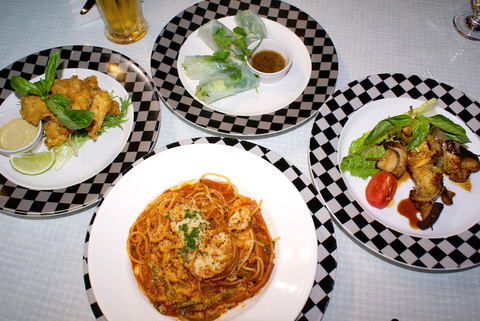
PHOTO: NOAH BUCHAN, TAIPEI TIMES
Cafe Grazie's appeal lies in sharing. If cooperation in decision-making is the norm of a service society then this place should be given an award for taking the concept into a restaurant. Be sure to leave picky eaters and those who want to dominate the menu ordering at home.
The "party special" (NT$1,300) is meant to serve four to five people, or fewer, more gluttonous patrons, the choice of ordering eight appetizers out of 23 selected from the main menu, five of the menu's 20 entrees and a desert for each diner. Included in the price are cups of coffee or tea.
The dinner for two (NT$880), or "couple festival," offers an equally large selection of items to choose from and is a perfect way to pass Valentine's Day with that special someone.
Staff said customers who plan on arriving between 6pm and 8pm should make reservations. This reviewer did not and on a recent Wednesday was seated half hour after arriving.

Taiwan’s English education system is being pulled apart by three opposing forces. Bilingual Nation 2030 pulls students toward English and global communication. Artificial Intelligence (AI) readiness pulls them toward digital judgment, verification and AI-mediated work. But Taiwan’s old exam culture pulls them back toward memorization, grammar drills, timed reading and correct answers. If the education system keeps using old exams to define success, it risks producing graduates who are neither genuinely bilingual nor genuinely AI-ready, but trained for tasks machines can already perform. The first force is Bilingual Nation 2030. Launched in 2018, the policy aimed to “help Taiwan’s workforce connect

It seems every few days one bumps into one of those “real man” comments in which Taiwan is urged to “face reality” or similar, and “make a deal,” with the speaker implying that soon it will be too late. “Deal” advocates always present themselves as having a superior grip on reality, and the manly ability to make the “hard choice.” Their testosterone-laden language often echoes that of Taiwan sellout advocates. Note that such commentary always specifies a process (“make a deal, work with, make progress”), never the end state of what occupation by a violent authoritarian colonialist state will entail. In
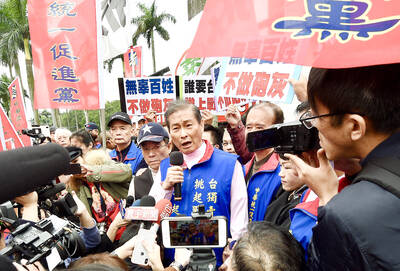
There are shadowy cabals plotting to sell out Taiwan to be annexed by China, by invasion if necessary. Fortunately, they are buffoons. In 2019, former Bamboo Union gangster and founder of the China Unification Promotion Party (CUPP), Chang An-le (張安樂, colorfully known as “White Wolf”), led a protest at the Legislative Yuan against comments made by then-premier Su Tseng-chang (蘇貞昌) that in the event of an attack by China, he would never surrender, but would protect the nation by fighting to the end, even if he only had a broom. Chang had party members bring a wooden casket that they
June 1 to June 7 "If all Taiwanese were as afraid of dying as you, then what would happen?” Physician Shih Chiang-nan (施江南) reportedly said this to his wife Chen Chiao-tung (陳焦桐) after she urged him to stop intervening on behalf of Taiwanese soldiers stranded overseas after serving in the Japanese Army during World War II. Shih had clashed with high-ranking officials over the issue, engaged in several heated arguments with Taiwan governor-general Chen Yi (陳儀) and allegedly shouted at general Ko Yuan-fen (柯遠芬), chief of staff of the Taiwan Garrison Command, over


 RSS
RSS