


During the Roaring 20s no athlete roared louder than Jack Dempsey. While Babe Ruth earned US$50,000 a year, Dempsey was able to bankrupt four Montana banks by forcing the mayor of Shelby to honor a US$250,000 guarantee that had been made to lure the champ to fight there. In 1924 Dempsey went into semiretirement by taking US$1 million from Universal to star in 10 silent movies. But two years later, playing a heavyweight on film wasn't cutting it.
Needing to taste his own blood again, the 31-year-old Dempsey approached the promoter Tex Rickard, who was attempting a comeback of his own. Rickard had just starred in a tabloid trial in which he was accused, and ultimately acquitted, of luring under-age girls to a pied a terre he kept above Madison Square Garden. Rickard's matchmaking skills were famous. But he didn't need much imagination to figure out whom Dempsey should fight next. The only boxer who came close in star power was Gene Tunney, the subject of Jack Cavanaugh's sprawling new biography.
Cavanaugh starts by recalling a chance meeting he had with Tunney on a commuter train in the mid-1960s. By then Tunney was a gray pillar of the financial world with seats on several corporate boards, and was content to go unnoticed. Cavanaugh, however, couldn't ignore him and still can't. Tunney "had the temerity, while still fighting, to become an intellectual and scholar," he writes. His "aloofness from the sport, following his retirement, coupled with his literacy, scholarly bent and wealth, damn near made him a pariah."
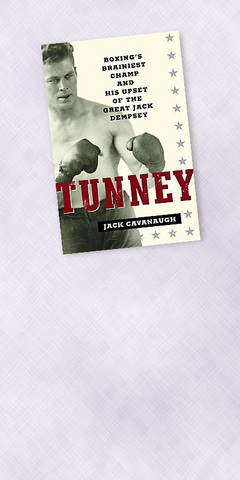
In Tunney, Cavanaugh aims to correct this injustice. But he's in no hurry to do it. The first half of his 471-page book, including acknowledgments, charts, bibliography, notes and index, is filled with so many detours (a master's class in Jewish boxing; the life story of mob-run wrestler-turned-boxer Primo Carnera) that one begins to wonder where the main character went. What we learn is that Tunney was raised poor, but not impoverished, in an Irish household on the West Side of Manhattan, where he developed an early love for literature. (To relax between matches, he often turned to his favorite play by Shakespeare, Troilus and Cressida.)
He used a pair of gloves that his father gave him to start sparring at a Knights of Columbus Hall and by age 18 was known as one of New York City's best boxers. He didn't see action when he served in World War I; he wound up guarding an airplane hangar south of Paris. But upon returning home in 1919, he was nicknamed the Fighting Marine.
While Tunney once remarked that he found "no joy in knocking people unconscious," he had a run of KOs by the mid-1920s that drew huge crowds and the eye of Dempsey, in whom he had a perfectly matched opposite. Tunney stood up straight and counterpunched while Dempsey attacked from the crouch, often landing low, dirty blows. There were other contrasts for Rickard to sell when he matched them on Sept. 23, 1926. Tunney as the erudite Easterner, Dempsey as the hard-luck ex-hobo who once mined copper for five bucks a day. But the fight already had all the glamour it needed as Dempsey's long-awaited return to the ring.
Cavanaugh, who was a frequent contributor to the New York Times, has a firm knowledge of the fight game, and his description of Tunney's 10-round upset in Philadelphia crackles. (The fight can be seen on YouTube, but this read is more fun.) The decision was so shocking, Ring Lardner wrote to F. Scott Fitzgerald that he was sure the fight was a "fake, a very well done fake."
Of course Rickard couldn't let it end there, not with the public giving the distant Tunney such a chilly hello and the press demanding a rematch. So 364 days later they met again.
Tunney-Dempsey II is known for "the long count": that moment at Soldier Field in Chicago when Dempsey knocked Tunney down in the seventh round, only to forget a new rule requiring him to move to a neutral corner before the knockdown count could start. Tunney later insisted that he was ready to get up two seconds after he hit the canvas. But the five seconds that Dempsey wasted before he was reminded of the new rule gave Tunney a 14-second break. Once he rose, he meted out three more rounds of punishment that led an exhausted Dempsey to his second straight defeat.
Dempsey was gracious afterward, and in his later years, he sat by the window of his Manhattan restaurant, greeting patrons who offered him an endless reserve of good will. Tunney, meanwhile, fell in love with an heiress to the Andrew Carnegie fortune and retired to a life of privilege.
Though in his prologue Cavanaugh notes that Tunney's marriage to Polly Lauder "became the most publicized and widely read love story of the 1920s," he never shows us how. And that's not an isolated problem. On the book's second page he says that Tunney was "an intellectual and scholar" who spent his life discussing writing with the likes of George Bernard Shaw and Somerset Maugham. But the friendship with Shaw is raced past sketchily, and Maugham — whom I spent the book waiting to see — is unforgivably dealt with in a scant footnote.
As a result Tunney doesn't accomplish its goal of making us regret the way history has regarded its subject. But the boxing scenes are spun gold, and the author is at his best when he shows us what Tunney meant to the sweet science.
Shaun Assael, a senior writer for ESPN Magazine, is at work on a history of steroids in America, to be published next fall. He also writes about boxing.
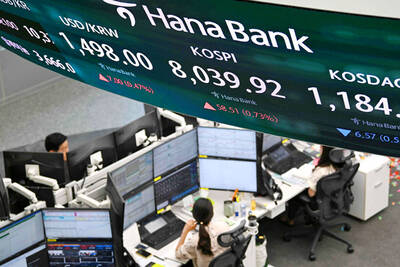
Taiwan’s overtaking of South Korea in GDP per capita is not a temporary anomaly, but the result of deeper structural problems in the South Korean economy says Chang Young-chul, the former CEO of Korea Asset Management Corp. Chang says that while it reflects Taiwan’s own gains, it also highlights weakening growth momentum in South Korea. As design and foundry capabilities become more important in the AI era, Seoul risks losing competitiveness if it relies too heavily on memory chips. IMF forecasts showing Taiwan widening its lead over South Korea have fueled debate in Seoul over memory chip dependence, industrial policy and
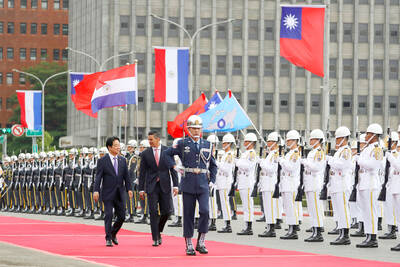
“China wants to unify with Taiwan at the lowest possible cost, and it currently believes that unification will become easier and less costly as time passes,” wrote Amanda Hsiao (蕭嫣然) and Bonnie Glaser in Foreign Affairs (“Why China Waits”) this month, describing how the People’s Republic of China (PRC) is playing the long game in its quest to seize Taiwan. This has been a favorite claim of many writers over the years, easy to argue because it is so trite. Very obviously, if the PRC isn’t attacking Taiwan, it is waiting. But for what? Hsiao and Glaser’s main point is trivial,
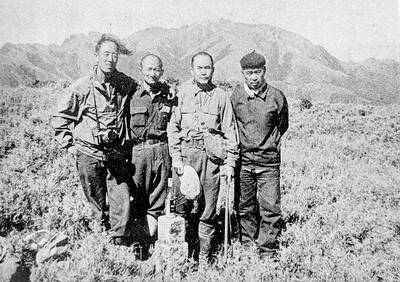
May 18 to May 24 Gathered on Yangtou Mountain (羊頭山) on Dec. 5, 1972, Taiwan’s hiking enthusiasts formally declared the formation of the “100 Peaks Club” (百岳俱樂部) and unveiled the final list of mountains. Famed mountaineer Lin Wen-an (林文安) led this effort for the Chinese Alpine Association (中華山岳協會). Working with other experienced climbers, he chose 100 peaks above 10,000 feet (3,048m) that featured triangulation points and varied in difficulty and character. The list sparked an alpine hiking craze, inspiring many to take up mountaineering and competing to “conquer” the summits. A common misconception is that the 100 Peaks represent Taiwan’s 100 tallest

And so, in the wake of US President Donald Trump’s trip to the People’s Republic of China (PRC), all the experts on the Strait of Hormuz suddenly became experts on US-China-Taiwan relations. The Internet has certainly expanded human knowledge. Lots of these sudden experts made noise this week about Trump’s words after the meeting with PRC dictator Xi Jin-ping (習近平). Trump is going to sell out Taiwan! Longtime Taiwan commentator J. Michael Cole summed the situation up neatly in the Guardian: “We need to keep in mind that he has a tendency to say many things — sometimes contradicting himself within


 RSS
RSS