


One thought comes to mind when a new band is promoted as featuring an accordion and singing Aboriginal songs tinged with bossa nova and other Latin American influences: This could be interesting, or it could be pretty bad.
Echo GS (艾可菊斯) is pretty good.
On Saturday at Witch House (女巫店) they had a packed audience — most of whom were hearing the group's acoustic ballads and fret-burning instrumentals for the first time — clapping their hands, singing along and calling for an encore. Which was impressive, considering it was Echo GS' first extended performance in nearly two years, and given that Taipei audiences seem to increasingly favor performances by musicians they know over new sounds.
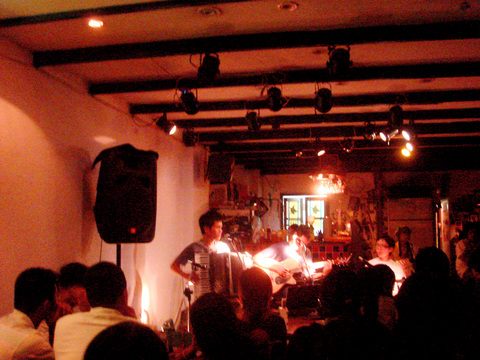
PHOTOS: RON BROWNLOW, TAIPEI TIMES
The "GS" in Echo GS stands for band members Gelresai (陳世川) and Suming (姜聖明), who met a few years ago when both were students at the National Taiwan University of Arts (國立台灣藝術大學). They lived in the same dorm and practiced together in a stairwell there because it had an echo and made their music sound better, hence the first part of their band's name.
You might know Suming, 28, as a guitar player for the increasingly popular Aboriginal blues rock band Totem (圖騰), winner of last year's battle of the bands contest at the Hohaiyan Music Festival (海洋音樂祭). With Echo GS, Suming sings, plays acoustic guitar, accordion, several different kinds of recorders, and an electric trumpet. Gelresai, 24, who completed a compulsory stint with the Air Force earlier this month, sings and plays guitar.
Since Gelresai's return from military service the band has added a third member, a friend who plays the bongo drum. Their music can best be described as a melodic folk sound covering a wide range of styles, from catchy acoustic ballads to instrumentals with an up-tempo, Latin-sounding rhythm. They usually sing in Mandarin, with a few songs featuring more powerful lyrics in the Amis language.
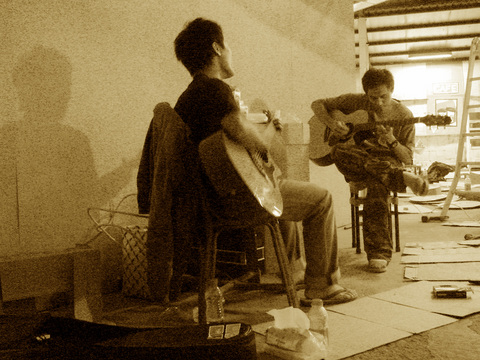
"We're a four-man band but we only have three people," said Suming, who in concert demonstrates a strong stage presence and engages the crowd in between songs with jokes about everything from his personal appearance to his ethnicity. "We're from Taitung County," he told the audience at Witch House on Saturday. "I'm from the Amis tribe and [Gelresai] is from the Rukai tribe ... . He's poorer and I'm more hard up."
On its Web site Wild Fire Music (野火樂集), the record label that promotes Echo GS, describes the band's music as having a "relaxing sound" that makes listeners feel like they're "on a sandy beach."
"I don't feel it's like this," Gelresai said in an interview in a warehouse in Tucheng (土城) last week, where he and Suming work building props for a movie. Suming agreed.
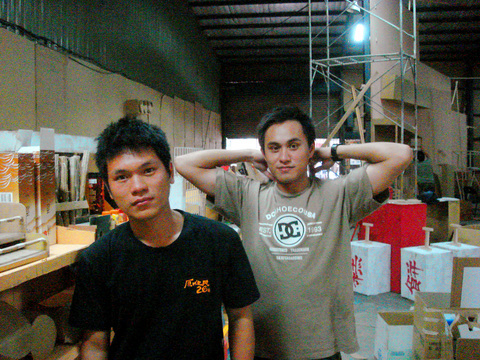
Both like the Cuban ensemble Buena Vista Social Club, but they also rejected the characterization that their songs have a Latin sound, though they had to play half-a-dozen songs before they found one that didn't fit that description. "We write our own music and don't copy other sounds," Suming explained.
"If we hear something we like, we remember it and keep it in our hearts," Gelresai said. "But we don't go out and buy it. We're afraid if we keep listening to it, we won't like it anymore."
When pressed for a better description of his music, Suming said, "I'm always looking to add new instruments. You can say we sound like we're pretending to sound like foreigners. What kind of foreign music? "I don't know," he said. "Random foreign styles."
What is certain is that Echo GS puts on a good show. None of the songs they played Saturday was a dud, even a riff on local dark metal act Chthonic (閃靈樂團) that saw Suming bellowing in a guttural drawl while he and Gelresai shredded their acoustic guitars.
If you're interested in hearing their music, you'll have to see them in concert. They have less than a dozen songs, and a spokeswoman for Wild Fire Music said Echo GS might get an album deal, but not this year or next year. "It depends on how they develop," she said.
Ajay Verma, a consultant gastroenterologist at Kettering general hospital in Northamptonshire, says our gut is a “complex machine.” “It is constantly providing us with the nutrition we need, initially to grow and develop, and then for us to survive, thrive and repair from injury and illness.” How can we keep it functioning well? Put simply: “Make sure what you put into it is balanced, and that you clear out its waste products adequately,” Verma says. “In a general gastroenterology clinic, the most common conditions we see are irritable bowel syndrome (IBS), gastroesophageal reflux disease, inflammatory bowel disease and constipation,” says Nisha
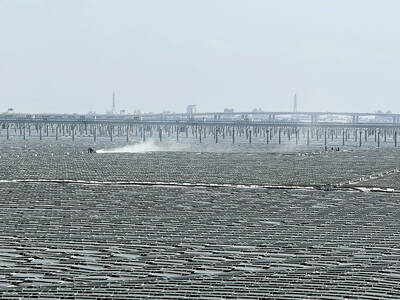
The arithmetic is straightforward and uncomfortable. By the end of 2025, Taiwan had committed itself to a 50-30-20 electricity mix — half natural gas, 30 per cent coal, 20 per cent renewables. The Ministry of Economic Affairs’s (MOEA) own monthly energy reports tell a different story. Natural gas reached 47.8 per cent of generation last year. Coal stood at 35.4 per cent, comfortably above its target ceiling. Renewables came in at 13.1 per cent, well short of the 20 per cent Taipei had pledged a decade earlier. Installed renewable capacity reached roughly half of the 12 gigawatts (GW) the government

Last week US President Donald Trump was asked by a reporter whether he would speak on the phone to the President of Taiwan. “l’ll speak to him. I speak to everybody. We have that situation very well in hand,” Trump said. This marked the second time in a couple of weeks he had said he would talk to the President of Taiwan. In 2016 he famously took a call from then-president Tsai Ing-wen (蔡英文), when he was president-elect. Despite warnings that the apocalypse was nigh because of a phone call, the world quickly forgot about the conversation between two democratically-elected presidents.
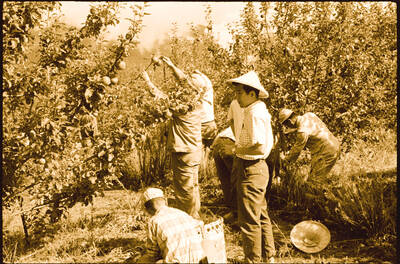
May 25 to May 31 Few believed that apples could be cultivated on a commercial scale in Taiwan’s high mountains. When horticulturalist Cheng Chao-hsiung (程兆熊) first proposed the idea in 1955, both American and Taiwanese colleagues dismissed it as implausible, arguing that temperate fruit could not be reliably grown on a subtropical island, especially on rugged terrain. However, it was this terrain in the Central Mountain Range where many Chinese Civil War veterans were resettled in the late 1950s. With limited job prospects and no family in Taiwan, they were placed on cooperative farms aimed toward self-sufficiency. Some say the conditions


 RSS
RSS