


If you are an instrumental bass enthusiast and are familiar with the works of American guitar heroes such as Joe Satriani, Steve Vai and Eric Johnson, the names of Stuart Hamm, Billy Sheehan and Jeff Berlin ought to equate with musical greatness. The three bass virtuosos from the US joined forces, formed BX3, and will make a swift visit to Taipei during their first Asian tour, staging the one and only concert tomorrow night at the Liberty Square Convention Center (自由廣場大樓).
BX3 is Hamm's bass version of the legendary G3, an almost annual live music show and guitar touring outfit founded in 1996 and featuring three of the most influential instrumental rock guitarists of the past decade in the US — Joe Satriani, Steve Vai and Eric Johnson, with whom Hamm and Sheehan have played alongside on G3 tours.
Far out of the mainstream where Britney Spears facsimiles and pretty-faced boy bands reign, the three premiere bass players with a raft of accolades under their belts have first hand experience of rock's post-1970s vicissitudes and remain true to the spirit of creative musicians who strive to test the limits of bass techniques and help to elevate bassists from supporting roles to become valid solo voices.
Born in 1960 to a musical family, Hamm became a household name to rock aficionados in the 1980s playing gigs and recording albums with Frank Gambale, Satriani and Vai, whom he met and established life-long friendships while studying at Berklee College of Music in Boston.
An innovative bassist proficient in slap, pop, slide styles and tapping, Hamm explored different types of music and honed a reputation as a mature artist in a variety of genres ranging from rock, experimentation to instrumental jazz.
Having his handprints permanently preserved in cement on the Hollywood Rockwalk at Guitar Center, Sheehan is another legendary figure who is said to have changed the way bass is played with his signature styles and techniques. The 53-year-old bassist rose to cult status in the late 1970s and early 1980s with his first full-time band Talas, a three-piece act based in Buffalo, New York.
Along with singer Eric Martin, guitarist Paul Gilbert, and drummer Pat Torpey, Sheehan formed Mr. Big in 1988, a group that leaned toward commercial hard rock. Throughout the 1990s, the band issued albums and several national hits and built up a following in Japan before breaking up in 2002. Since the split Sheehan has worked with various musicians and on projects such as the three-piece jazz-fusion-rock band Niacin.
Last but not least is Berlin, who independently records, manufactures and markets his music. Considered by many as the best living electric bass player in the world, the Berklee graduate plays a distinctive fusion sound and believes a true bassist shouldn't play like a bass player but explore different musical possibilities.
For their Taipei show, the three bassists will demonstrate their individual prowess in separate performances followed by a set from local jazz combo Delta On the Main Street and Brain Chiu (邱培榮), solo performer and bassist for pop stars such as A-mei (張惠妹), Coco Lee (李玟) and Power Station (動力火車). Hamm and Berlin will play with drummer John Mader and guitar player Jude Gold from San Francisco, and Sheehan will woo the audience with melodic tunes. Tonight's show will climax with a free-style jam by the doyens of bass guitar.
Performance notes:
What: BX3 Bass Virtuosity Taipei Concert
When: Tomorrow at 6:30pm
Where: Liberty Square Convention Center (自由廣場大樓), 2F, 399, Ruiguang Rd, Taipei (台北市瑞光路399號2樓).
Tickets: NT$1,700 for rock area, NT$1,100 for deck area, available through ERA ticketing outlets. Visit www.ticket.com.tw or call (02) 2341 9898

Yesterday, the Democratic Progressive Party (DPP) nominated legislator Puma Shen (沈伯洋) as their Taipei mayoral candidate, the Chinese Nationalist Party (KMT) put their stamp of approval on Wei Ping-cheng (魏平政) as their candidate for Changhua County commissioner and former legislator Tsai Pi-ru (蔡壁如) of the Taiwan People’s Party (TPP) has begun the process to also run in Changhua, though she has not yet been formally nominated. All three news items are bizarre. The DPP has struggled with settling on a Taipei nominee. The only candidate who declared interest was Enoch Wu (吳怡農), but the party seemed determined to nominate anyone

In a sudden move last week, opposition lawmakers of the Chinese Nationalist Party (KMT) and Taiwan People’s Party (TPP) passed a NT$780 billion special defense budget as a preemptive measure to stop either Chinese leader Xi Jinping (習近平) or US President Donald Trump from blocking US arms sales to Taiwan at their summit in Beijing, said KMT heavyweight Jaw Shaw-kong (趙少康), speaking to the Taipei Foreign Correspondents Club on Wednesday night in Taipei. The 76-year-old Jaw, a political talk show host who ran as the KMT’s vice presidential candidate in 2024, says that he personally brokered the deal to resolve
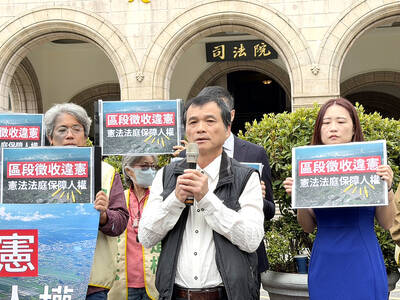
What government project has expropriated the most land in Taiwan? According to local media reports, it is the Taoyuan Aerotropolis, eating 2,500 hectares of land in its first phase, with more to come. Forty thousand people are expected to be displaced by the project. Naturally that enormous land grab is generating powerful pushback. Last week Chen Chien-ho (陳健和), a local resident of Jhuwei Borough (竹圍) in Taoyuan City’s Dayuan District (大園) filed a petition for constitutional review of the project after losing his case at the Taipei Administrative Court. The Administrative Court found in favor of nine other local landowners, but

The Chinese Nationalist Party (KMT) and its sock puppet, the Taiwan People’s Party (TPP), passed their version of the government’s proposed supplementary defense spending bill last week, engendering much commentary. While all eyes were on the defense budget, the PRC’s assault on Taiwan was advancing on other fronts. The removal of domestic drone production and other technologies critical to the nation’s asymmetrical defenses from the list of items purchased in the “compromise” bill shows how the KMT-TPP alliance appears to be serving the People’s Republic of China (PRC). Ironically, the cuts will impact industries heavily represented by tech firms in areas run


 RSS
RSS