


The widely reviled proliferation of cheap knockoffs of Chinese cooking in the English-speaking world could be seen as detrimental to cultural development. If you've been to the US, think Panda Express, the joint that plies Americans with "the wonderful flavors of authentic Chinese food."
That phrase, lifted from the company's Web site, is part of what makes Panda Express so grim: the corruption of authentic foreign cuisine.
Of course, the big question when entering Anadolu was whether the food would be authentically Turkish. James Liu (
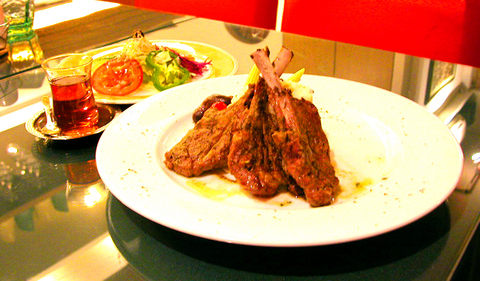
PHOTO: CHRIS PECHSTEDT, TAIPEI TIMES
"I had Turkish food [while I was studying] in England, and I loved it," he said. "Then I went to Turkey and it was completely different... . You have to adapt to local tastes, but keep it unique at the same time. That's the tricky part."
Tricky or not, Liu's food makes a convincing case for localized -- as opposed to local -- cuisine. At his recommendation, I tried two lamb dishes (lamb being an important meat in Turkish cooking), and a respectable Western-style salad.
Both lamb dishes were unusually tender, and characterized by simple yet pronounced flavors that showed, to varying degrees, elements of the Greek, Middle Eastern, and Central Asian influences in Turkish food.
At the same time, both dishes were distinctly Taiwanese, lacking both the dairy ingredients and the Mediterranean fruits used in Turkish cooking. The lamb in the excellent stew was cooked in a similar manner to the meat in Taiwanese beef noodles, but was served in a thin curry-like sauce and flavored with tomato.
This is not a place for adventure-seekers. There may be pine nuts in the rice, but the food does not really aspire to be challenging or exotic. The flavor is unique, but not jaw-droppingly so.
"There's already an authentic Turkish restaurant in Taipei, owned by people from Turkey," Liu said. "I'm not trying to compete with them."
Like Tex-Mex, British and Japanese curry houses, and the California roll, Anadolu mixes elements of various cuisines in a way that seems natural. The Turkishness, what there is of it, is not a gimmick.

Taiwan’s English education system is being pulled apart by three opposing forces. Bilingual Nation 2030 pulls students toward English and global communication. Artificial Intelligence (AI) readiness pulls them toward digital judgment, verification and AI-mediated work. But Taiwan’s old exam culture pulls them back toward memorization, grammar drills, timed reading and correct answers. If the education system keeps using old exams to define success, it risks producing graduates who are neither genuinely bilingual nor genuinely AI-ready, but trained for tasks machines can already perform. The first force is Bilingual Nation 2030. Launched in 2018, the policy aimed to “help Taiwan’s workforce connect
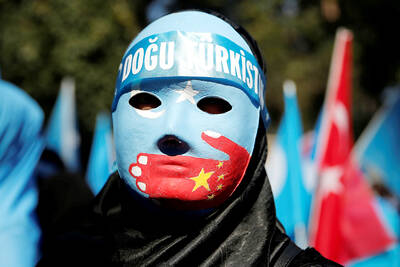
It seems every few days one bumps into one of those “real man” comments in which Taiwan is urged to “face reality” or similar, and “make a deal,” with the speaker implying that soon it will be too late. “Deal” advocates always present themselves as having a superior grip on reality, and the manly ability to make the “hard choice.” Their testosterone-laden language often echoes that of Taiwan sellout advocates. Note that such commentary always specifies a process (“make a deal, work with, make progress”), never the end state of what occupation by a violent authoritarian colonialist state will entail. In
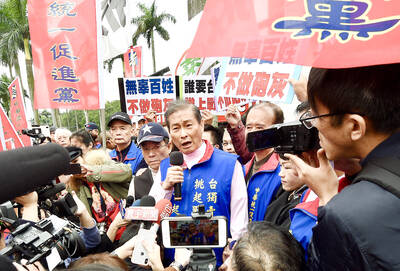
There are shadowy cabals plotting to sell out Taiwan to be annexed by China, by invasion if necessary. Fortunately, they are buffoons. In 2019, former Bamboo Union gangster and founder of the China Unification Promotion Party (CUPP), Chang An-le (張安樂, colorfully known as “White Wolf”), led a protest at the Legislative Yuan against comments made by then-premier Su Tseng-chang (蘇貞昌) that in the event of an attack by China, he would never surrender, but would protect the nation by fighting to the end, even if he only had a broom. Chang had party members bring a wooden casket that they
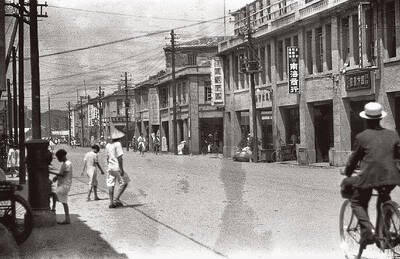
June 1 to June 7 "If all Taiwanese were as afraid of dying as you, then what would happen?” Physician Shih Chiang-nan (施江南) reportedly said this to his wife Chen Chiao-tung (陳焦桐) after she urged him to stop intervening on behalf of Taiwanese soldiers stranded overseas after serving in the Japanese Army during World War II. Shih had clashed with high-ranking officials over the issue, engaged in several heated arguments with Taiwan governor-general Chen Yi (陳儀) and allegedly shouted at general Ko Yuan-fen (柯遠芬), chief of staff of the Taiwan Garrison Command, over


 RSS
RSS