


Because Woody Allen's early films are about as funny as any ever made, it is often assumed that his temperament is essentially comic, which leads to all manner of disappointment and misunderstanding. Now and then, Allen tries to clear up the confusion, insisting, sometimes elegantly and sometimes a little too baldly, that his view of the world is essentially nihilistic. He has announced, in movie after movie, an absolute lack of faith in any ordering moral principle in the universe -- and still, people think he's joking.
In Match Point, his most satisfying film in more than a decade, the director once again brings the bad news, delivering it with a light, sure touch. This is a Champagne cocktail laced with strychnine. You would have to go back to the heady, amoral heyday of Ernst Lubitsch or Billy Wilder to find cynicism so deftly turned into superior entertainment. At the very beginning, Allen's hero, a young tennis player recently retired from the professional tour, explains that the role of luck in human affairs is often underestimated. Later, the harsh implications of this idea will be evident, but at first it seems as whimsical as what Fred Astaire said in The Gay Divorcee: that "chance is the fool's name for fate."
Allen's accomplishment here is to fool his audience, or at least to misdirect us, with a tale whose gilded surface disguises the darkness beneath. His guile -- another name for it is art -- keeps the story moving with the fleet momentum of a well-made play. Comparisons to Crimes and Misdemeanors are inevitable, since the themes and some elements of plot are similar, but the philosophical baggage in Match Point is more tightly and discreetly packed. There are few occasions for speech-making, and none of the desperate, self-conscious one-liners that have become, in Allen's recent movies, more tics than shtick. Nor is there an obvious surrogate for the director among the youthful, mostly British and altogether splendid cast. If you walked in after the opening titles, it might take you a while to guess who made this picture.
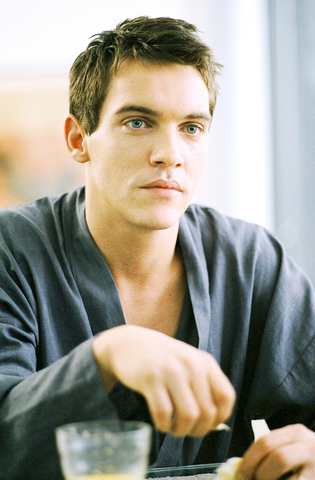
PHOTO COURTESY OF UNIVERSAL
After a while you would, of course. The usual literary signposts are in place: surely no other screenwriter could write a line like "darling, have you seen my copy of Strindberg?" or send his protagonist to bed with a paperback Dostoyevsky. But while a whiff of Russian fatalism lingers in the air -- and more than a whiff of Strindbergian misogyny -- these don't seem to be the most salient influences. The film's setting is modified Henry James (wealthy London, with a few social and cultural outsiders buzzing around the hives of privilege); the conceit owes something to Patricia Highsmith's Ripley books; and the narrative engine is pure Theodore Dreiser -- hunger, lust, ambition, greed.
Not that the tennis player, Chris Wilton (Jonathan Rhys-Meyers), seems at first to be consumed by such appetites. An Irishman of modest background, he takes a job at an exclusive London club, helping its rich members polish their ground strokes. He seems both easygoing and slightly ill at ease, ingratiating and diffident. Before long, he befriends Tom Hewett (Matthew Goode), the amiable, unserious heir to a business fortune, who invites Chris to the family box at the opera. From there, it is a short trip to an affair with Tom's sister, Chloe (Emily Mortimer), a job in the family firm and the intermittently awkward but materially rewarding position of son-in-law to parents played by Brian Cox and Penelope Wilton.
When Match Point was shown in Cannes last spring, some British critics objected that its depiction of London was inaccurate, a demurral that New Yorkers, accustomed to visiting Allen's fantasy Manhattan, could only greet with weary shrugs and sighs. Uprooting a script originally set in the Hamptons and repotting it in British soil has refreshed and sharpened the story, which depends not on insight into a particular social situation, but rather on a general theory of human behavior. London is Manhattan seen through a glass, brightly: Tate Modern stands in for the Museum of Modern Art; Covent Garden takes the place of Lincoln Center. As for the breathtaking South Bank loft into which Chris and Chloe move, it will satisfy the lust for high-end real estate that has kept the diehards in their seats during Allen's long creative malaise.
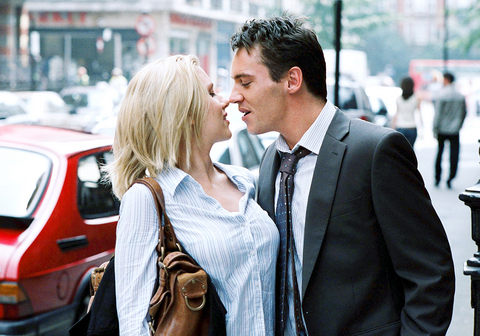
PHOTO COURTESY OF UNIVERSAL
In this case, though, what happens in the well-appointed rooms and fashionable restaurants is more interesting than the architecture or the decor. Rhys-Meyers has an unusual ability to keep the audience guessing, to draw us into sympathetic concord even as we're trying to figure him out. Is he a cipher or a sociopath? A careful social climber or a reckless rake? The first clue that he may be something other than a mild, well-mannered sidekick comes when Chris meets Tom's fiancee, a US actress named Nola Rice (Scarlett Johansson), in a scene that raises the movie's temperature from a polite simmer to a full sexual boil.
But it is the film's brisk, chilly precision that makes it so bracingly pleasurable. The gloom of random, meaningless existence has rarely been so much fun, and Allen's bite has never been so sharp, or so deep. A movie this good is no laughing matter.

The breakwater stretches out to sea from the sprawling Kaohsiung port in southern Taiwan. Normally, it’s crowded with massive tankers ferrying liquefied natural gas from Qatar to be stored in the bulbous white tanks that dot the shoreline. These are not normal times, though, and not a single shipment from Qatar has docked at the Yongan terminal since early March after the Strait of Hormuz was shuttered. The suspension has provided a realistic preview of a potential Chinese blockade, a move that would throttle an economy anchored by the world’s most advanced and power-hungry semiconductor industry. It is a stark reminder of
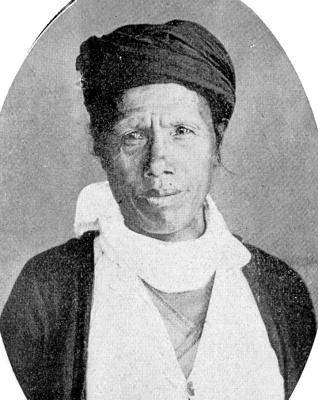
May 11 to May 17 Traversing the southern slopes of the Yushan Range in 1931, Japanese naturalist Tadao Kano knew he was approaching the last swath of Taiwan still beyond colonial control. The “vast, unknown territory,” protected by the “fierce” Bunun headman Dahu Ali, was “filled with an utterly endless jungle that choked the mountains and valleys,” Kano wrote. He noted how the group had “refused to submit to the measures of our authorities and entrenched themselves deep in these mountains … living a free existence spent chasing deer in the morning and seeking serow in the evening,” even describing them as
The last couple of weeks spectators in Taiwan and abroad have been treated to a remarkable display of infighting in the Chinese Nationalist Party (KMT) over the supplementary defense budget. The party has split into two camps, one supporting an NT$800 billion special defense budget and one supporting an NT$380 billion budget with additional funding contingent on receiving letters of acceptance (LOA) from the US. Recent media reports have said that the Taiwan People’s Party (TPP) is leaning toward the latter position. President William Lai (賴清德) has proposed NT$1.25 trillion for purchases of US arms and for development of domestic weapons

As a different column was being written, the big news dropped that Chinese Nationalist Party (KMT) caucus whip Fu Kun-chi (傅?萁) announced that negotiations within his caucus, with legislative speaker Han Kuo-yu (韓國瑜) of the KMT, party Chair Cheng Li-wun (鄭麗文), Taichung Mayor Lu Shiow-yen (盧秀燕) and Taiwan People’s Party (TPP) Chair Huang Kuo-chang (黃國昌) had produced a compromise special military budget proposal. On Thursday morning, prior to meeting with Cheng over a lunch of beef noodles, Lu reiterated her support for a budget of NT$800 or NT$900 billion — but refused to comment after the meeting. Right after Fu’s


 RSS
RSS