


"Come on, Oscar, let's you and me get drunk," snaps Bette Davis as Margaret Elliott, a down-on-her-luck fading movie queen, in The Star, as she grabs her gold statuette, places it on the dashboard of her 1946 Mercury sedan and heads out on a bender.
In an updated version, Davis wouldn't drive to the nearest bar to drown her sorrows. She would go directly to Sotheby's, where her Oscar would net her a half-million US dollars or more -- enough to keep her in mink and martinis for the rest of her post-diva days.
An Oscar has always been as much about commerce as about art: it ups an actor's asking price and box office appeal. These days the trophy itself can mean cold cash as a collec-tible, worth up to US$50,000 for a "common Oscar," as experts call the technical and tangential awards, and from several hundred thousand dollars to US$1.5 million for those bestowed upon famous films and actors.
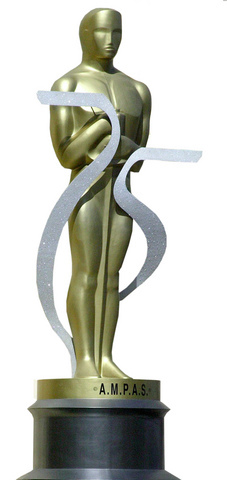
The trade in vintage Oscars through publicized auctions and an underground market has become a parallel universe as competitive and bitter as the annual acting derby itself.
"Someone called me up for an important Oscar for an important film, for a lot of money," said Josh Evans, chairman of Leland's, a New York-based auction house. He is not about to name names -- not because auctioneering is a business of confidentiality, but because the statuette in question was awarded after 1950, the year the Academy of Motion Picture Arts and Sciences began asking winners to sign an agreement that would keep them from selling their awards for profit. (Today the academy requires this.)
Evans likens the marketing of the proffered Oscar to getting rid of stolen merchandise.
"I don't see how it's possible," he said. "It's almost like buying the Mona Lisa -- no, like that painting The Scream. There's no or little value, or even underground value. It's too famous." (The film of the Oscar in question: On the Waterfront.)
During the 1990s, prices for collectibles soared into the stratosphere. Recently, the magician David Copperfield paid just under a quarter of a million dollars for the Oscar awarded to Michael Curtiz as director of Casablanca. In 1999, Michael Jackson paid US$1.54 million for the best-picture Oscar for Gone With the Wind.
These days the academy monitors auctions and hinders questionable sales with aggressive tactics.
"This isn't the nice people you see on TV who present the awards," said Steven Ames Brown, a lawyer who fought the academy for eight years over Orson Welles' 1941 Oscar for best original screenplay (which he shared with Herman J. Mankiewicz), for Citizen Kane, which Welles' daughter, Beatrice, wanted to auction to finance animal-rights causes. "This is a business, a very ugly business. They are completely uninterested in anybody else's life or needs. I call them thugs in suits, whose job it is to put a happy face on their conduct."
It's interesting that Beatrice Welles herself obtained the stat-uette only by taking legal action against the cinematographer Gary Graver, who was in possession of it. Graver, who described the gesture as a nod to both their friendship and Welles' gratitude for the years, said: "Orson gave it to me. He said, `Here, keep this."' Graver said he worked for next to nothing for the struggling director in the 1960s and 1980s. Welles' daughter sued Graver and won.
"I wouldn't say this in court," he said, "but he also gave me films and personal papers. I was afraid she'd go after everything he gave to me."
Bruce Davis, the academy's executive director, defends his organization's crusade by saying: "The more that Oscars are sold, the more it enables the idea of them as collectible items. This is an award for artistic excellence. So while no particular one is a disaster for us, every time one goes it's another ax stroke."
Those sympathizing with the academy include the director Steven Spielberg and the actor-producer Kevin Spacey -- both Oscar winners. They have jumped into the fray by digging into their wallets to rescue Oscars at public auction and then returning the statuettes to the academy. Spielberg has spent nearly US$1.5 million for the cause. He paid US$607,500 for Clark Gable's 1934 Oscar, for It Happened One Night; US$578,000 for Bette Davis' 1938 Oscar, for Jezebel; and US$207,500 for Davis' 1935 Oscar, for Dangerous.
Spacey paid US$156,875 for the composer George Stoll's 1945 Oscar for Anchors Aweigh.
On the other side of the battle are heirs of deceased Oscar winners and their lawyers and the collectors, many of whom look on the academy as the Evil Empire. One memorabilia seller, Nate Sanders, was sued by the academy when his Web site offered Judy Garland's 1939 Oscar, for The Wizard of Oz, on behalf of Sid Luft, Garland's third husband. "They had sued me for perjury, but the judge immediately dismissed it," Sanders said. "They had these lawyers come after me and Sid. They were very aggressive. I was very, very angry."
The Welles and Garland statuettes are pre-1950, but the legal argument used by the academy hinges on the validity of waivers necessary for the replacement of vintage Oscars lost over the years -- who actually signed the waiver and whether it covers the original as well as the replacement. Two years ago, Beatrice Welles finally won her case, allowing her to sell not only her father's Citizen Kane Oscar -- estimated at US$1 million -- but also his lifetime-achievement Oscar.
Copperfield, who legally acquired the Casablanca best-director Oscar at auction, defends his private ownership of the public icon. If Michael Curtiz's "family didn't want to sell or wanted to keep it in my family, that is their decision," Copperfield said, explaining that the statuette represents the excellence of old films that influenced his career as an illusionist. "It's a symbol, a reminder, to get my work even better. It keeps me hungry."
Needy heirs who own a stat-uette don't always have the luxury to debate the pros and cons of selling it. Survival trumps sentiment. "I came to a low point -- I needed money to survive and get along on," Graver said. There on his mantel, he recalled, stood the Citizen Kane Oscar. "And I looked at it, and it dawned on me that the Oscar was worth money, and I felt that after all those years I worked for Orson, for practically little or no money, maybe he would think it was OK and I could sell it."
When Bette Davis left an Oscar and other artifacts to her trusted assistant, Kathy Sermak, she had a similar motive, Robert Osborne, the Turner Classic Movies host and an old friend of the actress', specu-lated. "I would bet, knowing Bette, that she gave it to Kathy so that if she fell on hard times she would have something to turn into money," he said.
The ultimate hard-luck Oscar sale was made by Harold Russell, the paraplegic World War II vet in The Best Years of Our Lives (1946). The only winner to sell his own Oscar, he initially said he did it to pay his wife's medical bills. The real story, according to Bruce Davis, was decidedly less heart-tugging.
"A couple of reporters pinned him down," Davis said. "It came out that his wife wanted to take a cruise. He had a new wife who knew he had a spare Oscar. Lew Wasserman bought it and donated it back to us."
Unfortunately for Russell, his Oscar for best supporting actor in a best picture netted him only about US$50,000 in 1992. Today that would be a bare-bones minimum.
In the current marketplace, nameplates are sometimes removed from the statuettes to make them salable, even though less valuable. The owner of a statuette whose plate is lost can use the serial number on the bottom to replace the plate and thereby bump up the value.
Evans of Leland's auction house says a Paramount executive once offered him a blank statuette, claiming it was Leo McCarey's best-director Oscar for Going My Way.
"I said, `How do you know it's Leo McCarey's?"' Evans said. "He says, `I know because I got it from McCarey's son."'
Evans said he gave him US$10,000 for the anonymous statuette. "But I told him if he got the nameplate I'd give him another US$10,000."
The executive ordered the plate from the academy, and Evans paid.
"That's US$10,000 for a little piece of plastic," Evans said with a chuckle. "And if the academy had known it was going to be sold, they never would have helped him."
To claim that the Oscar's image is sullied by the auctioning of the occasional statuette is hypocrisy, said Brown, the lawyer who represented Orson Welles' daughter. "If the image of the Oscars is so sacrosanct, I posed to them through the pleadings, then why did you give an Oscar to Roman Polanski after he raped a minor? And why did you not put the Oscars on time delay two years ago and stop Michael Moore from bashing American foreign policy during active combat?"
Copperfield simply laughed when asked to comment on the academy's fear that statuette purchases threaten to turn the award into a commercial commodity.

What was the population of Taiwan when the first Negritos arrived? In 500BC? The 1st century? The 18th? These questions are important, because they can contextualize the number of babies born last month, 6,523, to all the people on Taiwan, indigenous and colonial alike. That figure represents a year on year drop of 3,884 babies, prefiguring total births under 90,000 for the year. It also represents the 26th straight month of deaths exceeding births. Why isn’t this a bigger crisis? Because we don’t experience it. Instead, what we experience is a growing and more diverse population. POPULATION What is Taiwan’s actual population?

For the past five years, Sammy Jou (周祥敏) has climbed Kinmen’s highest peak, Taiwu Mountain (太武山) at 6am before heading to work. In the winter, it’s dark when he sets out but even at this hour, other climbers are already coming down the mountain. All of this is a big change from Jou’s childhood during the Martial Law period, when the military requisitioned the mountain for strategic purposes and most of it was off-limits. Back then, only two mountain trails were open, and they were open only during special occasions, such as for prayers to one’s ancestors during Lunar New Year.

A key feature of Taiwan’s environmental impact assessments (EIA) is that they seldom stop projects, especially once the project has passed its second stage EIA review (the original Suhua Highway proposal, killed after passing the second stage review, seems to be the lone exception). Mingjian Township (名間鄉) in Nantou County has been the site of rising public anger over the proposed construction of a waste incinerator in an important agricultural area. The township is a key producer of tea (over 40 percent of the island’s production), ginger and turmeric. The incinerator project is currently in its second stage EIA. The incinerator

It sounded innocuous enough. On the morning of March 12, a group of Taichung political powerbrokers held a press conference in support of Deputy Legislative Speaker Johnny Chiang’s (江啟臣) bid to win the Chinese Nationalist Party (KMT) primary in the Taichung mayoral race. Big deal, right? It was a big deal, one with national impact and likely sent shivers down the spine of KMT Chairwoman Cheng Li-wun (鄭麗文). Who attended, who did not, the timing and the messaging were all very carefully calibrated for maximum impact — a masterclass in political messaging. In October last year, the Democratic Progressive Party (DPP)


 RSS
RSS