


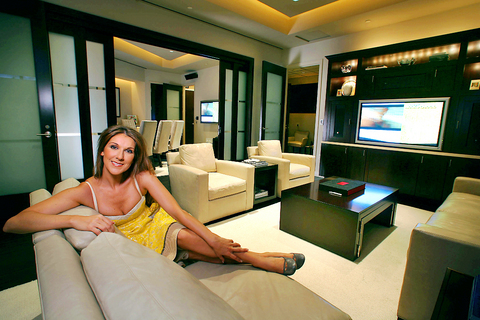
Not many performers have backstage dressing rooms in a luxurious league with Celine Dion's. Hers is less a niche for primping and idling than a rambling private apartment, reached by way of a secure, hidden garage deep below Caesars Palace, in Las Vegas. It not only has a large dining room, where she can entertain guests, but also a smaller one, where she can sup alone. Beyond the brightly lighted area for hair and makeup is a softly lighted chamber for massages. All that belting and chest thumping are murder on her back.
But the most striking aspect of Dion's spread at Caesars is its uncanny resemblance to her home, which overlooks a manmade lake about 30km away. Using the same interior decorator, she created a doppelgaenger domicile, with a similarly muted palette of browns, beiges, and grays; similar contemporary furniture, a similar gallery of photographs of her husband, Rene Angelil, and their four-year-old son, Rene Charles.
People in the Las Vegas entertainment world titter that Dion, an unabashedly indulgent mother, wanted to make sure that her son never felt displaced. Dion says the reason is simpler. "We are comfortable in this environment," she said one recent afternoon at her home, where she and her husband sat on a patio off the living room. "Why not make ourselves comfortable over there?"
PHOTOS: NY TIMES
Las Vegas has been nothing if not comfortable to Dion, who made her debut here two years ago as the resident talent at Caesars, performing about five shows a week in a 4,100-seat theater built specifically for her, at a cost of roughly US$95 million. Now instead of flying to a new city every day, she slips into the back seat of a black Mercedes for a 20-to-30-minute commute. Instead of adjusting to different working conditions in each new venue, she enjoys a special climate control system that maintains a voice-soothing 55 percent humidity level onstage, just like the level in her house.
"The traveling and the stadiums -- the kick of being on the road -- is like a rock 'n' roll song," she said, as she sank into one of the tan leather seats in that Mercedes. Within reach were a Tiffany's catalog and a surgical mask in case ash from desert wildfires hung in the air.
"No ballads will take a rock 'n' roll song away. And no rock 'n' roll song will ever take a ballad away. To me, it's like pretty smooth riding here."
To varying degrees, Dion has been joined on that easier street -- that ballad of a boulevard -- by Barry Manilow, who has planted roots at the Las Vegas Hilton, where he has a 1,700-seat auditorium and a rooftop suite. By Elton John, who performs in Dion's moist theater when she takes vacations. By the comedians Rita Rudner and David Brenner, who are Vegas residents now.
They are turning Vegas into a sort of non-retirement retirement home for performers who are weary of the road, but who have not yet been consigned to the nostalgic kitsch of Wayne Newton or Don Rickles. They are drawn here in part by the same changes that have recently attracted other new residents and new kinds of tourists. Some of the world's most revered chefs, including the Frenchmen Alain Ducasse and Joel Robuchon, have opened or are about to open restaurants here. George Clooney is building a hotel. Hollywood stars are buying condominiums. The television gossip show Extra has even established a Vegas bureau.
"Five years ago, I was in New York, and I saw Elvis Costello and I said, `I look forward to seeing you in Vegas,"' recalled Penn Jillette, 50, a Vegas resident since the early 1990s and one half of the magic and comedy act Penn and Teller. "He said, `I don't think so. They prefer the dead Elvis in Vegas."' Since then, the live one has performed here more than once.
But a sense of Vegas as newly and
improbably cool is not the principal lure or benefit for the performers who have made it a home or a headquarters. For all its noise and light, Vegas eliminates distractions. It collapses distances. They are discovering that the abnormal city of Las Vegas allows them perhaps the most normal, nine-to-five-style schedules and insular lives that stage stars can find beyond Broadway.
The predictable rhythms and self-containment of Vegas mean that stars seldom encounter anything unexpected. The reliable tides of tourists mean that a performer can stay put and fill seats night after night. And so a concert by Dion, Sir Elton, or Manilow is now somewhat like the Trevi Fountain or Ayers Rock. It doesn't come to you. You go to it.
"It's a dream come true," Manilow said in his suite here recently.
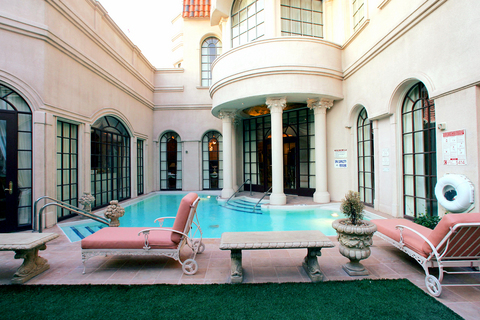
It's some suite. It came as part of his deal with the Hilton, and its amenities include an outdoor pool, which by some minor miracle of modern botany has a lawn around it. Seemingly every room inside has faux Corinthian columns and ceiling frescoes. There's a riot of gold paint, as if Midas didn't so much touch as grope the place. His marble master bathroom has two spas, one rectangular and one circular. It has a walk-in shower so
complicated it terrifies him.
"I finally figured out how to use one spigot," he said, "and that's all I use."
He doesn't actually spend all his time there -- a private plane can have him in his house and bed in Palm Springs in just 45 minutes -- but the Hilton makes the most of his presence. The front desk answers all calls with the line, "Las Vegas Hilton, home of Barry Manilow's music and passion." And the back office tries hard to anticipate his every whim. If he muses out loud about wanting to invite his band up to his suite for some Chinese, lo and behold it appears.
Best of all, said Manilow, 59, he doesn't have to pack several suitcases and adjust to new acoustics and a new time zone every few nights.
His friend Brenner -- who already had a deal with the Hilton, and still does -- pitched him on coming to Vegas while he was doing a long, depleting final tour last year. "I said, `How would you like to be in one place?"' Brenner, 60, recalled during a recent lunch with Manilow here. "He said, `What place?' I could have said, `Des Moines."'
"I was ready," Manilow said.
"You weren't doing a Cher thing," Brenner said. "This wasn't your 12th farewell tour."
George Wallace, a comedian with a nightly show at the Flamingo Hotel, explains, "We're tired of running all over the world." At the Flamingo, he has a two-bedroom suite on the 27th floor, an office on a lower floor, and a separate dressing room near that. He can travel among them without ever stepping outside, a movement and exposure he deems vastly overrated. "It's 116 degrees at midnight," he said.
"Sixty percent of my days," he later added, "I never leave the hotel." It has all the periodicals, food, and fresh towels he could need. He did indeed go out on a recent night, but only to walk across Las Vegas Boulevard for a rib-eye at a steakhouse inside Caesars.
Seemingly every server there knew him, and he was so relaxed that even as the clock passed 9:40pm -- just 20 minutes before show time -- he lazily rose from the table and shuffled without hurry through the Caesars lobby.
Dion, too, has her routine down pat, leaving her house about 5pm, taking the stage about 8:30, finishing around 10 and arriving home as early as 11. She seldom digresses to visit stores or restaurants, she said, "because of air-conditioning, meeting a lot of people, shaking hands -- more chances to get sick."
Next to the entrance to Dion's theater in Vegas is an all-Celine store, nearly as big as a Gap, in which her fans can purchase Celine discs, books, refrigerator magnets, and coffee mugs, of course, and also Celine bath togs, Celine crystal pendants by Baccarat, Celine watches by Fossil, and lotions and sprays with any of the three Celine scents: Celine Dion, Notes, and the newest, Belong.
The Hilton has a store devoted to Manilow, in which the items on sale include Barry Manilow zinfandel and a bottled juice drink called the Strawberry Manilow. Enormous pictures of him hang inside and outside the hotel, and a tiny picture of him adorns the currency with which gamblers at the hotel play.
"They've got my little face on the chips," Manilow said.
"I was playing with them last night!" chimed in his publicist, Carol Marshall.
As he walked down a service hallway, a female hotel employee said, "I love you and I love your music."
"You better," he said as soon as she was out of earshot, then added, to his companions, "It's all they play here all day long. I'm surprised she didn't say, `I'm sick of you."'
It's a surreal life in Vegas, Manilow
acknowledged, but a sweet one, and that may be why gossip columns are increasingly
atwitter with reports of entertainers like Madonna and Britney Spears considering permanent gigs here.

As mega K-pop group BTS returns to the stage after a hiatus of more than three years, one major market is conspicuously missing from its 12-month world tour: China. The omission of one of the group’s biggest fan bases comes as no surprise. In fact, just the opposite would have been huge news. China has blocked most South Korean entertainment since 2016 under an unofficial ban that also restricts movies and the country’s popular TV dramas. For some Chinese, that means flying to Seoul to see their favorite groups perform — as many were expected to do for three shows opening
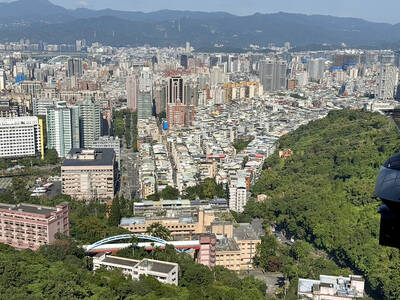
A recent report from the Environmental Management Administration of the Ministry of Environment highlights a perennial problem: illegal dumping of construction waste. In Taoyuan’s Yangmei District (楊梅) and Hsinchu’s Longtan District (龍潭) criminals leased 10,000 square meters of farmland, saying they were going to engage in horticulture. They then accepted between 40,000 and 50,000 cubic meters of construction waste from sites in northern Taiwan, charging less than the going rate for disposal, and dumped the waste concrete, tile, metal and glass onto the leased land. Taoyuan District prosecutors charged 33 individuals from seven companies with numerous violations of the law. This
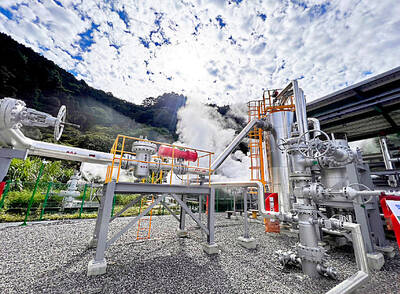
Taiwan’s semiconductor industry consumes electricity at rates that would strain most national grids. Taiwan Semiconductor Manufacturing Co (TSMC) alone accounted for more than 9 percent, or 2,590 megawatts (MW), of the nation’s power demand last year. The factories that produce chips for the world’s phones and servers run around the clock. They cannot tolerate blackouts. Yet Taiwan imports 97 percent of its energy, with liquefied natural gas reserves measured in days. Underground, Taiwan has options. Studies from National Taiwan University estimate recoverable geothermal resources at more than 33,000 MW. Current installed capacity stands below 10 MW. OBSTACLES Despite Taiwan’s significant geothermal potential, the

Chinese Nationalist Party (KMT) Chair Cheng Li-wun (鄭麗文) returned from her trip to meet People’s Republic of China (PRC) dictator Xi Jinping (習近平) bearing “a gift” for the people of Taiwan: 10 measures the PRC proposed to “facilitate the peaceful development of cross-strait relations.” “China on Sunday unveiled 10 new incentive measures for Taiwan,” wrote Reuters, wrongly. The PRC’s longstanding habit with Taiwan relations is to repackage already extant or once-existing policies and declare that they are “new.” The list forwarded by Cheng reflects that practice. NEW MEASURES? Note the first item: establishing regular communication mechanisms between the Chinese Communist Party


 RSS
RSS